
Study highlights the evolutionary uniqueness and premier conservation importance of the elusive Chinese mountain cat.
We know that the domestic cat has distant relatives that roam the earth – lions, tigers, cheetahs, and mountain lions. Less familiar are the 38 distinct species in the Family Felidae, many with strange names like pampas cat, kodkod, and rusty spotted cat. The new field of genomics – the unraveling of DNA genomes of separate species – is resolving old conundrums and revealing new secrets across the history of evolutionarily related species among cats, dogs, bears, and ourselves.
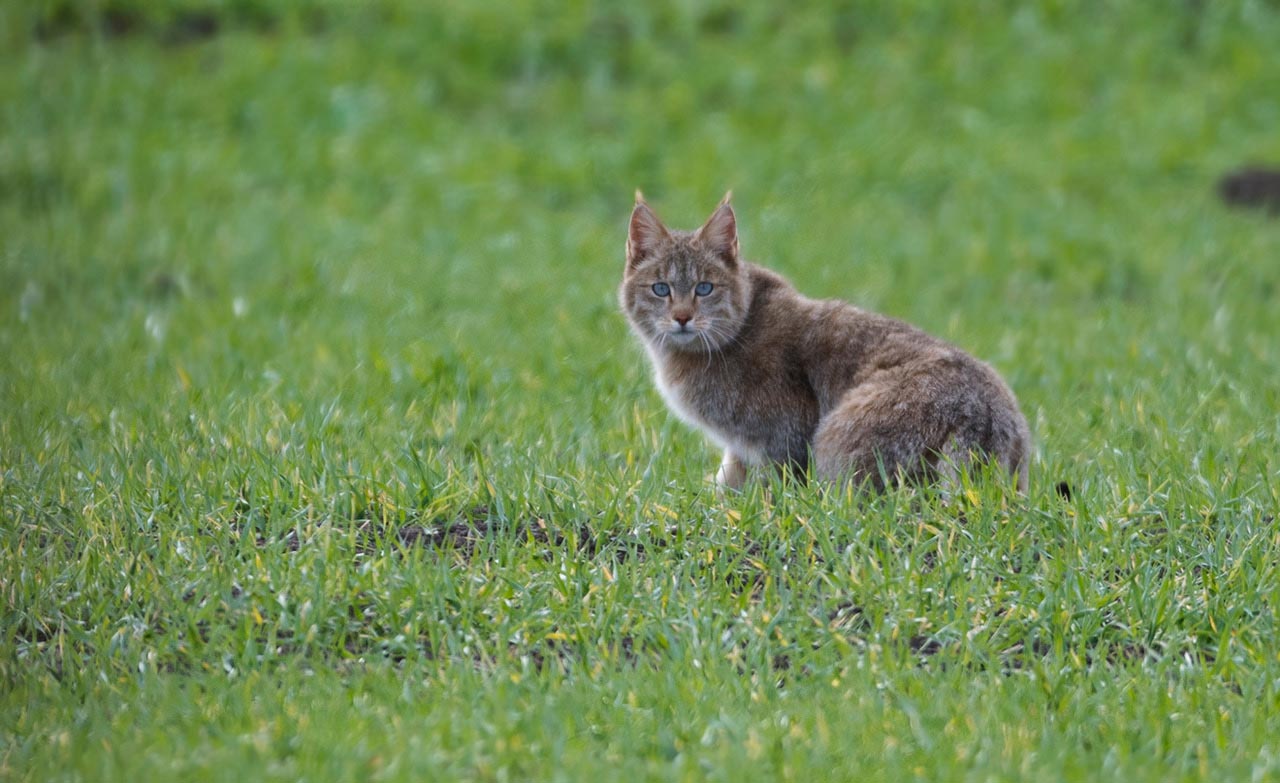
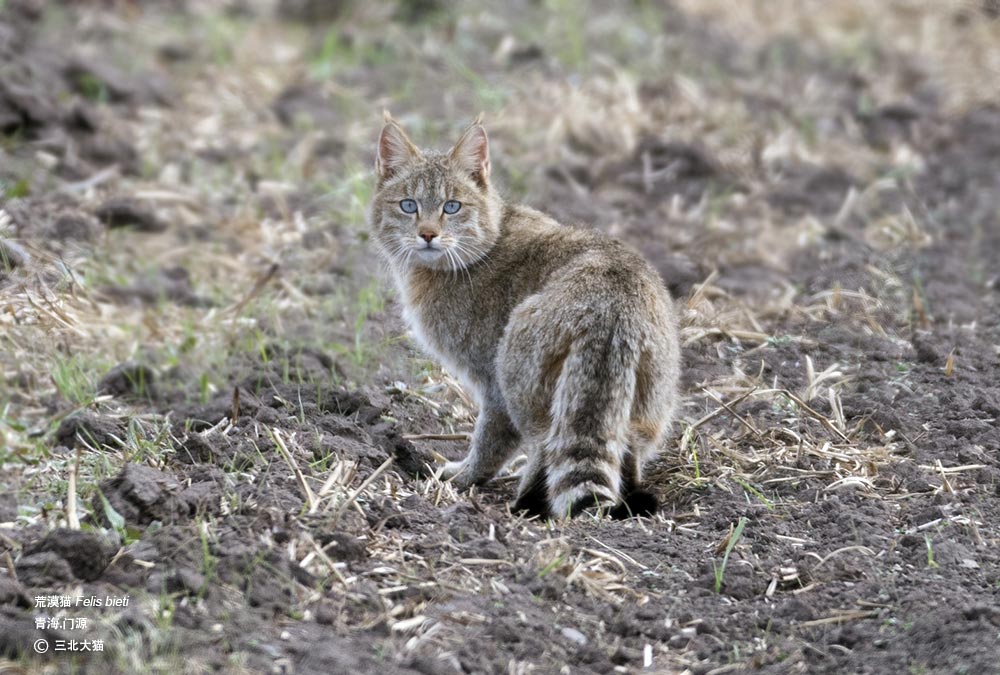
In the largest-ever study undertaken of Chinese cats, genetic detectives highlight the evolutionary uniqueness and premier conservation importance of the elusive Chinese mountain cat (Felis silvestris bieti), found only in the Tibetan plateau of China. Also called Chinese desert cat or Steppe cat, the Chinese mountain cat has a distinctive appearance of sand-colored fur, with faint dark stripes a thick tail, and light blue pupils.
The research is published in Scientific Advances.
Comparative Genomic Analysis of Chinese Cats
This new study compared three different felines living in China: the Chinese mountain cat, Felis silvestris bieti, the Asiatic wildcat Felis silvestris ornata, and feral domestic cats Felis silvestris catus. The Asiatic wildcat has distinguishing spotted coat pattern across a wide range extending from the Caspian Sea in the East through western India and southern Mongolia to parts of western China. Approximately 600 million domestic cats are found across the world.
The study was led by the Laboratory of Genomic Diversity at Peking University in Beijing and supported by an international team including lead genetic researchers at Nova Southeastern University, USA, and in Malaysia. The genomic data resolves a taxonomic classification uncertainty, reveals the timing of evolutionary divergence and pinpoints the prospects for survival of an important endangered species.
Using 270 individual samples, the molecular genetic study finds that the Chinese mountain cat is a unique subspecies of the wide-ranging Wildcat, Felis silvestris. The wildcat species is found throughout Europe, Africa, and much of Western Asia. The Felis silvestris bieti subspecies, however, is found only in China, being adapted to the prey and alpine climate of the Tibetan plateau.
Evolutionary Divergence and Origins
Applying the molecular clock hypotheses, the date of evolutionary split between F. s. bieti and F. s. ornata was an estimated at ~1.5 million years ago while the genetic distance from both to the closest Felis species relative, the black footed cat, Felis nigripes is twice that at 3.0 MY ago. These different times support the classification of F. s. ornata and F. s. bieti as subspecies of Felis silvestris. A closely related subspecies from Central Asia and north Africa, Felis silvestris lybica, is the clear predecessor of the world’s domestic cats, including those throughout China. The cat domestication process happened 10-12,000 years ago in the Near East at around the same time and locale, when humankind’s ancestors morphed from peripatetic hunter-gatherers to sedentary farmers in the Fertile Crescent region.
The Chinese mountain cat faces several major threats, one from modern agricultural practices that divert precious habitat. A second, more existential threat, is from interbreeding with domestic cats brought by the growing human population in the cat’s limited habitat. And finally, climate change, that may be expanding the range of neighboring wildcats into the mountain cat’s core homeland.
“This study will help conservation scientists to identify threats and decide the best ways to conserve this special cat in its native range,” said Stephen J. O’Brien, Ph.D., a world-renowned geneticist and research scientist at NSU’s Halmos College of Arts and Sciences.
The study solidifies the taxonomic status of the mountain cat, Felis silvestris lybica, through an analysis of the cat’s genome, placing the cat in an evolutionary context relative to other species and subspecies of cats. These arcane taxonomic distinctions are important for conservation because scientists have to be sure they are all talking about the same animal when discussing strategies, and no less important, because legal protections have to be specific to the group in question. Without an agreed-upon taxonomy, legal protections and conservation come to a stop.
Single Origin for Domestic Cats Worldwide
Another important result of this study is the finding that domestic cats in China are derived from the same common stock and origin as domestic cats throughout the world, and that there was not an independent origin of domesticity in China. Previous studies have hinted at close associations between early Chinese farming communities and local wild animals, including Asian mountain cats, and that some of these animals may have begun the crossing from the wild to living with people in settled communities.
What the current study shows is that this did not happen with domestic cats; now the focus of research can move to determining – why? Why were some species domesticated in some places but not in others? Why did these processes happen when they did, and what were the conditions obtaining that allowed, maybe even promoted, the integration of wild animals into human societies? Answering these related questions will help us understand the history of early China, indeed helps us understand the history of the ancient anthropocentric world, in more detail.
Reference: “Genomic evidence for the Chinese mountain cat as a wildcat conspecific (Felis silvestris bieti) and its introgression to domestic cats” by He Yu, Yue-Ting Xing, Hao Meng, Bing He, Wen-Jing Li, Xin-Zhang Qi, Jian-You Zhao, Yan Zhuang, Xiao Xu, Nobuyuki Yamaguchi, Carlos A. Driscoll, Stephen J. O’Brien and Shu-Jin Luo, 23 June 2021, Science Advances.
DOI: 10.1126/sciadv.abg0221
Never miss a breakthrough: Join the SciTechDaily newsletter.
Follow us on Google and Google News.
5 Comments
Thanks so much for sharing this study! I’ve never heard of the Chinese mountain cat before!
Great article! I think there is a typo in this sentence:
“The study solidifies the taxonomic status of the mountain cat, Felis silvestris lybica”
It should read: “Felis silvestris bieti” ?
Regarding the earlier comment re Felis chaus – that is another species. See all the Felis species at https://www.wildcatfamily.com/felis-lineage/
Thanks. It was interesting.
Great article! I think there is a typo in this sentence:
“The study solidifies the taxonomic status of the mountain cat, Felis silvestris lybica”
It should read: “Felis silvestris bieti” ?
https://viplikes.net/
This post is unique and lovely, and it really helps us. Your post is awesome. I appreciate you giving this fantastic information. But also check our website https://lodhahosaroad.in/