
Close Menu
    Facebook X (Twitter) Instagram
    SciTechDaily
    • Biology
    • Chemistry
    • Earth
    • Health
    • Physics
    • Science
    • Space
    • Technology
    Facebook X (Twitter) Pinterest YouTube RSS
    SciTechDaily
    Home»Physics»Scientists Investigate Self-Excited Dust Density Wave Behavior in Plasmas
    Physics

    Scientists Investigate Self-Excited Dust Density Wave Behavior in Plasmas

    By Rhys Leahy, Physics of PlasmasAugust 8, 2018No Comments3 Mins Read
    Facebook Twitter Pinterest Telegram LinkedIn WhatsApp Email Reddit
    Share
    Facebook Twitter LinkedIn Pinterest Telegram Email Reddit
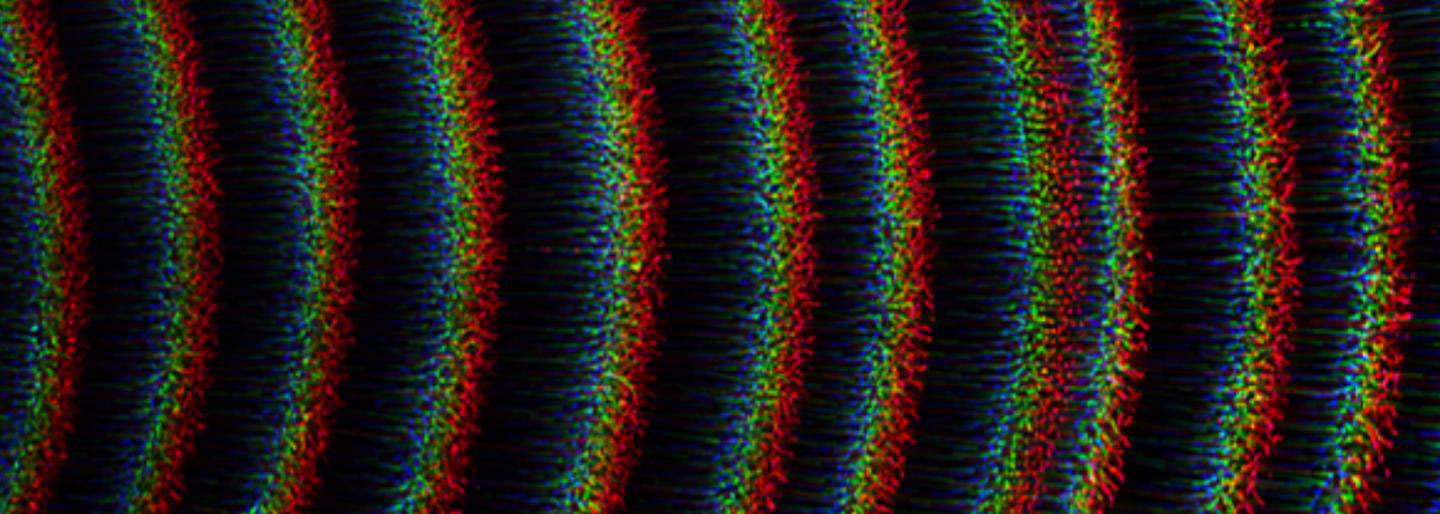
    In Space Researchers Examine Waves in Complex Plasma
    A self-excited dust density wave CREDIT: Jaiswal et al.

    New microgravity research finds that microparticles in complex plasma behave in nonuniform ways around varying electrical fields.

    400 kilometers (250 miles) above Earth, researchers examined waves in complex plasma under microgravity conditions and found that the microparticles behaved in nonuniform ways in the presence of varying electrical fields. They report some of the first findings from the Plasma-Kristall 4 (PK-4) experiment in Physics of Plasmas, from AIP Publishing.

    PK-4 is a collaboration between the European Space Agency and the Russian State Space Corporation “Roscosmos” to investigate complex plasmas. Complex or dusty plasmas contain electrons, ions, and neutral gas, as well as microparticles such as dust grains. The microparticles become highly charged in the plasma and interact strongly with each other, which can lead to liquid or even crystalline behavior within the complex plasma. The most important property of such a system is that investigations of physical phenomena can be performed on the individual (micro-) particle level allowing new insights into fluid and solid-state physics.

    Gravity distorts most complex plasma experiments on Earth, so the microgravity environment on the International Space Station enables otherwise impossible research. In February 2017, researchers from the DLR-Institute of Materials Physics in Space at the German Aerospace Center (DLR) and Joint Institute for High Temperatures of the Russian Academy of Sciences observed dust density waves or visible sound waves as they moved through the complex plasma.

    In the experiment, a microparticle cloud drifted in a plasma with a constant direct current and formed self-excited wave patterns. After that, the discharge polarity was reversed. Although the field strength was nearly identical for both discharge polarities, the wave patterns exhibited bifurcations: A new wave crest formed between the two old crests in the head of the microparticle cloud.

    “The most interesting finding was the velocity of these waves strongly depends on the electric field, which is exciting the waves,” said Mikhail Pustylnik, an author on the paper. “We expect to encounter these types of waves in astrophysical situations where you might have dust — in a cometary tail, for example.”

    “Many plasma processes are also used in the semiconductor industry,” Pustylnik said. Dust poses big challenges for the semiconductor industry because particles may damage a silicon wafer during manufacturing. Starting this fall, the researchers are planning additional experiments that will vary the range of electric fields by switching the polarity of the discharge.

    Reference: “Dust density waves in a dc flowing complex plasma with discharge polarity reversal” by S. Jaiswal, M. Y. Pustylnik, S. Zhdanov, H. M. Thomas, A. M. Lipaev, A. D. Usachev, V. I. Molotkov, V. E. Fortov, M. H. Thoma, and O. V. Novitskii, 7 August 2018, Physics of Plasmas.
    DOI: 10.1063/1.5040417

    Never miss a breakthrough: Join the SciTechDaily newsletter.
    Follow us on Google and Google News.

    Particle Physics Physics of Plasmas Plasma
    Share. Facebook Twitter Pinterest LinkedIn Email Reddit

    Related Articles

    Scientists Recreate the Fiery Birth of the Universe in the Lab

    High-Energy Collisions Unveil New Clues to the Universe’s Origins

    Redefining Physics: Plasma Jets With Unexpected X-Ray Emissions

    Breakthrough in Understanding Quark-Gluon Plasma, the Primordial Form of Matter in the Early Universe

    Evidence of Elusive Majorana Fermions Raises Possibilities for Quantum Computing

    Possible Mistakes Found in Faster Than Light Neutrino Measurement

    Quantum Entanglement of 8 Photons Successfully Accomplished by Physicists

    Higgs Boson Signals Gain Strength at Large Hadron Collider

    Quantum Physicists Take a Step Forward in Understanding Quantum Inseparability

    Leave A Reply Cancel Reply

    • Facebook
    • Twitter
    • Pinterest
    • YouTube

    Don't Miss a Discovery

    Subscribe for the Latest in Science & Tech!

    Trending News

    New Study Reveals Why Ozempic Works Better for Some People Than Others

    Climate Change Is Altering a Key Greenhouse Gas in a Way Scientists Didn’t Expect

    New Study Suggests Gravitational Waves May Have Created Dark Matter

    Scientists Discover Why the Brain Gets Stuck in Schizophrenia

    Scientists Engineer “Tumor-Eating” Bacteria That Devour Cancer From Within

    Even “Failed” Diets May Deliver Long-Term Health Gains, Study Finds

    NIH Scientists Discover Powerful New Opioid That Relieves Pain Without Dangerous Side Effects

    Collapsing Plasma May Hold the Key to Cosmic Magnetism

    Follow SciTechDaily
    • Facebook
    • Twitter
    • YouTube
    • Pinterest
    • Newsletter
    • RSS
    SciTech News
    • Biology News
    • Chemistry News
    • Earth News
    • Health News
    • Physics News
    • Science News
    • Space News
    • Technology News
    Recent Posts
    • The Surprising Reason You Might Want To Sleep Without a Pillow
    • Household Cats Could Hold the Secret to Fighting Breast Cancer
    • Scientists Say This Natural Hormone Reverses Obesity by Targeting the Brain
    • This 15,000-Year-Old Discovery Changes What We Know About Early Human Creativity
    • 35-Million-Year-Old Mystery: Strange Arachnid Discovered Preserved in Amber
    Copyright © 1998 - 2026 SciTechDaily. All Rights Reserved.
    • Science News
    • About
    • Contact
    • Editorial Board
    • Privacy Policy
    • Terms of Use

    Type above and press Enter to search. Press Esc to cancel.