
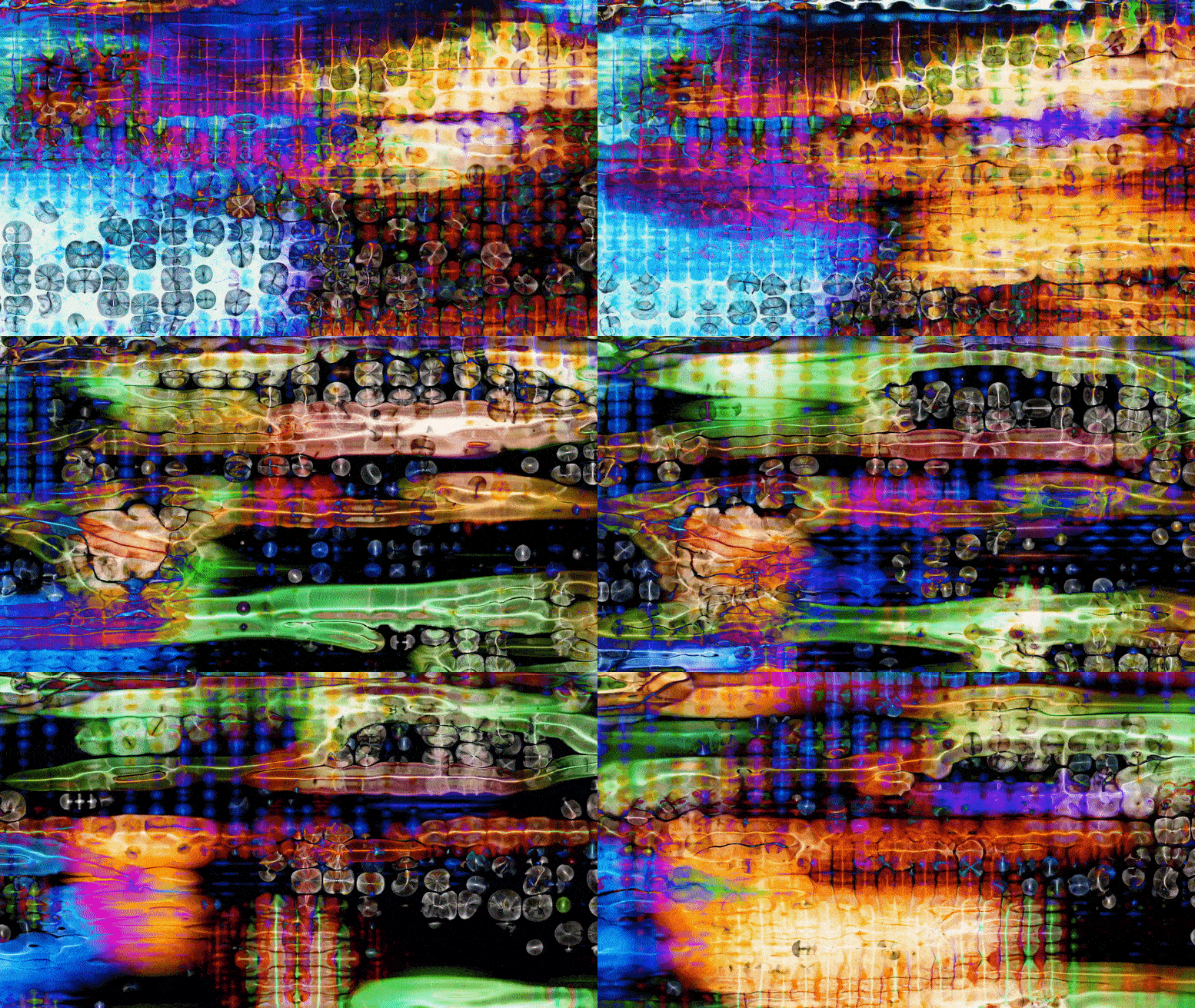
Light travels at a speed of about 300,000,000 meters per second (671,000,000 as light particles, photons, or equivalently as electromagnetic field waves. Experiments led by Hrvoje Petek, an R.K. Mellon professor in the Department of Physics and Astronomy examined ideas surrounding the origins of light, taking snapshots of light, stopping light, and using it to change properties of matter.
Petek worked with students and collaborators Prof. Chen-Bin (Robin) Huang of the National Tsing Hua University in Taiwan, and Atsushi Kubo of the Tsukuba University of Japan on the experiments. Their findings were reported in the paper, “Plasmonic topological quasiparticle on the nanometer and femtosecond scales,” which was published in the December 24, 2020, issue of Nature magazine.
Petek credited graduate student Yanan Dai for his foresight and work in the process.
“The denouement of the research, however, is that Yanan, who performed the experiments and provided the theoretical modeling, demonstrated that he was educated far beyond his Professor’s level and could interpret incisively the nanofemto topological properties and interactions of optical fields,” he said.
The team performed an ultrafast microscopy experiment, where they trapped green light pulses of 20 fs (2×10-14 s) duration as composite light-electron density fluctuation waves, known as surface plasmon polaritons, and imaged their propagation on a silver surface at the speed of light. But they did this with a twist so that the light waves came together from two sides to form a light vortex where light waves appear to circulate about a stationary common core as a whirlwind of waves. They could generate a movie of how light waves churn on their nanometer (10-9 m) wavelength scale by imaging electrons that two light photons coming together cause to emit from the surface.
Gathering all such electrons with an electron microscope forms images where the light had passed, thus enabling the researchers to take its snapshot. Of course, if nothing is faster than light, one cannot take its snapshot, but by sending in two light pulses with their time separation advanced in 10-16 s steps, they could image how light waves come together causing their joint amplitude to rise and fall at fixed points in space forming a light vortex on the nano (10-9 m)-femto (10-15 s) scale.
Such light vortices form when you shine your red or green laser pointer onto a rough surface and see a speckle reflection, but they also have a cosmological significance. The light vortex fields can potentially cause transitions in the quantum mechanical phase order in solid state materials, such that the transformed material structure and its mirror image cannot be superimposed. In other words, the sense of the vortex rotation generates two materials that are topologically distinct.
Petek said such topological phase transitions are at the vanguard of physics research because they are thought to be responsible for some aspects of the structure of the Universe.
“Even the forces of nature including light, are thought to have emerged as symmetry-breaking transitions of a primordial field. Thus, the ability to record the optical fields and plasmonic vortices in the experiment opens the way to perform ultrafast microscopy studies of related light-initiated phase transitions in condensed matter materials at the laboratory scale,” he said.
Reference: “Plasmonic topological quasiparticle on the nanometre and femtosecond scales” by Yanan Dai, Zhikang Zhou, Atreyie Ghosh, Roger S. K. Mong, Atsushi Kubo, Chen-Bin Huang and Hrvoje Petek, 23 December 2020, Nature.
DOI: 10.1038/s41586-020-3030-1
Never miss a breakthrough: Join the SciTechDaily newsletter.
Follow us on Google and Google News.