
Close Menu
    Facebook X (Twitter) Instagram
    SciTechDaily
    • Biology
    • Chemistry
    • Earth
    • Health
    • Physics
    • Science
    • Space
    • Technology
    Facebook X (Twitter) Pinterest YouTube RSS
    SciTechDaily
    Home»Space»Understanding of How Planets Form Challenged by Giant Exoplanet Around Tiny Star
    Space

    Understanding of How Planets Form Challenged by Giant Exoplanet Around Tiny Star

    By University of GöttingenOctober 27, 2019No Comments3 Mins Read
    Facebook Twitter Pinterest Telegram LinkedIn WhatsApp Email Reddit
    Share
    Facebook Twitter LinkedIn Pinterest Telegram Email Reddit
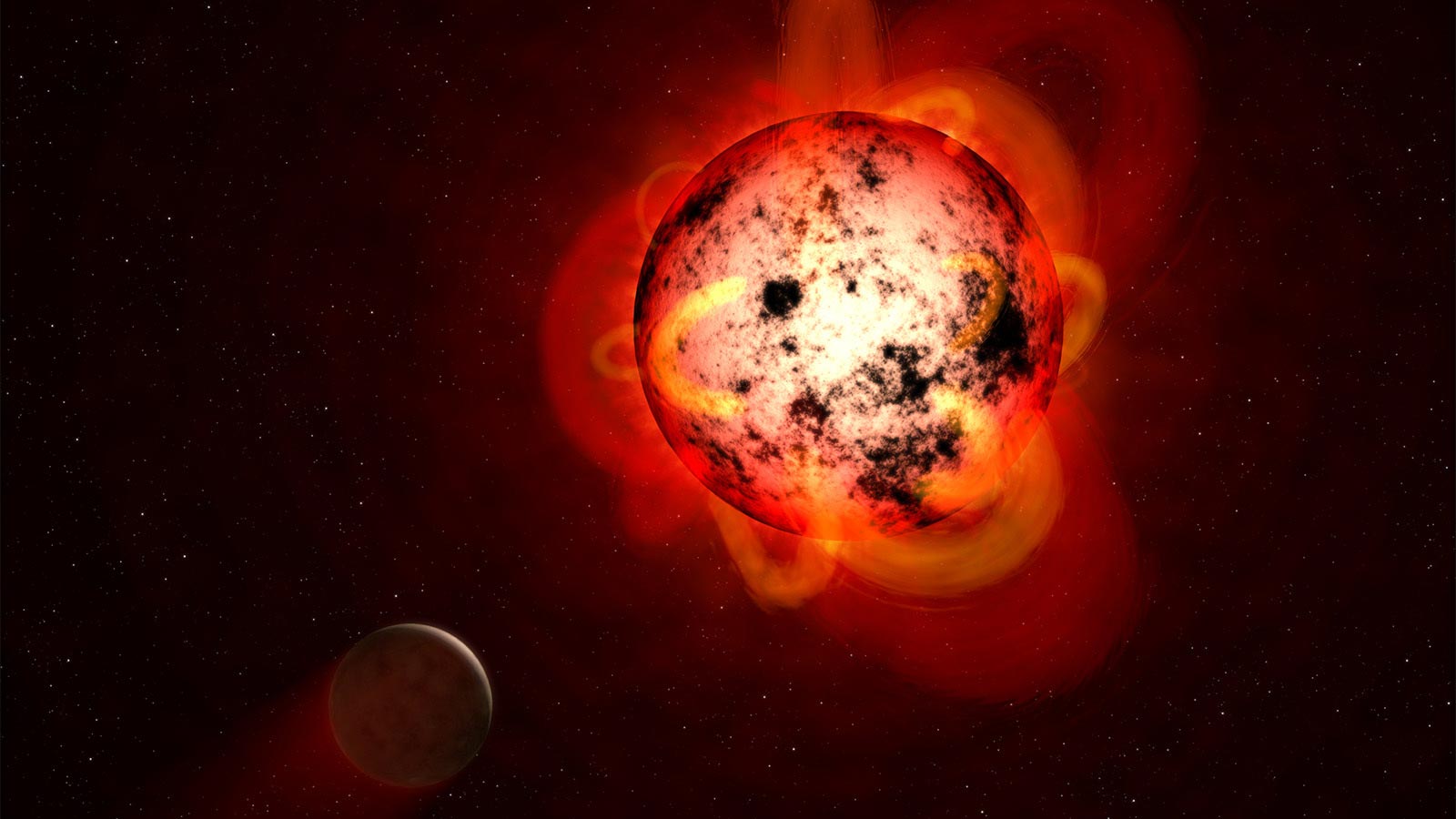
    Red Dwarf Star Orbited by Exoplanet
    This illustration shows a red dwarf star orbited by a hypothetical exoplanet. Credit: NASA/ESA/G. Bacon (STScI)

    An international team of researchers with participation from the University of Göttingen has discovered the first large gas giant orbiting a small star. The planet was found orbiting the nearby red dwarf star GJ 3512. This discovery challenges scientists’ very understanding of how planets form: low-mass stars should have less available material to form planets. Moreover, this new gas giant is on an eccentric orbit, which suggests the presence of another massive planet, which may have been ejected from the system in a chaotic interaction. The results were published in Science.

    The Institute for Astrophysics at the University of Göttingen calibrated the data, a task that is fundamental to understanding the minute affect the motion of the planet or planets exert on a star. The Institute is also responsible for the analysis of the enormous amount of complex data sent from the observatory. Every day, fresh information arrives at the institute and is converted into numbers that the CARMENES consortium scientists can then interpret as stellar motion.

    To discover the planets, the astronomers used the Doppler technique, which monitors the back-and-forth motion of a star when it is orbited by one or more planets. The star was so faint that it almost did not make it into the list of targets. However, once the data had been analyzed, it was clear that its behavior suggested something very interesting. The star’s velocity was changing very rapidly and consistently, indicating the presence of at least one massive companion, an unusual feature for a red dwarf. In addition, the irregular orbit of the newly discovered planet suggests the possibility of an earlier collision with another planet meaning there could be a wandering world in the galactic void.
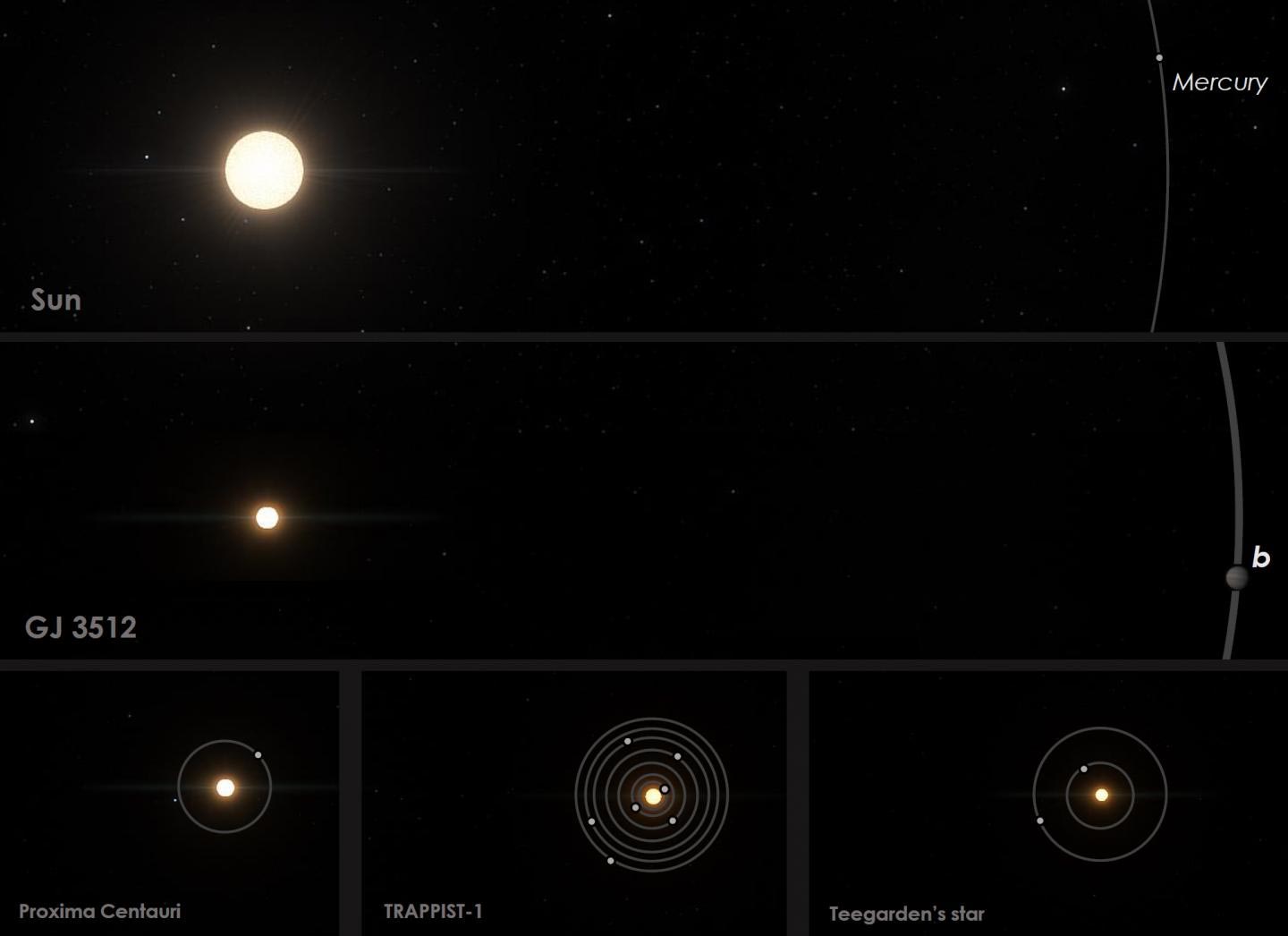
    Comparison Diagram of Our Sun with Stars
    Comparison of GJ 3512 to the Solar System and other nearby red-dwarf planetary systems. Planets around a solar-mass star can grow until they start accreting gas and become giant planets such as Jupiter, in a few million years. But we thought that small stars such as Proxima, TRAPPIST-1, Teegardern’s star, and GJ 3512, could not form Jupiter-mass planets. Credit: Guillem Anglada-Escude — IEEC, using SpaceEngine.org

    “As their name indicates, red dwarfs emit most of their light in the red and near-infrared parts of the spectrum stabilized. CARMENES was designed to make optimal use of all the light wavelengths where the stars are brighter,” explains Professor Ansgar Reiners, from the Institute for Astrophysics at the University of Göttingen. “Despite the fact that optical high-resolution and spectrographs have existed for a while, for example, HARPS, near-infrared ones represent a new technology.”
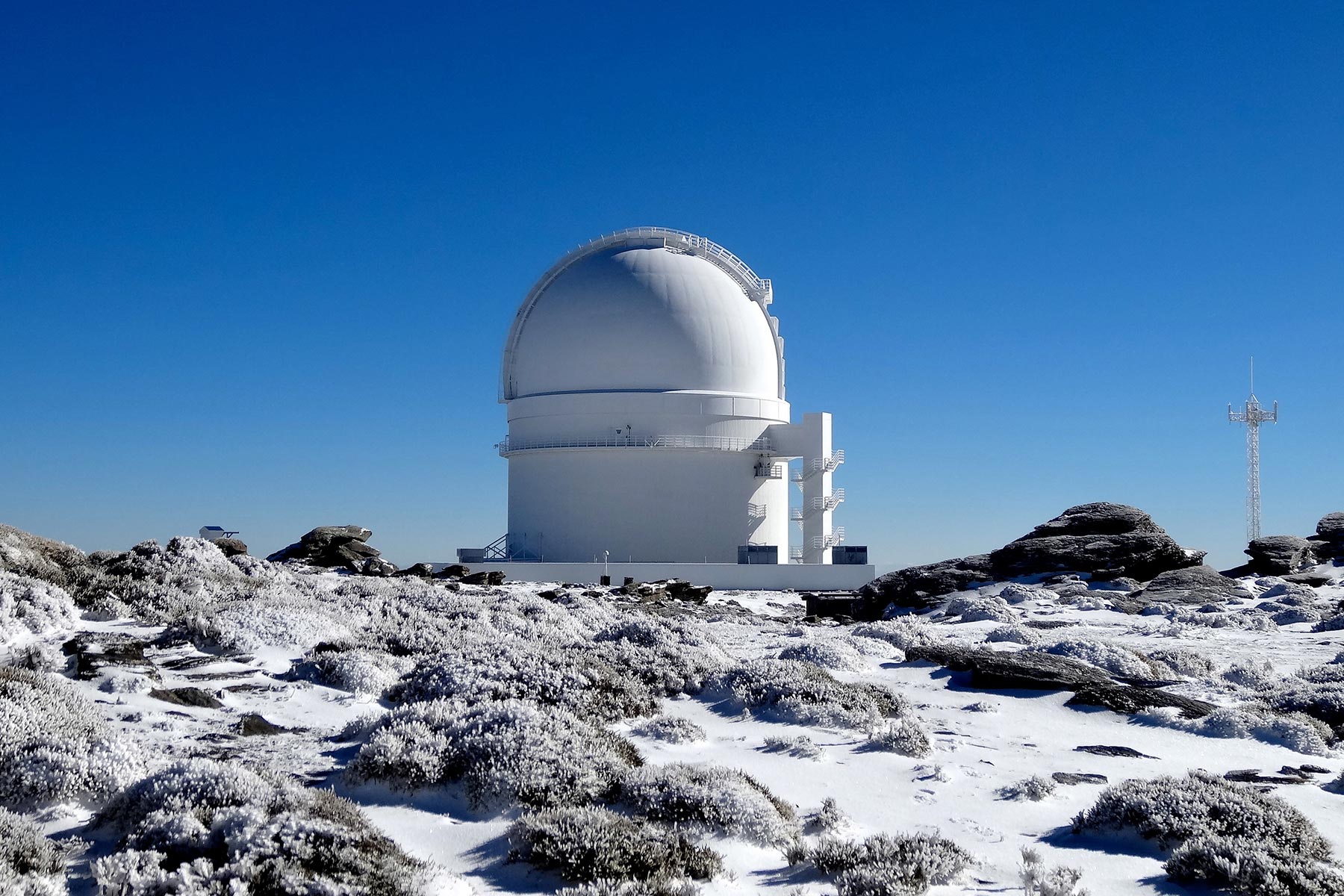
    Calar Alto Observatory
    Dome of the 3.5-m telescope at the Calar Alto Observatory where the CARMENES spectrograph is installed. Credit: Pedro Amado/Marco Azzaro — IAA/CSIC

    Professor Stefan Dreizler, also from the Institute for Astrophysics, added, “Although we know about 4,000 planets outside the solar system, there are still discoveries which bring new surprises. The planet around GJ 3512 is one of those.”

    Göttingen is the lead university of the DFG research group “Blue Planets around Red Stars” whose purpose is scientific exploitation of the CARMENES data.

    Read more about this unusual planet:

    • Planet Formation Theory Challenged by Massive Exoplanet Orbiting Tiny Star
    • New Models Show There Are Many Gas Giant Exoplanets Waiting to Be Discovered
    • This Mysterious Exoplanet Should Not Exist

    Reference: “A giant exoplanet orbiting a very-low-mass star challenges planet formation models” by  J C Morales et al., 27 September 2019, Science.
    DOI: 10.1126/science.aax3198

    Never miss a breakthrough: Join the SciTechDaily newsletter.
    Follow us on Google and Google News.

    Astronomy Astrophysics Exoplanet University of Göttingen
    Share. Facebook Twitter Pinterest LinkedIn Email Reddit

    Related Articles

    Super-Earths Discovered Orbiting Nearby Red Dwarf Gliese 887

    Earth-like Planets May Have Older and More Evolved Life

    At Least 100 Billion Planets Populate the Milky Way

    WASP-12 b, A Planet Being Consumed By Its Own Sun

    New Study Revives Doubted Exoplanet Fomalhaut b

    Scientists Detected Exoplanetary System With Regularly Aligned Orbits Similar to Our Solar System

    NASA Data Reveals Significant Changes in Exoplanet’s Atmosphere

    Astronomers Obtain Precise Measurements of the Two Kepler-16 Stars

    NASA’s Kepler Mission Discovers 11 New Extrasolar Systems with 26 Exoplanets

    Leave A Reply Cancel Reply

    • Facebook
    • Twitter
    • Pinterest
    • YouTube

    Don't Miss a Discovery

    Subscribe for the Latest in Science & Tech!

    Trending News

    Breakthrough Bowel Cancer Trial Leaves Patients Cancer-Free for Nearly 3 Years

    Natural Compound Shows Powerful Potential Against Rheumatoid Arthritis

    100,000-Year-Old Neanderthal Fossils in Poland Reveal Unexpected Genetic Connections

    Simple “Gut Reset” May Prevent Weight Gain After Ozempic or Wegovy

    2.8 Days to Disaster: Scientists Warn Low Earth Orbit Could Suddenly Collapse

    Common Food Compound Shows Surprising Power Against Superbugs

    5 Simple Ways To Remember More and Forget Less

    The Atomic Gap That Could Cost the Semiconductor Industry Billions

    Follow SciTechDaily
    • Facebook
    • Twitter
    • YouTube
    • Pinterest
    • Newsletter
    • RSS
    SciTech News
    • Biology News
    • Chemistry News
    • Earth News
    • Health News
    • Physics News
    • Science News
    • Space News
    • Technology News
    Recent Posts
    • Scientists Print Artificial Neurons That Can Talk to the Brain
    • Bowel and Ovarian Cancers Are Dramatically Rising in Young Adults and Scientists Aren’t Sure Why
    • Alzheimer’s May Begin Decades Earlier Than You Think, New Mayo Clinic Study Finds
    • The Hidden Risk of Taking Breaks From Weight-Loss Drugs Like Ozempic
    • Total Solar Eclipse Made Cities Go Eerily Quiet Beneath the Surface
    Copyright © 1998 - 2026 SciTechDaily. All Rights Reserved.
    • Science News
    • About
    • Contact
    • Editorial Board
    • Privacy Policy
    • Terms of Use

    Type above and press Enter to search. Press Esc to cancel.