
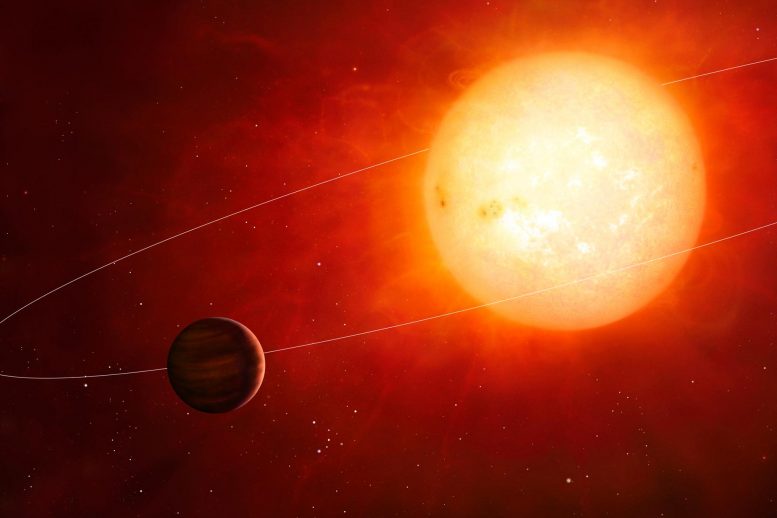
Astronomers have discovered a giant Jupiter-like exoplanet in an unlikely location — orbiting a small red dwarf star. The newly identified gas giant, designated GJ 3512b, is nearly half as massive as Jupiter, very large given the small host star, which is little more than a tenth of the mass of the Sun. Such a large planet around such a small star is difficult to explain in standard planet formation theories.
“A freshly discovered exoplanet is, by itself, no longer particularly noteworthy. But one that challenges current theories of planet formation can animate astronomers,” writes Greg Laughlin in a related Perspective.
M-type red dwarfs are among the smallest and coolest stars, but by far the most common type of star in the Milky Way. However, despite their ubiquity, only about 10% of the nearly 4,000 exoplanets discovered to date orbit these low-mass stars. Exoplanetary surveys and standard planet formation models suggest that Jupiter-mass gas giants are in fact rather rare in red dwarf systems, and how such large planets can form around low-mass stars, when they do, remains unclear.
Juan Carlos Morales and colleagues used optical and near-infrared radial velocity Doppler observations to study a nearby red dwarf (GJ 3512). To their surprise, they discovered the gas giant exoplanet GJ 3512b, which exhibited an eccentric 204-day orbit around the star. Morales et al. also found evidence suggesting the presence of another candidate planet in the system. Using this new data, the authors show that the widely utilized core accretion models of planet formation fail to explain how this particular system was able to form. They demonstrate that alternative disc instability theories may be more relevant in some cases than previously thought, when it comes to explaining planet formation.
Reference: “A giant exoplanet orbiting a very-low-mass star challenges planet formation models” by J. C. Morales, A. J. Mustill, I. Ribas, M. B. Davies, A. Reiners, F. F. Bauer, D. Kossakowski, E. Herrero, E. Rodríguez, M. J. López-González, C. Rodríguez-López, V. J. S. Béjar, L. González-Cuesta, R. Luque, E. Pallé, M. Perger, D. Baroch, A. Johansen, H. Klahr, C. Mordasini, G. Anglada-Escudé, J. A. Caballero, M. Cortés-Contreras, S. Dreizler, M. Lafarga, E. Nagel, V. M. Passegger, S. Reffert, A. Rosich, A. Schweitzer, L. Tal-Or, T. Trifonov, M. Zechmeister, A. Quirrenbach, P. J. Amado, E. W. Guenther, H.-J. Hagen, T. Henning, S. V. Jeffers, A. Kaminski, M. Kürster, D. Montes, W. Seifert, F. J. Abellán, M. Abril, J. Aceituno, F. J. Aceituno, F. J. Alonso-Floriano, M. Ammler-von Eiff, R. Antona, B. Arroyo-Torres, M. Azzaro, D. Barrado, S. Becerril-Jarque, D. Benítez, Z. M. Berdiñas, G. Bergond, M. Brinkmöller, C. del Burgo, R. Burn, R. Calvo-Ortega, J. Cano, M. C. Cárdenas, C. Cardona Guillén, J. Carro, E. Casal, V. Casanova, N. Casasayas-Barris, P. Chaturvedi, C. Cifuentes, A. Claret, J. Colomé, S. Czesla, E. Díez-Alonso, R. Dorda, A. Emsenhuber, M. Fernández, A. Fernández-Martín, I. M. Ferro, B. Fuhrmeister, D. Galadí-Enríquez, I. Gallardo Cava, M. L. García Vargas, A. Garcia-Piquer, L. Gesa, E. González-Álvarez, J. I. González Hernández, R. González-Peinado, J. Guàrdia, A. Guijarro, E. de Guindos, A. P. Hatzes, P. H. Hauschildt, R. P. Hedrosa, I. Hermelo, R. Hernández Arabi, F. Hernández Otero, D. Hintz, G. Holgado, A. Huber, P. Huke, E. N. Johnson, E. de Juan, M. Kehr, J. Kemmer, M. Kim, J. Klüter, A. Klutsch, F. Labarga, N. Labiche, S. Lalitha, M. Lampón, L. M. Lara, R. Launhardt, F. J. Lázaro, J.-L. Lizon, M. Llamas, N. Lodieu, M. López del Fresno, J. F. López Salas, J. López-Santiago, H. Magán Madinabeitia, U. Mall, L. Mancini, H. Mandel, E. Marfil, J. A. Marín Molina, E. L. Martín, P. Martín-Fernández, S. Martín-Ruiz, H. Martínez-Rodríguez, C. J. Marvin, E. Mirabet, A. Moya, V. Naranjo, R. P. Nelson, L. Nortmann, G. Nowak, A. Ofir, J. Pascual, A. Pavlov, S. Pedraz, D. Pérez Medialdea, A. Pérez-Calpena, M. A. C. Perryman, O. Rabaza, A. Ramón Ballesta, R. Rebolo, P. Redondo, H.-W. Rix, F. Rodler, A. Rodríguez Trinidad, S. Sabotta, S. Sadegi, M. Salz, E. Sánchez-Blanco, M. A. Sánchez Carrasco, A. Sánchez-López, J. Sanz-Forcada, P. Sarkis, L. F. Sarmiento, S. Schäfer, M. Schlecker, J. H. M. M. Schmitt, P. Schöfer, E. Solano, A. Sota, O. Stahl, S. Stock, T. Stuber, J. Stürmer, J. C. Suárez, H. M. Tabernero, S. M. Tulloch, G. Veredas, J. I. Vico-Linares, F. Vilardell, K. Wagner, J. Winkler, V. Wolthoff, F. Yan and M. R. Zapatero Osorio, 27 September 2019, Science.
DOI: 10.1126/science.aax3198
Read more about this discovery:
- This Mysterious Exoplanet Should Not Exist
- New Models Show There Are Many Gas Giant Exoplanets Waiting to Be Discovered
Never miss a breakthrough: Join the SciTechDaily newsletter.
Follow us on Google and Google News.