
Close Menu
    Facebook X (Twitter) Instagram
    SciTechDaily
    • Biology
    • Chemistry
    • Earth
    • Health
    • Physics
    • Science
    • Space
    • Technology
    Facebook X (Twitter) Pinterest YouTube RSS
    SciTechDaily
    Home»Earth»How a T. Rex Can Bite Hard Enough to Shatter the Bones of Its Prey Without Breaking Its Own Skull
    Earth

    How a T. Rex Can Bite Hard Enough to Shatter the Bones of Its Prey Without Breaking Its Own Skull

    By University of Missouri-ColumbiaSeptember 27, 2019No Comments4 Mins Read
    Facebook Twitter Pinterest Telegram LinkedIn WhatsApp Email Reddit
    Share
    Facebook Twitter LinkedIn Pinterest Telegram Email Reddit
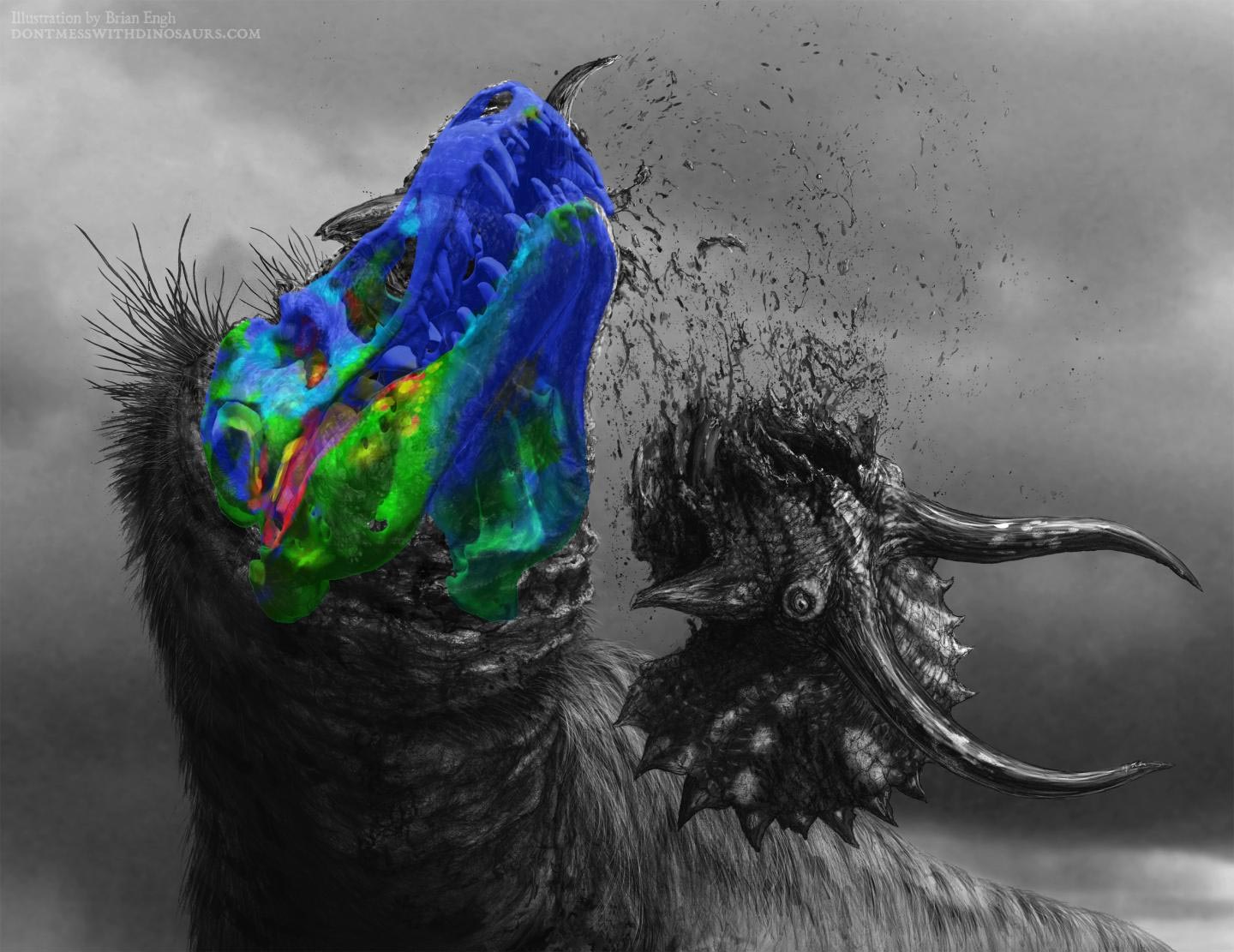
    Tyrannosaurus Rex Muscle Activation
    An artist’s rendition of the Tyrannosaurus rex with the 3D imaging showing muscle activation in its head. Illustration courtesy of Brian Engh.

    University of Missouri scientists created one of the first 3D models showing how ligaments and joints in the skull of a Tyrannosaurus rex work.

    A Tyrannosaurus rex could bite hard enough to shatter the bones of its prey. But how it accomplished this feat without breaking its own skull bones has baffled paleontologists. That’s why scientists at the University of Missouri are arguing that the T. rex’s skull was stiff much like the skulls of hyenas and crocodiles, and not flexible like snakes and birds as paleontologists previously thought.

    “The T. rex had a skull that’s 6 feet (1.8 m) long, 5 feet (1.5 m) wide, and 4 feet (1.2 m) high, and bites with the force of about 6 tons,” said Kaleb Sellers, a graduate student in the MU School of Medicine. “Previous researchers looked at this from a bone-only perspective without taking into account all of the connections — ligaments and cartilage — that really mediate the interactions between the bones.”

    Using a combination of imaging, anatomy, and engineering analysis, the team observed how the roof of the mouth of the T. rex reacted to the stresses and strains from chewing by applying models of how two present day relatives of T. rex — a gecko and a parrot — chew to how the T. rex skull worked.
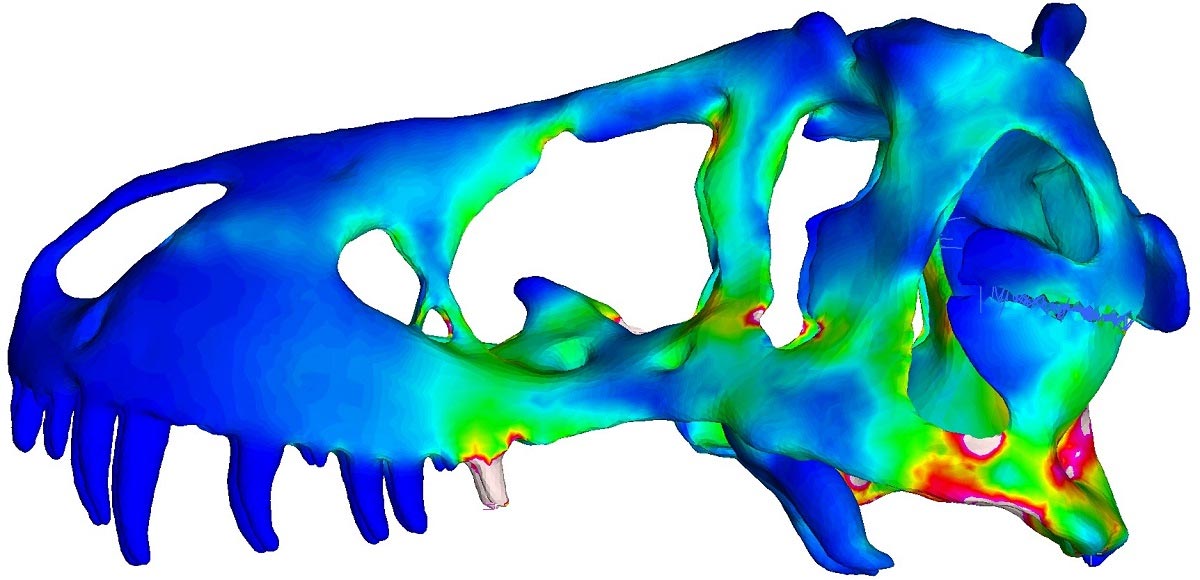
    3D Image of a T Rex Skull
    A 3D image of a Tyrannosaurus rex skull showing muscle activation. University of Missouri scientists created one of the first 3D models showing how ligaments and joints in the skull of a Tyrannosaurus rex work. Credit: University of Missouri

    “Dinosaurs are like modern-day birds, crocodiles, and lizards in that they inherited particular joints in their skulls from fish — ball and socket joints, much like people’s hip joints — that seem to lend themselves, but not always, to movement like in snakes,” said Casey Holliday, an associate professor of anatomy in the MU School of Medicine. “When you put a lot of force on things, there’s a tradeoff between movement and stability. Birds and lizards have more movement but less stability. When we applied their individual movements to the T. rex skull, we saw it did not like being wiggled in ways that the lizard and bird skulls do, which suggests more stiffness.”

    In addition to helping paleontologists with a detailed study of the anatomy of fossilized animals, researchers believe their findings can help advance human and animal medicine by providing better models of how joints and ligaments interact.
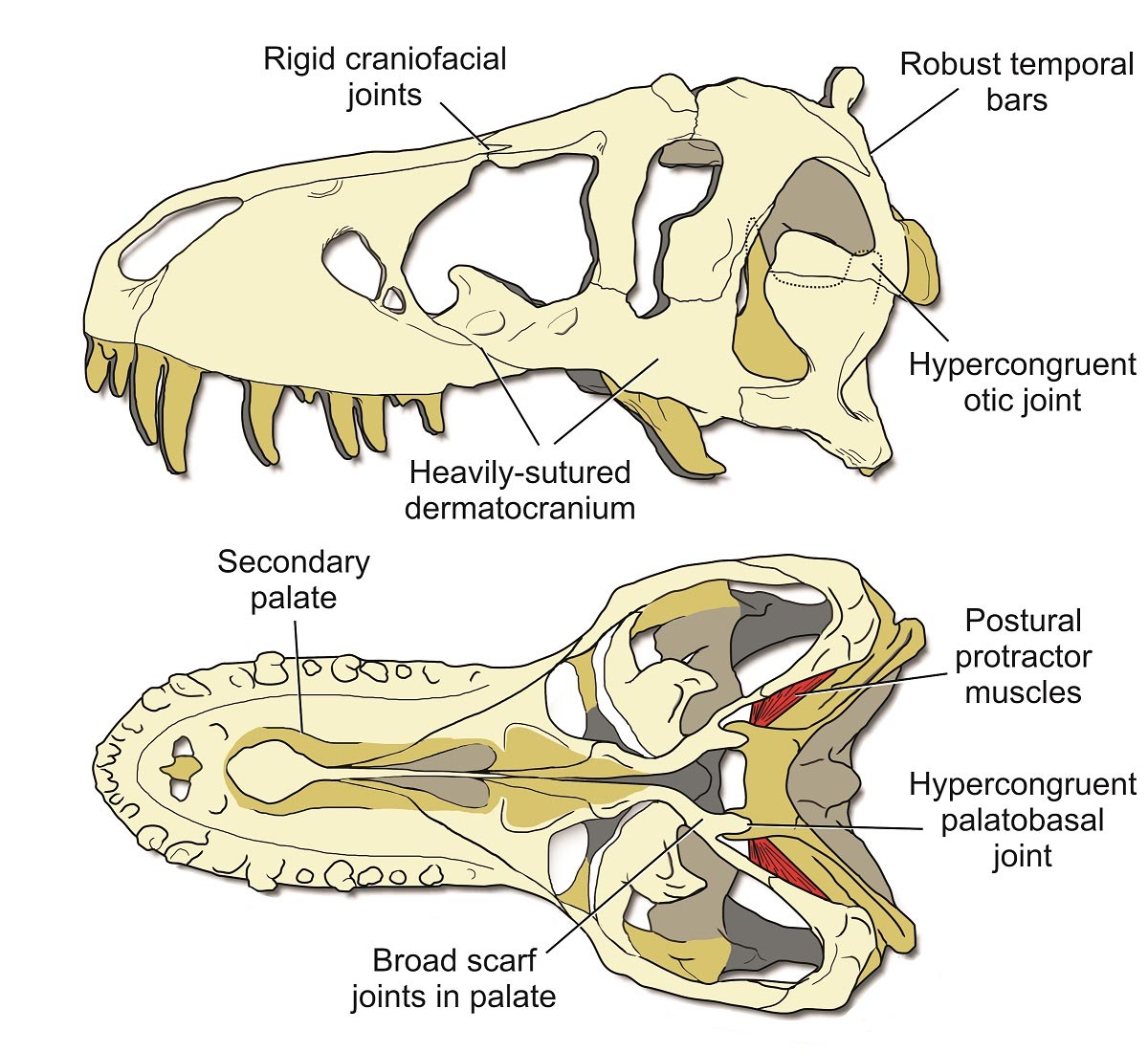
    Illustration of a Stiff T Rex Skull
    An illustration of the key features of a stiff T. rex skull. Credit: University of Missouri

    “In humans, this can also be applied to how people’s jaws work, such as studying how the jaw joint is loaded by stresses and strains during chewing,” said Ian Cost, the lead researcher on the study. Cost is an assistant professor at Albright College and a former doctoral student in the MU School of Medicine. “In animals, understanding how those movements occur and joints are loaded will, for instance, help veterinarians better understand how to treat exotic animals such as parrots, which suffer from arthritis in their faces.”

    ###

    The study, “Palatal biomechanics and its significance for cranial kinesis in Tyrannosaurus rex,” was published in The Anatomical Record. Other authors include Kevin Middleton of the MU School of Medicine; M. Scott Echols of The Medical Center for Birds; Lawrence Witmer of Ohio University; and Julian Davis of University of Southern Indiana. Funding was provided by the National Science Foundation, Jurassic Foundation, Missouri Research Council, Missouri Research Board, and MU Department of Pathology and Anatomical Sciences. The content is solely the responsibility of the authors and does not necessarily represent the official views of the funding agencies.

    Reference: “Palatal Biomechanics and Its Significance for Cranial Kinesis in Tyrannosaurus rex” by Ian N. Cost, Kevin M. Middleton, Kaleb C. Sellers, Michael Scott Echols, Lawrence M. Witmer, Julian L. Davis and Casey M. Holliday, 1 July 2019, The Anatomical Record.
    DOI: 10.1002/ar.24219

    Never miss a breakthrough: Join the SciTechDaily newsletter.
    Follow us on Google and Google News.

    Biomechanics Dinosaurs Paleontology Physiology University of Missouri-Columbia
    Share. Facebook Twitter Pinterest LinkedIn Email Reddit

    Related Articles

    Story of Dinosaur Evolution and Ecology Rewritten After Unambiguous Fossil Evidence Discovered

    Studying Pterosaurs – Largest Animals Ever to Fly – To Better Engineer Manmade Flight

    How Late Cretaceous Dinosaur-Dominated Ecosystems Were Structured

    Remarkable New Species of Meat-Eating Jurassic Dinosaur Discovered in Utah

    Mass Extinction That Killed the Dinosaurs Was All About the Asteroid – Not Volcanoes

    Scientists Find 550 Million-Year-Old Fossilized Digestive Tract – Solving a Mystery of Primordial Evolution

    Global Mercury Contamination and Warming When Dinosaurs Perished

    Dinosaur Footprints Suggest That Jurassic Beasts Trotted Between Africa and Europe

    Scientists Replicate the Molecular Processes That Led from Dinosaur Snouts to Bird Beaks

    Leave A Reply Cancel Reply

    • Facebook
    • Twitter
    • Pinterest
    • YouTube

    Don't Miss a Discovery

    Subscribe for the Latest in Science & Tech!

    Trending News

    Breakthrough Bowel Cancer Trial Leaves Patients Cancer-Free for Nearly 3 Years

    Natural Compound Shows Powerful Potential Against Rheumatoid Arthritis

    100,000-Year-Old Neanderthal Fossils in Poland Reveal Unexpected Genetic Connections

    Simple “Gut Reset” May Prevent Weight Gain After Ozempic or Wegovy

    2.8 Days to Disaster: Scientists Warn Low Earth Orbit Could Suddenly Collapse

    Common Food Compound Shows Surprising Power Against Superbugs

    5 Simple Ways To Remember More and Forget Less

    The Atomic Gap That Could Cost the Semiconductor Industry Billions

    Follow SciTechDaily
    • Facebook
    • Twitter
    • YouTube
    • Pinterest
    • Newsletter
    • RSS
    SciTech News
    • Biology News
    • Chemistry News
    • Earth News
    • Health News
    • Physics News
    • Science News
    • Space News
    • Technology News
    Recent Posts
    • MIT Laser Breakthrough Lets Scientists Watch Drugs Enter the Brain in Real Time
    • Study Reveals Malaria’s Hidden Role in Human Evolution
    • Scientists Print Artificial Neurons That Can Talk to the Brain
    • Bowel and Ovarian Cancers Are Dramatically Rising in Young Adults and Scientists Aren’t Sure Why
    • Alzheimer’s May Begin Decades Earlier Than You Think, New Mayo Clinic Study Finds
    Copyright © 1998 - 2026 SciTechDaily. All Rights Reserved.
    • Science News
    • About
    • Contact
    • Editorial Board
    • Privacy Policy
    • Terms of Use

    Type above and press Enter to search. Press Esc to cancel.