
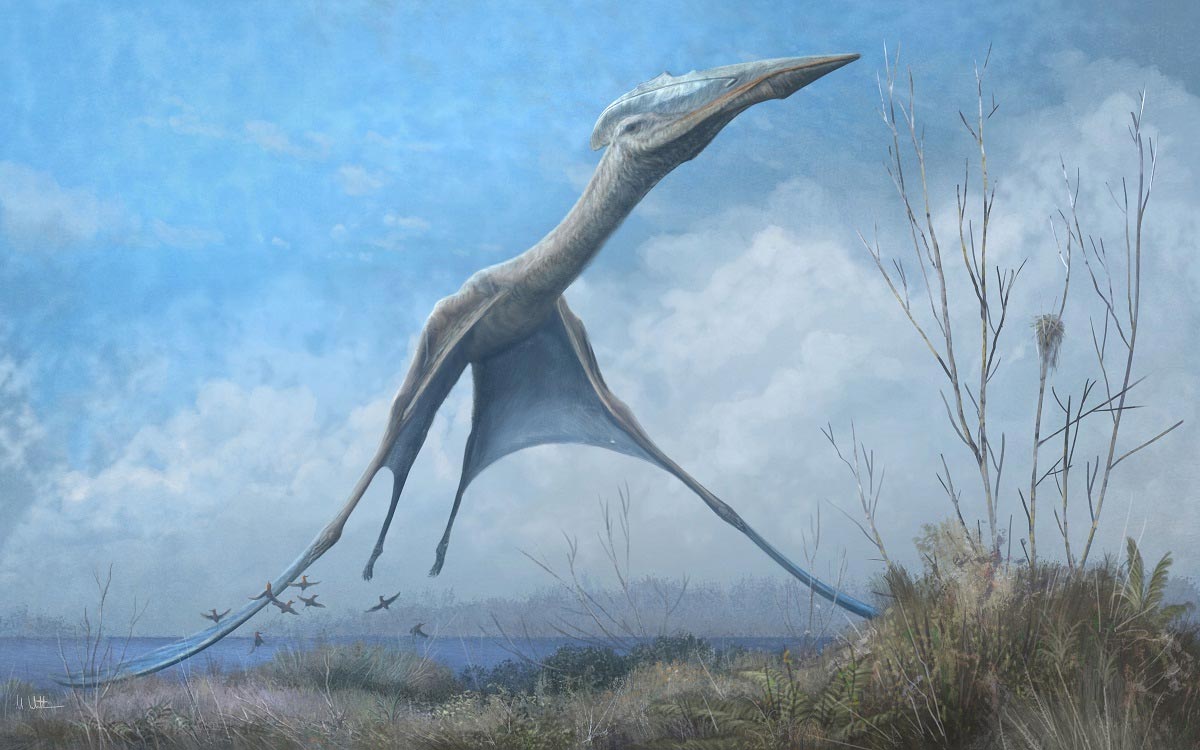
Pterosaurs were the largest animals ever to fly. They soared the skies for 160 million years–much longer than any species of modern bird. Despite their aeronautic excellence, these ancient flyers have largely been overlooked in the pursuit of bioinspired flight technologies. In a review published April 15 in the journal Trends in Ecology and Evolution researchers outline why and how the physiology of fossil flyers could provide ancient solutions to modern flight problems, such as aerial stability and the ability of drones to self-launch.
“There’s a lot of really cool stuff in the fossil record that goes unexplored because engineers generally don’t look to paleontology when thinking about inspiration for flight,” says first author Liz Martin-Silverstone (@gimpasaura), a post-doctoral researcher and paleontologist at the University of Bristol. “If we’re only looking at modern animals for inspiration, we’re really missing a large degree of the morphology out there and ignoring a lot of options that I think could be useful.”
Previously, engineers have largely focused on the physiology of modern birds and insects when designing aeronautic technology like drones and planes; they might not think to examine fossils that–by their nature–are often incomplete. However, Martin-Silverstone says there are a select few pterosaur fossils that provide extraordinarily deep insight into the anatomy of their wings, which is essential for understanding their flight capabilities.
“There are two or three absolutely amazingly preserved pterosaur fossils that let you see the different layers within the wing membrane, giving us insight into its fibrous components. Also, some fossils are preserved enough to show the wing attachments beneath the hip,” she says. “While you don’t know exactly the shape of the wing, by knowing the membrane attachments you can model the effectiveness of different wing shapes and determine which would have performed best in natural conditions.” Analyzing the morphology and predicted flight mechanics of these ancient creatures has revealed novel tactics that don’t exist in modern flyers.
Becoming airborne is one example. Launching into the air through a leap or jump, also known as a ballistic launch, is standard throughout the animal kingdom. However, larger birds require a running start to gain enough momentum for lift-off. Pterosaurs, on the other hand, may have developed a method to launch from a stationary position despite some specimens weighing nearly 300 kilograms. One hypothesis, proposed by review co-author Mike Habib (@aeroevo) of the Dinosaur Institute at the Natural History Museum of Los Angeles County, suggests that the wing membrane and the robust muscle attachments in the wings allowed pterosaurs to generate a high-powered leap off of their elbows and wrists, giving them enough height to become airborne.
“Today, something like a drone requires a flat surface to launch and is quite restricted on how it actually gets into the air. The unique launch physiology of pterosaurs might be able to help solve some of these problems,” Martin-Silverstone says.
Pterosaurs can also provide insights on how to prevent flight instability once in the air. Contrary to how sails can become unstable in a strong wind, pterosaurs evolved strategies to resist flutter of their broad wings. “So far we’ve struggled to design things like flight suits that can resist the pressures of flight. If we can understand how pterosaurs did it, for instance by understanding how their wing membrane was actually structured, then that’s something we can use to answer modern engineering questions,” she says.
These unique physiological elements aren’t limited to pterosaurs, either. Other ancient flyers, like Microraptor, had feathered wings on both their arms and legs, while the newly discovered dinosaur, Yi qi, had wings that combine feathers with a bat-like membrane–a body plan that has never been repeated since their extinction. As such, the authors say many flight strategies remain to be properly explored.
Martin-Silverstone suggests that if we combine our knowledge from flyers both living and extinct, we will have a much better chance of overcoming the hurdles still hindering man-made flight. She says: “We want biologists and engineers alike to reach out to paleontologists when they are looking to solve flight problems, as there might be something extinct that could help. If we limit ourselves to looking at the modern animals, then we’re missing out on a lot of diversity that might be useful.”
Reference: “Volant Fossil Vertebrates: Potential for Bioinspired Flight Technology” by Elizabeth Martin-Silverstone, Michael B. Habib and David W. E. Hone, 14 April 2020, Trends in Ecology and Evolution.
DOI: 10.1016/j.tree.2020.03.005
Never miss a breakthrough: Join the SciTechDaily newsletter.
Follow us on Google and Google News.