
Close Menu
    Facebook X (Twitter) Instagram
    SciTechDaily
    • Biology
    • Chemistry
    • Earth
    • Health
    • Physics
    • Science
    • Space
    • Technology
    Facebook X (Twitter) Pinterest YouTube RSS
    SciTechDaily
    Home»Health»How the COVID Virus Induces Inflammation, Cytokine Storm and Stress in Infected Lung Cells
    Health

    How the COVID Virus Induces Inflammation, Cytokine Storm and Stress in Infected Lung Cells

    By Heinrich-Heine University DuesseldorfDecember 23, 20201 Comment3 Mins Read
    Facebook Twitter Pinterest Telegram LinkedIn WhatsApp Email Reddit
    Share
    Facebook Twitter LinkedIn Pinterest Telegram Email Reddit
    SARS-CoV-2 Docks Receptor-ACE2 Lung Cells
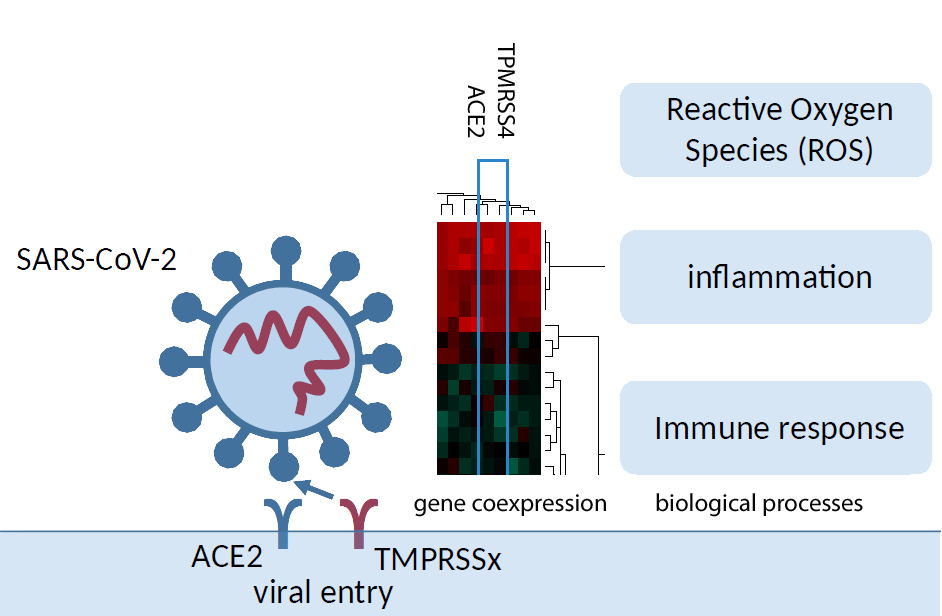
    The coronavirus SARS-CoV-2 docks with its spike protein onto the receptor-ACE2 found on the surface of lung cells. The levels of co-expressed genes with the human receptor-ACE2 were calculated from several publicly available datasets pertaining to lung epithelial cells infected with SARS-CoV-2. The resulting gene-signature consisted of members from the Trans-Membrane-Serine-Protease (TMPRSS) gene family which prime the virus spike protein for cell entry. Other genes from the gene-signature are associated with reduced immune responses and activated inflammation, Reactive Oxygen Species (ROS) and cellular stress. Credit: WruckW /AdjayeJ, HHU Duesseldorf, Germany

    The researchers Wasco Wruck and Prof. James Adjaye from the Institute of Stem Cell Research and Regenerative Medicine, Medical Faculty of Heinrich-Heine-University Duesseldorf, Germany, employed a bioinformatic approach on transcriptome data pertaining to human lung epithelial cells infected with SARS-CoV-2. The meta-analysis unveiled several adversely affected biological processes in the lung which no doubt also applies to other infected organs such as the heart and kidney. Their study is published in Scientific Reports.

    With a current estimation of more than 60 Mio. infected people and more than 1.4 Mio. recorded deaths worldwide, COVID-19 — the disease caused by the coronavirus SARS-CoV-2 and is classified as a pandemic by the WHO — poses a threat to public health, national economies, and society as a whole. Although effective vaccines are becoming available, we still need a better understanding of the molecular mechanisms underlying the etiology of COVID-19 to enable more effective therapies in the future.

    Wasco Wruck, first author of the study, says: “We initially viewed the results of the analysis in an unbiased manner. To our surprise, we noticed that several Transmembrane Serine Proteases besides the already known TMPRSS2 were highly correlated with ACE2 expression. Furthermore, in a more in-depth analysis, the gene-signature could be annotated with numerous biological processes. Among these were regulation of viral life cycle, immune responses, pro-inflammatory responses, several interleukins such as IL6, IL1, IL20, and IL33, IFI16 regulating the interferon response to a virus, chemo-attraction of macrophages, and cellular stress resulting from activated Reactive Oxygen Species.

    Prof. James Adjaye, senior author of the study, summarizes: “We have shown that not having access or the necessary infrastructure to carry out research with the deadly coronavirus SARS-CoV-2 should not preclude progress in dissecting the etiology underlying COVID-19. There are currently numerous transcriptome-based datasets related to experiments carried out on numerous cell types infected with SARS-CoV-2 which can be retrieved and analyzed to identify adversely affected biological processes with the hope of identifying putative druggable targets that can be used to better manage COVID-19 in the future.

    Reference: “SARS-CoV-2 receptor ACE2 is co-expressed with genes related to transmembrane serine proteases, viral entry, immunity and cellular stress” by Wasco Wruck and James Adjaye, 8 December 2020, Scientific Reports.
    DOI: 10.1038/s41598-020-78402-2

    Never miss a breakthrough: Join the SciTechDaily newsletter.
    Follow us on Google and Google News.

    Bioinformatics COVID-19 Immunology Infectious Diseases
    Share. Facebook Twitter Pinterest LinkedIn Email Reddit

    Related Articles

    Pirola Panic? T Cells Might Be Our Secret Weapon Against the Latest COVID “Variant of Concern”

    Researchers Assess the Power of T-Cell Immune Response to COVID-19 BA.1 and BA.2 Omicron Variants

    Russian Scientists Investigate the Immune Response to COVID Variants (Alpha, Beta, Gamma, Delta, Epsilon, Zeta, Eta, Theta, Iota, Kappa and Lambda)

    AI Trained With Genetic Data Predicts How Patients With Viral Infections – Including COVID-19 – Will Fare

    Artificial Intelligence Model Predicts Which Immune System Key Opens the Locks of Coronavirus

    New Research Finds Most People Are Naturally Armed Against the COVID-19 Coronavirus

    Bioinformatic Analysis Offers New Clues to How SARS-CoV-2 Infects Cells

    Researchers Unravel the Network of Molecules That Influence COVID-19 Severity

    COVID-19 Treatment May Lie in Pangolin Genetics – May Possess Evolutionary Advantage Against Coronavirus

    1 Comment

    1. Morzina on December 23, 2020 9:07 pm

      Many Kind Stress Problems & A Great Solution
      Hello… Do you know it ? Restilen is an effective way to forget about stress. Taking it regularly helps to increase resistance to stress, reduce stress symptoms, fatigue and exhaustion. The product is based exclusively on natural ingredients that act directly on the source of the problem.
      Restilen is designed for men and women who has ever felt stress, anxiety or nervousness and wants to relieve the stress. The product’s effects can be seen from the first day of use. Restilen is here : https://tinyurl.com/yazq5cd4

      Reply
    Leave A Reply Cancel Reply

    • Facebook
    • Twitter
    • Pinterest
    • YouTube

    Don't Miss a Discovery

    Subscribe for the Latest in Science & Tech!

    Trending News

    This Experimental Drug Repaired the Gut and Reversed Severe Fatty Liver Disease

    Physicists Just Turned a Black Hole Energy Theory Into Reality

    Stanford Scientists Solve a 252-Million-Year-Old Mass Extinction Mystery

    The Ancient Survival Mechanism Making Weight Loss So Difficult

    Just 3,000 Steps a Day May Help Protect the Brain From Alzheimer’s

    “Weird Clams” Reveal a New Invasion Along the U.S. Northeast Coast

    Archaeologists Decapitated Tutankhamun and Glued His Body Back Together

    New Black Hole Theory Solves a 50-Year-Old Problem

    Follow SciTechDaily
    • Facebook
    • Twitter
    • YouTube
    • Pinterest
    • Newsletter
    • RSS
    SciTech News
    • Biology News
    • Chemistry News
    • Earth News
    • Health News
    • Physics News
    • Science News
    • Space News
    • Technology News
    Recent Posts
    • Quantum Computer Stores Data in Vibrations Like Notes on a Guitar
    • Astronomers Discover Two Super Puff Planets Lighter Than Cotton Candy
    • One Asteroid Collision May Have Rocked Earth, Mars, and the Moon
    • Scientists Restore the Sense of Touch With Electrical Brain Stimulation
    • New Study Reveals Herpesvirus Infection May Accelerate Alzheimer’s Disease
    Copyright © 1998 - 2026 SciTechDaily. All Rights Reserved.
    • Science News
    • About
    • Contact
    • Editorial Board
    • Privacy Policy
    • Terms of Use

    Type above and press Enter to search. Press Esc to cancel.