
Close Menu
    Facebook X (Twitter) Instagram
    SciTechDaily
    • Biology
    • Chemistry
    • Earth
    • Health
    • Physics
    • Science
    • Space
    • Technology
    Facebook X (Twitter) Pinterest YouTube RSS
    SciTechDaily
    Home»Technology»Turbocharged Skyrmions: Accelerating Toward the Future of Computing
    Technology

    Turbocharged Skyrmions: Accelerating Toward the Future of Computing

    By CNRSApril 20, 2024No Comments2 Mins Read
    Facebook Twitter Pinterest Telegram LinkedIn WhatsApp Email Reddit
    Share
    Facebook Twitter LinkedIn Pinterest Telegram Email Reddit
    Antiferromagnetic Skyrmions Magnetic Racetrack
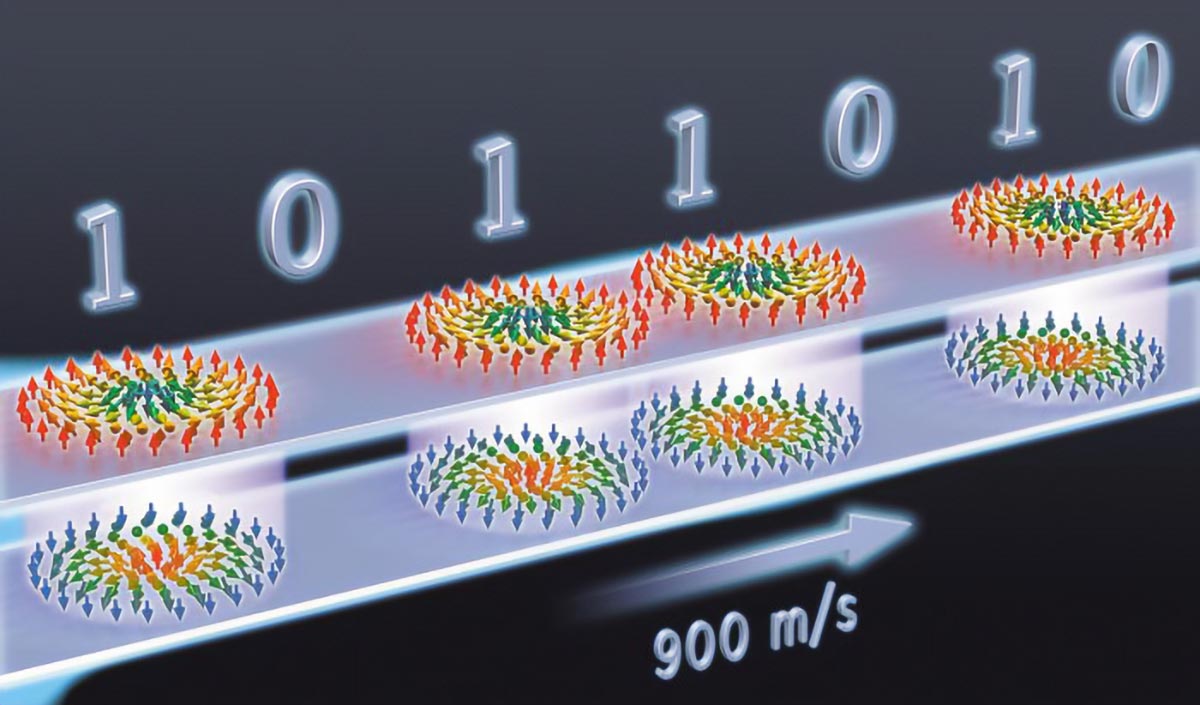
    Antiferromagnetic skyrmions moved in a magnetic racetrack by an electrical current. Credit: © Bruno Bourgeois and Olivier Boulle

    Scientists discovered that skyrmions, potential future bits for computer memory, can now move at speeds up to 900 m/s, a significant increase facilitated by the use of antiferromagnetic materials.

    An international research team led by scientists from the CNRS[1] has discovered that the magnetic nanobubbles[2] known as skyrmions can be moved by electrical currents, attaining record speeds up to 900 m/s.

    Anticipated as future bits in computer memory, these nanobubbles offer enhanced avenues for information processing in electronic devices. Their tiny size[3] provides great computing and information storage capacity, as well as low energy consumption.

    Until now, these nanobubbles moved no faster than 100 m/s, which is too slow for computing applications. However, thanks to the use of an antiferromagnetic material[4] as medium, the scientists successfully had the skyrmions move 10 times faster than previously observed.

    These results, which were published in Science on March 19, offer new prospects for developing higher-performance and less energy-intensive computing devices.

    This study is part of the SPIN national research program[5] launched on January 29, which supports innovative research in spintronics, with a view to helping develop a more agile and enduring digital world.

    Notes

    1. The French laboratories involved are SPINTEC (CEA/CNRS/Université Grenoble Alpes), the Institut Néel (CNRS), and the Charles Coulomb Laboratory (CNRS/Université de Montpellier).
    2. A skyrmion consists of elementary nanomagnets (“spins”) that wind to form a highly stable spiral structure, like a tight knot.
    3. The size of a skyrmion can reach a few nanometres, which is to say approximately a dozen atoms.
    4. Antiferromagnetic stacks consist of two nano-sized ferromagnetic layers (such as cobalt) separated by a think non-magnetic layer, with opposite magnetisation.
    5. The SPIN Priority Research Programme and equipment (PEPR) is an exploratory program in connection with the France 2030 investment plan.

    Reference: “Fast current-induced skyrmion motion in synthetic antiferromagnets” by Van Tuong Pham, Naveen Sisodia, Ilaria Di Manici, Joseba Urrestarazu-Larrañaga, Kaushik Bairagi, Johan Pelloux-Prayer, Rodrigo Guedas, Liliana D. Buda-Prejbeanu, Stéphane Auffret, Andrea Locatelli, Tevfik Onur Menteş, Stefania Pizzini, Pawan Kumar, Aurore Finco, Vincent Jacques, Gilles Gaudin and Olivier Boulle, 18 April 2024, Science.
    DOI: 10.1126/science.add5751

    Never miss a breakthrough: Join the SciTechDaily newsletter.
    Follow us on Google and Google News.

    Antiferromagnetism CNRS Computer Science Information Technology Skyrmions
    Share. Facebook Twitter Pinterest LinkedIn Email Reddit

    Related Articles

    New Open-Source Tool Makes Complex Data Easily Understandable

    Whirlwind Tech: The Future of Energy-Efficient Spintronics Computing

    New Programming System Could Help Prevent Information Leaks

    Algorithm Enables Robots to Learn and Adapt to Help Complete Tasks

    Educational Touch-Screen Games Prove Effective

    New Approach Uses Mathematics to Improve Automated Security Monitoring

    Mathematical Framework Formalizes Loop Perforation Technique

    “Inexact” Computer Chip, 15 Times More Efficient than Today’s Technology

    Calculating the Total Capacity of a Data Network

    Leave A Reply Cancel Reply

    • Facebook
    • Twitter
    • Pinterest
    • YouTube

    Don't Miss a Discovery

    Subscribe for the Latest in Science & Tech!

    Trending News

    The Universe Is Expanding Too Fast and Scientists Can’t Explain Why

    “Like Liquid Metal”: Scientists Create Strange Shape-Shifting Material

    Early Warning Signals of Esophageal Cancer May Be Hiding in Plain Sight

    Common Blood Pressure Drug Shows Surprising Power Against Deadly Antibiotic-Resistant Superbug

    Scientists Uncover Dangerous Connection Between Serotonin and Heart Valve Disease

    Scientists Discover a “Protector” Protein That Could Help Reverse Hair Loss

    Bone-Strengthening Discovery Could Reverse Osteoporosis

    Scientists Uncover Hidden Trigger Behind Stem Cell Aging

    Follow SciTechDaily
    • Facebook
    • Twitter
    • YouTube
    • Pinterest
    • Newsletter
    • RSS
    SciTech News
    • Biology News
    • Chemistry News
    • Earth News
    • Health News
    • Physics News
    • Science News
    • Space News
    • Technology News
    Recent Posts
    • Scientists Overcome Major Quantum Bottleneck, Potentially Transforming Teleportation and Computing
    • Quantum Physics’ Strangest Problem May Hold the Key to Time Itself
    • Scientists Create “Liquid Gears” That Spin Without Touching
    • The Simple Habit That Could Help Prevent Cancer
    • Forgotten Medicinal Plant Shows Promise in Fighting Dangerous Superbugs
    Copyright © 1998 - 2026 SciTechDaily. All Rights Reserved.
    • Science News
    • About
    • Contact
    • Editorial Board
    • Privacy Policy
    • Terms of Use

    Type above and press Enter to search. Press Esc to cancel.