
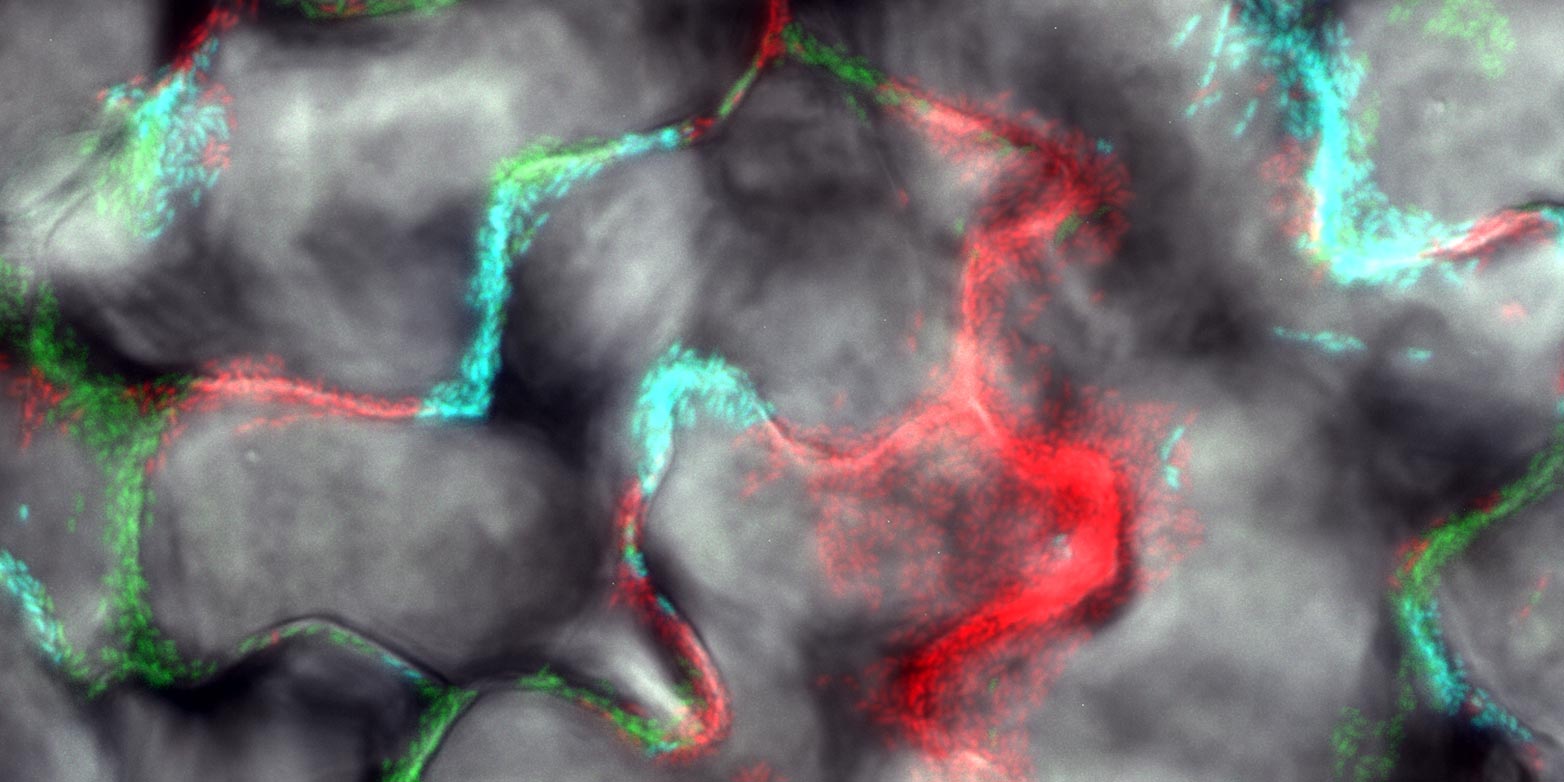
Not only animals and humans host a complex community of microorganisms – plants do this as well. Researchers at ETH Zurich have recently published two new studies that shed light on fundamental aspects of these close – and often overlooked – relationships.
Hundreds of different bacterial species live in and on leaves and roots of plants. A research team led by Julia Vorholt from the Institute of Microbiology at ETH Zurich, together with colleagues in Germany, first inventoried and categorized these bacteria six years ago. Back then, they isolated 224 strains from the various bacterial groups that live on the leaves of thale cress (Arabidopsis thaliana). These can be assembled into simplified, or “synthetic” plant microbiomes. The researchers thus laid the foundations for their two new studies, which were just published in the journals Nature Plants and Nature Microbiology.
Volume Control of the Plant Response
In the first study, the researchers investigated how plants respond to their colonization by microorganisms. Vorholt’s team dripped bacterial cultures onto the leaves of plants that had, up to that point, been cultivated under sterile conditions. As expected, different types of bacteria triggered a variety of responses in the plants. For example, exposure to certain genera of Gammaproteobacteria caused the thale cress plants to activate a total of more than 3,000 different genes, while those of Alphaproteobacteria triggered a response in only 88 genes on average.
“Despite this broad range of responses to the different bacteria of the microbiome, we were astonished to pinpoint a central response: the plants practically always activate a core set of 24 genes,” Vorholt says. But that’s not all the team found: acting as a kind of volume control for the plant response, the activation intensity of these 24 genes provides information as to how extensively the bacteria have colonized the plant. This volume control also predicts how many additional genes the plant will activate as it adapts to the new arrivals.
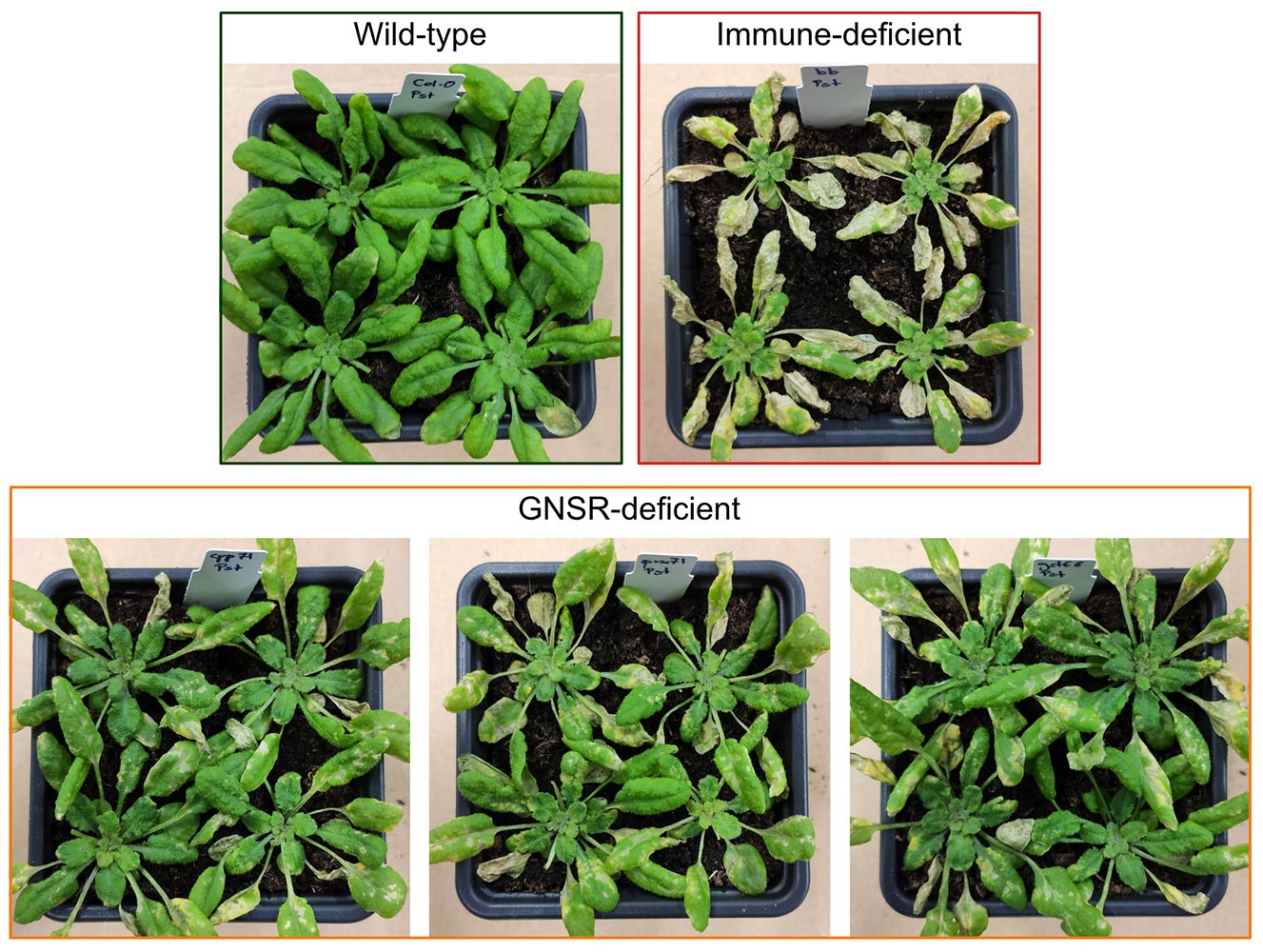
Plants with defects in some of these 24 genes are more susceptible to harmful bacteria, Vorholt’s team has shown. And since other studies had noticed that some genes in the core set are also involved in plant responses to osmotic shock or fungal infestation, the ETH researchers infer that the 24 genes constitute a general defensive response. “It looks like an immune training, even though the bacteria we used aren’t pathogens, but rather partners in a natural community,” Vorholt says.
Bacterial Community out of Control
In the second study, Vorholt and her team explored how bacterial communities change when mutations cause a plant to be deficient in one or several genes. The team expected to see that genetic defects in receptors, which plants use to detect the presence of microbes, play a major role in the story.
What they didn’t expect was that another genetic defect would have the biggest effect: if the plants were deficient in a certain enzyme, an NADPH oxidase, the bacterial community was thrown off-kilter. Plants use this enzyme to produce highly reactive oxygen radicals, which have an antimicrobial effect. In the absence of this NADPH oxidase, microbes that under normal circumstances lived peacefully on the leaves developed into what are known as opportunistic pathogens.
Is the NADPH oxidase found among the core set of 24 genes responsible for a general defensive response? “No, that would have been too good to be true,” says Sebastian Pfeilmeier, a member of Vorholt’s research group and lead author of the study. This is because the gene responsible for the NADPH oxidase is turned on prior to contact with microbes and because the enzyme is activated by chemical reactions governed by phosphorylation.
For Vorholt, the two studies show that synthetic microbiomes are a promising approach to investigating the complex interactions within different communities. “Since we can control and precisely engineer the communities, we can do much more than just observe what happens. In addition to simply determining cause and effect, we can understand them on a molecular level,” Vorholt says. An ideal microbiome protects plants from diseases while also making them more resilient to drought and salty conditions. This is why the agricultural industry is among those interested in the team’s results. They should help farmers harness the power of the microbiome in the future.
References:
“A general non-self response as part of plant immunity” by Benjamin A. Maier, Patrick Kiefer, Christopher M. Field, Lucas Hemmerle, Miriam Bortfeld-Miller, Barbara Emmenegger, Martin Schäfer, Sebastian Pfeilmeier, Shinichi Sunagawa, Christine M. Vogel and Julia A. Vorholt, 17 May 2021, Nature Plants.
DOI: 10.1038/s41477-021-00913-1
“The plant NADPH oxidase RBOHD is required for microbiota homeostasis in leaves” by Sebastian Pfeilmeier, Gabriella C. Petti, Miriam Bortfeld-Miller, Benjamin Daniel, Christopher M. Field, Shinichi Sunagawa and Julia A. Vorholt, 30 June 2021, Nature Microbiology.
DOI: 10.1038/s41564-021-00929-5
Never miss a breakthrough: Join the SciTechDaily newsletter.
Follow us on Google and Google News.