

Close Menu
    Facebook X (Twitter) Instagram
    SciTechDaily
    • Biology
    • Chemistry
    • Earth
    • Health
    • Physics
    • Science
    • Space
    • Technology
    Facebook X (Twitter) Pinterest YouTube RSS
    SciTechDaily
    Home»Health»Alzheimer’s Breakthrough: Scientists Make Revolutionary Leap in Brain Network Analysis
    Health

    Alzheimer’s Breakthrough: Scientists Make Revolutionary Leap in Brain Network Analysis

    By West China Hospital of Sichuan UniversityApril 5, 20241 Comment3 Mins Read
    Facebook Twitter Pinterest Telegram LinkedIn WhatsApp Email Reddit
    Share
    Facebook Twitter LinkedIn Pinterest Telegram Email Reddit
    Alzheimer's Losing Brain
    A new study highlights the crucial role of brain networks in Alzheimer’s disease research, offering insights into methodologies and future challenges. It emphasizes the need for advancements in data integration and model interpretability to enhance research and clinical practices, with optimism for overcoming AD through current technological advancements.

    Dementia is a major health issue worldwide in the 21st century, impacting over 50 million people globally. This figure is expected to soar to 152 million by 2050, as the global population ages. Alzheimer’s disease (AD) is the leading type of dementia, responsible for 60–80% of all dementia cases.

    Research on AD identifies two primary pathological hallmarks: the progressive accumulation of extracellular amyloid beta (Aβ) plaques and the presence of intracellular neurofibrillary tangles (NFTs).

    The accumulation of these pathological proteins in specific brain regions, followed by their dissemination throughout the broader brain network, leads to disruptions in both individual brain regions and their interconnections. Consequently, brain networks play a pivotal role in the development and progression of AD.

    Innovative Research in Alzheimer’s Disease

    In a study recently published in Psychoradiology, researchers from the University of Texas at Arlington and the University of Georgia have systematically summarized studies on brain networks within the context of AD, critically analyzed the strengths and weaknesses of existing methodologies, and offered novel perspectives and insights, intending to serve as inspiration for future research.

    This study offers a comprehensive overview of the dynamic landscape of Alzheimer’s disease (AD) research within the realm of brain network analysis. It underscores the pivotal role of brain networks in elucidating the mechanisms underpinning AD and their profound impact on disease progression.
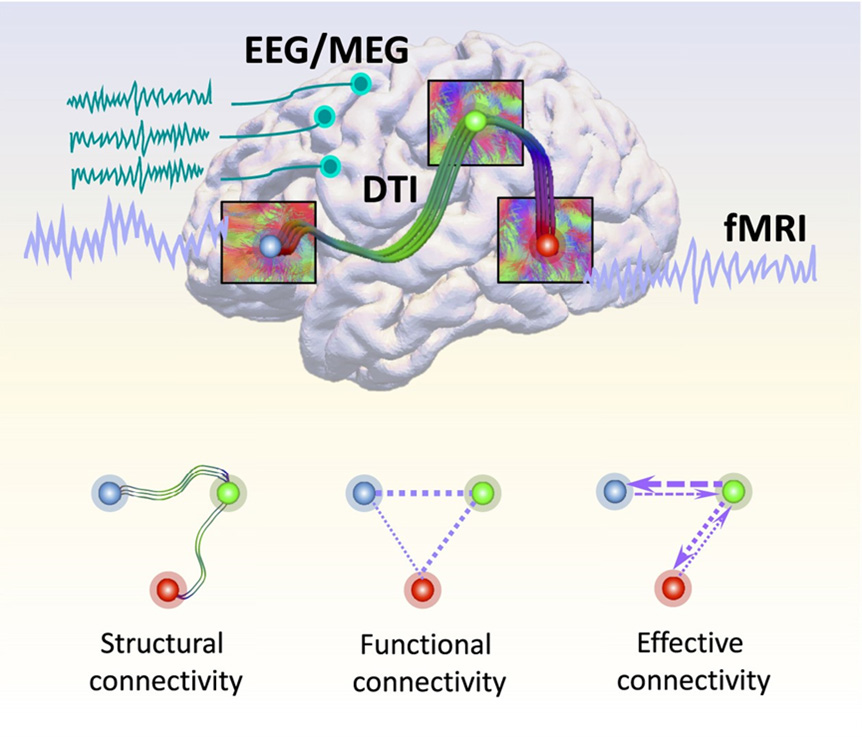
    Depictions of Connections in a Brain Connectome and the Resulting Three Types of Connectivity
    Structural connectivity (SC) refers to anatomical links and is usually estimated using fiber bundles derived from diffusion MRI; Functional connectivity (FC) and effective connectivity (EC) are generally inferred through the correlation of nodal activities based on BOLD-fMRI or EEG/MEG. Credit: Psychoradiology

    The review sheds light on the rich spectrum of graph-based methods employed in AD investigations, classifying them into traditional graph theory-based approaches and cutting-edge deep graph neural network-based techniques. These methodologies have significantly enriched our understanding of AD by unveiling intricate patterns within brain networks. Consequently, they have opened doors to pioneering diagnostic tools, predictive models, and the identification of potential biomarkers.

    Moreover, this review highlights numerous substantial challenges lying ahead. These challenges encompass issues such as the interpretability of complex models and the effective integration of multimodal data, especially within the context of limited medical datasets. Addressing these hurdles remains paramount for the continued advancement of AD research and its translation into clinical practice.

    Lead researcher, Dr. Lu Zhang, states, “Today, we have easier access to diverse modalities of data and possess more powerful computational models. I firmly believe that based on these advancements, we will ultimately overcome Alzheimer’s disease in the near future.”

    Reference: “Exploring Alzheimer’s disease: a comprehensive brain connectome-based survey” by Lu Zhang, Junqi Qu, Haotian Ma, Tong Chen, Tianming Liu and Dajiang Zhu, 11 January 2024, Psychoradiology.
    DOI: 10.1093/psyrad/kkad033

    Never miss a breakthrough: Join the SciTechDaily newsletter.
    Follow us on Google and Google News.

    Alzheimer's Disease Brain Neuroscience
    Share. Facebook Twitter Pinterest LinkedIn Email Reddit

    Related Articles

    “Cognitive Clock” – Researchers Develop New Measure of Brain Health

    Identifying “The Terrorist Inside My Husband’s Brain” – Living Brain Imaging Can Clearly Differentiate Between Types of Dementia

    Neuroscientists Discover Promising Way to Restore Cognitive Function Impaired by Alzheimer’s Disease

    Century of Data Shows COVID-19 Likely to Impact the Brain Long-Term

    Treating Neurodegenerative Diseases From Glaucoma to Alzheimer’s: New Discovery on How to Protect Neurons and Encourage Their Growth

    Long Before Alzheimer’s Symptoms, Plaque Emerges Deep in the Brain [Video]

    Common Nutrient Supplement May Prevent Alzheimer’s Disease

    Test for Alzheimer’s May Be Undermining Drug Trials

    Disrupted Sleep Patterns Linked to Alzheimer’s

    1 Comment

    1. Paul Dodd on April 8, 2024 12:15 am

      The sentence “Consequently, brain networks play a pivotal role in the development and progression of AD.” implies a causal relationship. It should be, “Consequently, disruption of brain networks may play a pivotal role in the development and progression of AD.”

      Reply
    Leave A Reply Cancel Reply

    • Facebook
    • Twitter
    • Pinterest
    • YouTube

    Don't Miss a Discovery

    Subscribe for the Latest in Science & Tech!

    Trending News

    Artificial Sweeteners May Harm Future Generations, Study Suggests

    Splashdown! NASA Artemis II Returns From Record-Breaking Moon Mission

    What If Consciousness Exists Beyond Your Brain

    Scientists Finally Crack the 100-Million-Year Evolutionary Mystery of Squid and Cuttlefish

    Beyond “Safe Levels”: Study Challenges What We Know About Pesticides and Cancer

    Researchers Have Found a Dietary Compound That Increases Longevity

    Scientists Baffled by Bizarre “Living Fossil” From 275 Million Years Ago

    Your IQ at 23 Could Predict Your Wealth at 27, Study Finds

    Follow SciTechDaily
    • Facebook
    • Twitter
    • YouTube
    • Pinterest
    • Newsletter
    • RSS
    SciTech News
    • Biology News
    • Chemistry News
    • Earth News
    • Health News
    • Physics News
    • Science News
    • Space News
    • Technology News
    Recent Posts
    • 34-Million-Year-Old Snake Found in Wyoming Rewrites Our Understanding of Evolution
    • Prehistoric “Vomit Fossil” Reveals Never-Before-Seen Flying Reptile
    • Scientists Discover Bizarre Crocodile Relative That Walked on Two Legs
    • How Quantum Mechanics Went From Baffling Theory to Revolutionizing Modern Technology
    • Scientists May Have Found the Key to Jupiter and Saturn’s Moon Mystery
    Copyright © 1998 - 2026 SciTechDaily. All Rights Reserved.
    • Science News
    • About
    • Contact
    • Editorial Board
    • Privacy Policy
    • Terms of Use

    Type above and press Enter to search. Press Esc to cancel.