
Close Menu
    Facebook X (Twitter) Instagram
    SciTechDaily
    • Biology
    • Chemistry
    • Earth
    • Health
    • Physics
    • Science
    • Space
    • Technology
    Facebook X (Twitter) Pinterest YouTube RSS
    SciTechDaily
    Home»Space»NASA’s Upgraded SLS Mega Rocket Design for Next-Gen Moon Missions
    Space

    NASA’s Upgraded SLS Mega Rocket Design for Next-Gen Moon Missions

    By NASAApril 5, 2024No Comments6 Mins Read
    Facebook Twitter Pinterest Telegram LinkedIn WhatsApp Email Reddit
    Share
    Facebook Twitter LinkedIn Pinterest Telegram Email Reddit
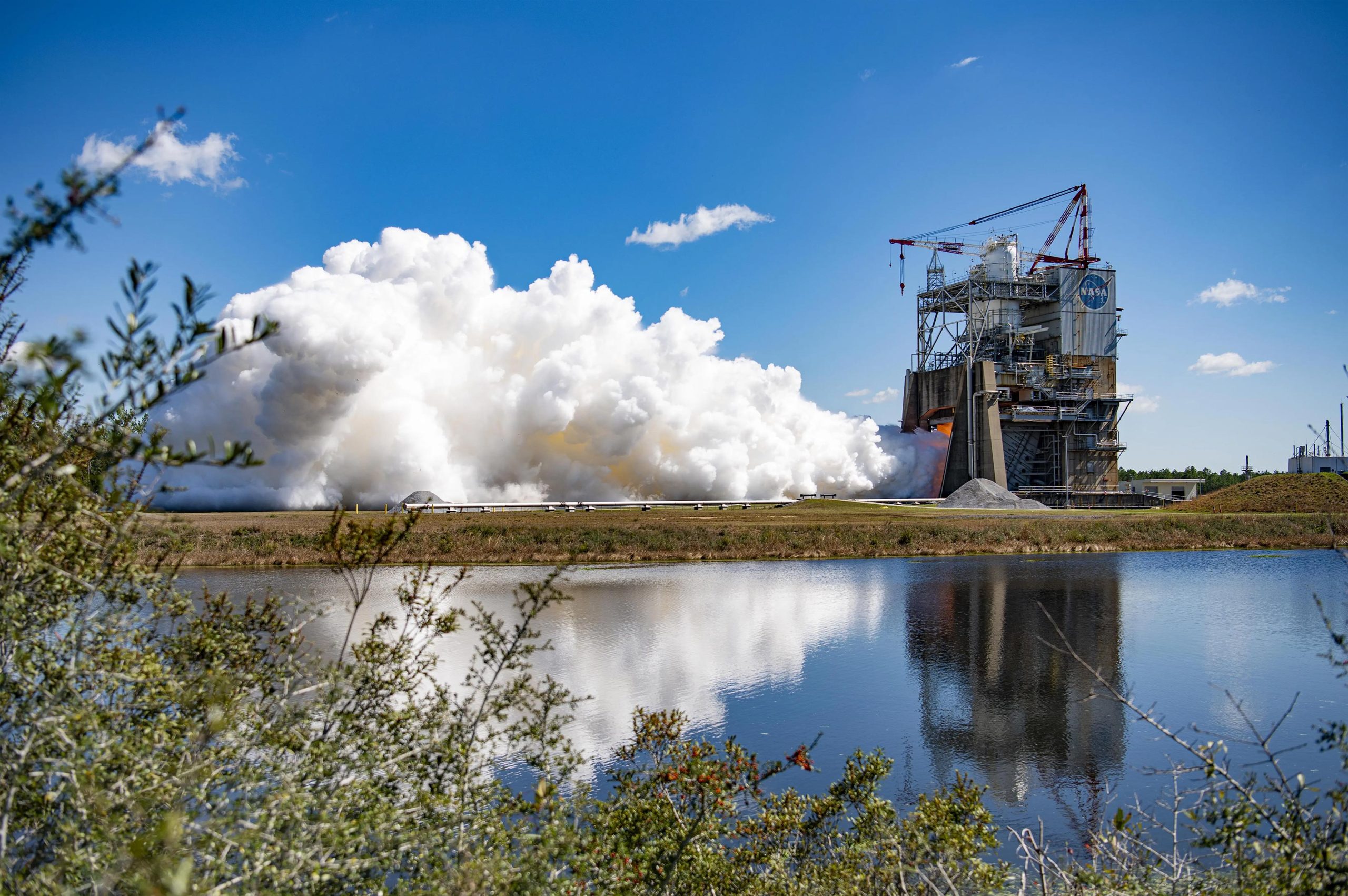
    Full-Duration RS-25 Engine Hot Fire
    A final round of certification testing for production of new RS-25 engines to power the SLS (Space Launch System) rocket, beginning with Artemis V, is underway at NASA’s Stennis Space Center near Bay St. Louis, Mississippi.  Block 1B will also be built to house new-production RS-25 core stage engines that will operate routinely at 111% of their rated power versus the Block 1 RS-25 engines that operate at 109%, providing almost 2,000 more pounds of payload to the Moon. Credit: NASA/Danny Nowlin

    NASA is advancing its Space Launch System with the Block 1B upgrade, enhancing its moon mission capabilities by introducing a more powerful second stage and a cargo adapter, which supports the upcoming Artemis IV mission. Manufacturing and testing are in progress, aiming to extend the rocket’s payload and facilitate more frequent lunar expeditions.

    As NASA prepares for its first crewed Artemis missions, the agency is making preparations to build, test, and assemble the next evolution of its SLS (Space Launch System) rocket. The larger and more powerful version of SLS, known as Block 1B, can send a crew and large pieces of hardware to the Moon in a single launch and is set to debut for the Artemis IV mission.

    “From the beginning, NASA’s Space Launch System was designed to evolve into more powerful crew and cargo configurations to provide a flexible platform as we seek to explore more of our solar system,” said John Honeycutt, SLS Program manager. “Each of the evolutionary changes made to the SLS engines, boosters, and upper stage of the SLS rocket are built on the successes of the Block 1 design that flew first with Artemis I in November 2022 and will, again, for the first crewed missions for Artemis II and III.”

    Early manufacturing is already underway at NASA’s Michoud Assembly Facility in New Orleans, while preparations for the green run test series for its upgraded upper stage are in progress at nearby Stennis Space Center in Bay St. Louis, Mississippi.
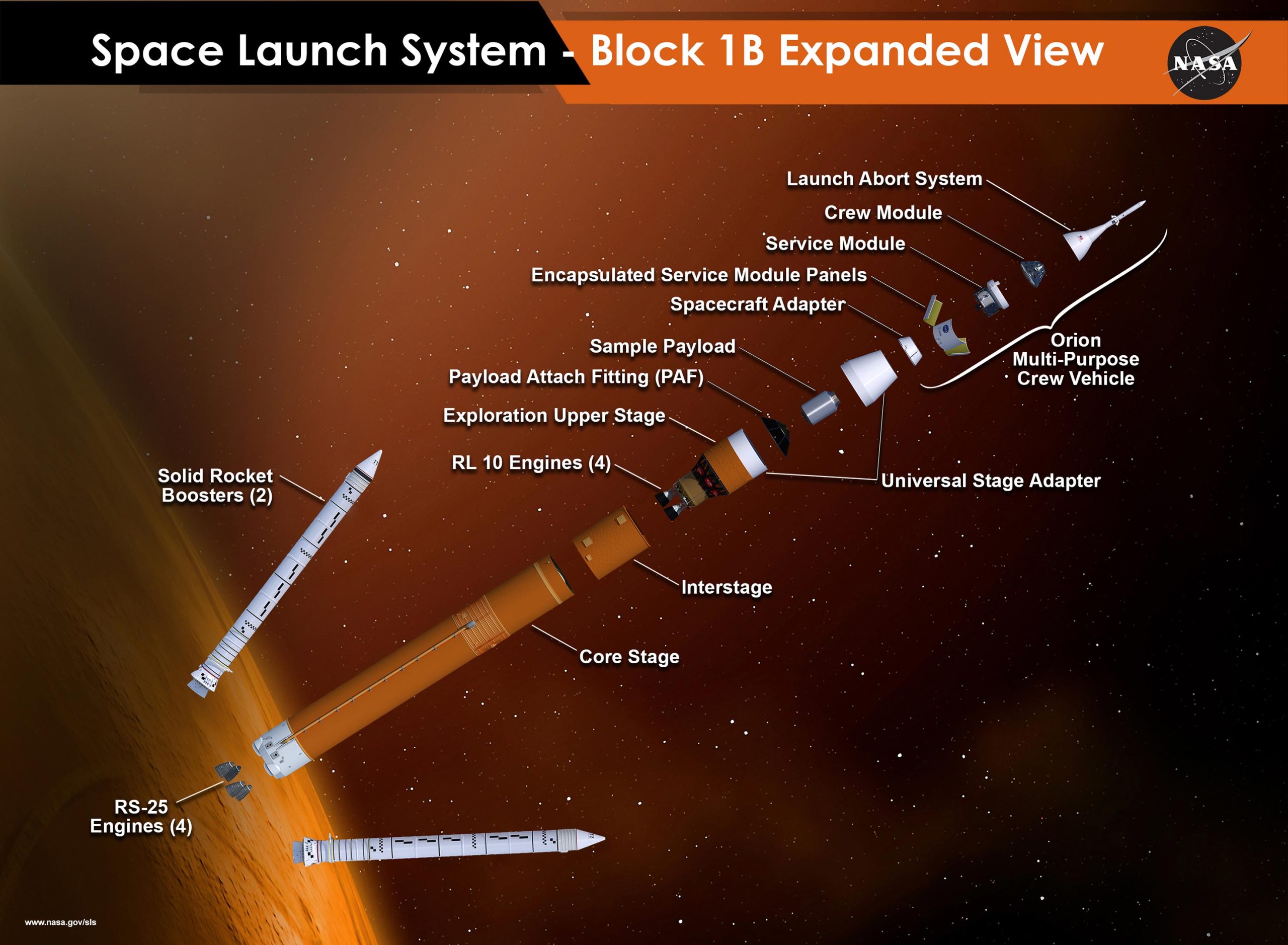
    Space Launch System Block IB Configuration
    An expanded view of the Block IB configuration of NASA’s Space Launch System rocket, including the four RL10 engines. Credit: NASA

    New Upgrades for Bolder Missions

    While using the same basic core stage and solid rocket booster design, and related components as the Block 1, Block 1B features two big evolutionary changes that will make NASA’s workhorse rocket even more capable for future missions to the Moon and beyond. A more powerful second stage and an adapter for large cargos will expand the possibilities for future Artemis missions.

    “The Space Launch System Block 1B rocket will be the primary transportation for astronauts to the Moon for years to come,” said James Burnum, deputy manager of the NASA Block 1B Development Office. “We are building on the SLS Block 1 design, testing, and flight experience to develop safe, reliable transportation that will send bigger and heavier hardware to the Moon in a single launch than existing rockets.”

    SLS Exploration Upper Stage Infographic
    NASA’s Space Launch System (SLS) rocket delivers propulsion in stages to send NASA’s Orion spacecraft and heavy cargo to the Moon for the Artemis lunar missions. At liftoff, the core stage and twin solid rocket boosters fire to propel the rocket off the launch pad and send it into orbit. Once in orbit, the upper stage provides the in-space propulsion to set the spacecraft on a precise trajectory. While the rocket’s core stage design will remain the same for each of the Artemis missions, the rocket’s upper stage is selected to meet various mission requirements and goals. Credit: NASA/Kevin O’Brien

    The in-space stage used to send the first three Artemis missions to the Moon, called the interim cryogenic propulsion stage (ICPS), uses a single engine and will be replaced by a larger, more powerful four-engine stage called the exploration upper stage (EUS). A different battery is among the many changes that will allow EUS to support the first eight hours of the mission following launch compared to the current ICPS two hours. All new hardware and software will be designed and tested to meet the different performance and environmental requirements.

    The other configuration change is a universal stage adapter that connects the rocket to the Orion spacecraft. It also offers more than 10,000 cubic feet (286 cubic meters) of space to carry large components, such as modules for NASA’s future Gateway outpost that will be in lunar orbit to support crew between surface missions and unique opportunities for science at the Moon.
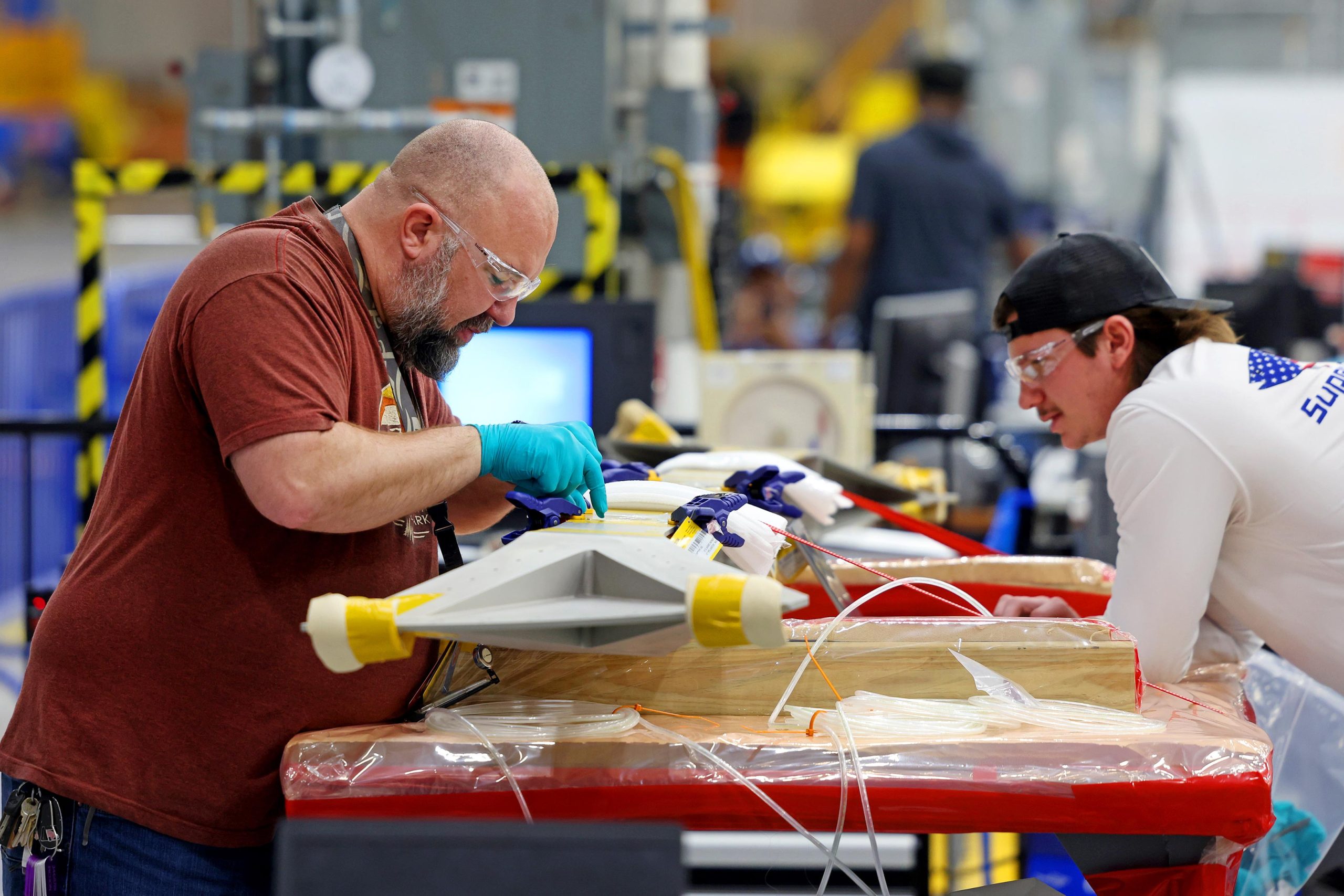
    Technicians at NASA’s Michoud Assembly Facility Prepare Elements for Midbody of the Exploration Upper Stage
    Technicians at NASA’s Michoud Assembly Facility in New Orleans on Feb. 22 prepare elements that will form part of the midbody for the exploration upper stage. The midbody struts, or V-struts, will create the cage-like outer structure of the midbody that will connect the upper stage’s large liquid hydrogen tank to the smaller liquid oxygen tank. Manufacturing flight and test hardware for the future upper stage is a collaborative effort between NASA and Boeing, the lead contractor for EUS and the SLS core stage. Credit: NASA

    Together, those upgrades will increase the payload capability for SLS from 59,000 pounds (27 metric tons) to approximately 84,000 pounds (38 metric tons). The four RL10 engines that will be used during the exploration upper stage green run test series at Stennis are complete, and work on the Artemis IV core stage is in progress at nearby Michoud.

    More Opportunities

    The evolved design also gives astronaut explorers more launch opportunities on a path to intercept the Moon. With four times the engines and almost four times the propellant and thrust of ICPS, the EUS also enables two daily launch opportunities compared to Block 1’s more limited lunar launch availability.

    Among other capabilities, both astronauts and ground teams will be able to communicate with the in-space stage and safely control it while using Orion’s docking system to extract components destined for Gateway from the stage adapter.

    NASA is working to land the first woman, first person of color, and its first international partner astronaut on the Moon under Artemis. SLS is part of NASA’s backbone for deep space exploration, along with Orion and the Gateway in orbit around the Moon and commercial human landing systems, next-generation spacesuits, and rovers on the lunar surface. SLS is the only rocket that can send Orion, astronauts, and supplies to the Moon in a single launch.

    Never miss a breakthrough: Join the SciTechDaily newsletter.
    Follow us on Google and Google News.

    ARTEMIS Mission NASA NASA Marshall Space Flight Center Rocket Space Launch System
    Share. Facebook Twitter Pinterest LinkedIn Email Reddit

    Related Articles

    NASA’s Engineering Marvel: Preparing the Gateway to the Moon

    Moonbound Majesty: Astronauts’ Inside Look at SLS, the Engine of Artemis Dreams

    NASA Upgrades Powerful SLS Rocket Engines – Production Restarted for Next Era of Space Exploration

    Progress Underway on NASA Space Launch System (SLS) Moon Rockets for Artemis II, III, and IV

    NASA Prepares for Future Artemis Missions Using Data From the First SLS Flight

    NASA’s Artemis SLS Moon Rocket Showed Excellent Performance – World’s Most Powerful Rocket

    Fired Up: A Look at the 55 Engines and Motors That Power NASA’s Artemis Mission

    NASA Prepares Massive SLS Moon Rockets for First Crewed Artemis Missions

    First Massive SLS Rocket Core Stage for NASA’s Artemis Completed and Loaded for Transport

    Leave A Reply Cancel Reply

    • Facebook
    • Twitter
    • Pinterest
    • YouTube

    Don't Miss a Discovery

    Subscribe for the Latest in Science & Tech!

    Trending News

    Researchers Have Found a Dietary Compound That Increases Longevity

    Scientists Baffled by Bizarre “Living Fossil” From 275 Million Years Ago

    Your IQ at 23 Could Predict Your Wealth at 27, Study Finds

    320 Light-Years Away, a Planet Confirms a Fundamental Cosmic Assumption

    The Crown Jewel of Dentistry? Breakthrough Tech Could Transform Tooth Repair

    Python Blood Could Hold the Secret to Weight Loss Without Side Effects

    Naturally Occurring Bacteria Completely Eradicate Tumors in Mice With a Single Dose

    New “Nanozyme Hypothesis” Could Rewrite the Story of Life’s Origins

    Follow SciTechDaily
    • Facebook
    • Twitter
    • YouTube
    • Pinterest
    • Newsletter
    • RSS
    SciTech News
    • Biology News
    • Chemistry News
    • Earth News
    • Health News
    • Physics News
    • Science News
    • Space News
    • Technology News
    Recent Posts
    • Prehistoric “Vomit Fossil” Reveals Never-Before-Seen Flying Reptile
    • Scientists Discover Bizarre Crocodile Relative That Walked on Two Legs
    • How Quantum Mechanics Went From Baffling Theory to Revolutionizing Modern Technology
    • Scientists May Have Found the Key to Jupiter and Saturn’s Moon Mystery
    • Scientists Uncover Hidden Clues to the Origin of the Genetic Code
    Copyright © 1998 - 2026 SciTechDaily. All Rights Reserved.
    • Science News
    • About
    • Contact
    • Editorial Board
    • Privacy Policy
    • Terms of Use

    Type above and press Enter to search. Press Esc to cancel.