
Close Menu
    Facebook X (Twitter) Instagram
    SciTechDaily
    • Biology
    • Chemistry
    • Earth
    • Health
    • Physics
    • Science
    • Space
    • Technology
    Facebook X (Twitter) Pinterest YouTube RSS
    SciTechDaily
    Home»Physics»Researchers Create Electron Vortex Beams Inside Electron Microscopes
    Physics

    Researchers Create Electron Vortex Beams Inside Electron Microscopes

    By University of YorkFebruary 16, 2012No Comments3 Mins Read
    Facebook Twitter Pinterest Telegram LinkedIn WhatsApp Email Reddit
    Share
    Facebook Twitter LinkedIn Pinterest Telegram Email Reddit
    Abstract Laser Beam Concept
    Researchers produced electron vortex beams with orbital angular momentum, paving the way for novel applications, including more efficient examinations of magnetic materials.

    Researchers at the University of York have created electron beams with orbital angular momentum, electron vortex beams, which improve the resolution and sensitivity of imaging. The researchers believe this will open the way to many novel applications including the more efficient examining of magnetic materials.

    Researchers from the University of York are pioneering the development of electron microscopes which will allow scientists to examine a greater variety of materials in new revolutionary ways.

    The team, headed by Professor Jun Yuan and Professor Mohamed Babiker, from the University’s Department of Physics has created electron beams with orbital angular momentum – electron vortex beams – which will open the way to many novel applications including the more efficient examining of magnetic materials.

    Electron microscopes use a beam of electrons to illuminate a specimen and produce a magnified image, allowing scientists to investigate atomic arrangements. Compared to conventional electron beams, electron vortex beams improve the resolution and sensitivity of imaging, which is key when determining the structure of biological specimens such as proteins. They also have applications in the manipulation of nano-scale objects such as atoms and molecules.

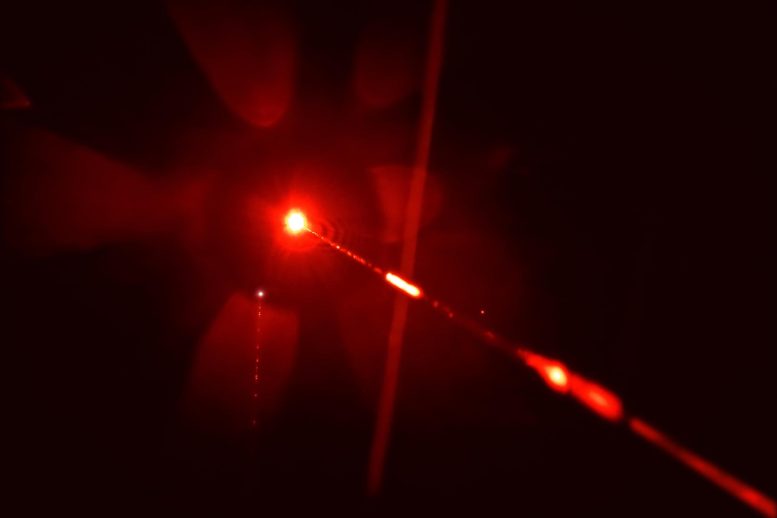
    researchers create tornados inside electron microscopes.jpg
    Credit: University of York

    As the electron vortex consists of moving charged particles, there is a magnetic field associated with the vortex. This magnetic field will be invaluable in examining magnetic materials, enabling the nanoscale magnetic structure to be imaged.

    The York team has created a design for a holographic mask to generate an electron vortex beam and now plans to use this to improve the imaging capabilities of the electron microscope in its York-JEOL nanocenter.

    Details of York’s latest work – part of the research by second-year PhD student Sophia Lloyd – showing that orbital angular momentum of electron beams with vortex structure are more efficient than light for probing atomic magnetism, are published in the February edition of the Physical Review Letters.

    Professor Yuan said: “The introduction of vortex beams into electron microscopy, with its screw-like revolving wavefront – much like tornados, will revolutionize the study of magnetic nanostructures, as well as create new applications in terms of nanoparticle manipulation and trapping, and edge contrast detection.”

    Professor Babiker, an expert in light vortex research, added: “Optical vortex beams, created using beams of light photons, have been studied for the past 20 years. They have found a great many applications, most notably in fine-scale manipulation of single molecules and nano-objects in so-called optical tweezers and optical spanners.

    “Research being carried out at York is intended to further current understanding of electron vortices so that a similarly broad range of applications can be realized.”

    Reference: “Quantized Orbital Angular Momentum Transfer and Magnetic Dichroism in the Interaction of Electron Vortices with Matter” by Sophia Lloyd, Mohamed Babiker and Jun Yuan, 15 February 2012, Physical Review Letters.
    DOI: 10.1103/PhysRevLett.108.074802

    Never miss a breakthrough: Join the SciTechDaily newsletter.
    Follow us on Google and Google News.

    Electron Microscope Electron Vortex Beams Electrons Nanotechnology University of York
    Share. Facebook Twitter Pinterest LinkedIn Email Reddit

    Related Articles

    Electrons on Demand: Scientists Unlock the Secret of Light-Driven Charge Control

    A Physics Discovery So Strange It’s Changing Quantum Theory

    Electron-Cloaking Material May Enable More Efficient Transfer of Electrons

    Researchers Explain Mysterious Nanoscale Crop Circles

    Nucleons in a Dense Nucleus Exceed 25 Percent of the Speed of Light

    Researchers Discover Electrical Switch for Magnetic Current

    NIST Researches the Use of Switching Mechanisms in Advanced Computer Memory Device

    Researching the Properties of Relativistic Electron Vortex Beams

    Two-Dimensional Polymers Created for the First Time

    Leave A Reply Cancel Reply

    • Facebook
    • Twitter
    • Pinterest
    • YouTube

    Don't Miss a Discovery

    Subscribe for the Latest in Science & Tech!

    Trending News

    Scientists Discover 132-Million-Year-Old Dinosaur Tracks on South Africa’s Coast

    Scientists Uncover the Secret Ingredient Behind the Spark That May Have Started Life on Earth

    Physicists Observe Matter in Two Places at Once in Mind-Bending Quantum Experiment

    Stanford Scientists Discover Hidden Brain Circuit That Fuels Chronic Pain

    New Study Reveals Why Ozempic Works Better for Some People Than Others

    Climate Change Is Altering a Key Greenhouse Gas in a Way Scientists Didn’t Expect

    New Study Suggests Gravitational Waves May Have Created Dark Matter

    Scientists Discover Why the Brain Gets Stuck in Schizophrenia

    Follow SciTechDaily
    • Facebook
    • Twitter
    • YouTube
    • Pinterest
    • Newsletter
    • RSS
    SciTech News
    • Biology News
    • Chemistry News
    • Earth News
    • Health News
    • Physics News
    • Science News
    • Space News
    • Technology News
    Recent Posts
    • Your IQ at 23 Could Predict Your Wealth at 27, Study Finds
    • 320 Light-Years Away, a Planet Confirms a Fundamental Cosmic Assumption
    • Astronomers Solve Decades-Long Mystery About Saturn’s Spin – “Something Strange Was Happening”
    • Scientists Uncover Strange New State of Matter Inside Uranus and Neptune
    • The Crown Jewel of Dentistry? Breakthrough Tech Could Transform Tooth Repair
    Copyright © 1998 - 2026 SciTechDaily. All Rights Reserved.
    • Science News
    • About
    • Contact
    • Editorial Board
    • Privacy Policy
    • Terms of Use

    Type above and press Enter to search. Press Esc to cancel.