
Using data obtained from the Hubble Space Telescope’s spectrograph, a team of researchers from MIT and various institutions have detected tellurium for the first time in three ancient stars. The roughly 12 billion year old stars are located a few thousand light-years away and the finding supports the theory that tellurium likely originated from a very rare type of supernova during a rapid process of nuclear fusion.
Nearly 13.7 billion years ago, the universe was made of only hydrogen, helium and traces of lithium — byproducts of the Big Bang. Some 300 million years later, the very first stars emerged, creating additional chemical elements throughout the universe. Since then, giant stellar explosions, or supernovas, have given rise to carbon, oxygen, iron and the rest of the 94 naturally occurring elements of the periodic table.
Today, stars and planetary bodies bear traces of these elements, having formed from the gas enriched by these supernovas over time. For the past 50 years, scientists have been analyzing stars of various ages, looking to chart the evolution of chemical elements in the universe and to identify the astrophysical phenomena that created them.
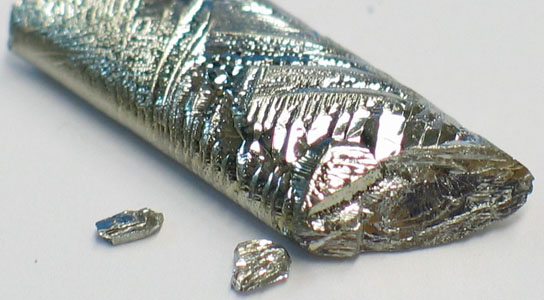
Now a team of researchers from institutions including MIT has detected the element tellurium for the first time in three ancient stars. The researchers found traces of this brittle, semiconducting element — which is very rare on Earth — in stars that are nearly 12 billion years old. The finding supports the theory that tellurium, along with even heavier elements in the periodic table, likely originated from a very rare type of supernova during a rapid process of nuclear fusion. The researchers published their findings online in Astrophysical Journal Letters.
“We want to understand the evolution of tellurium — and by extension any other element — from the Big Bang to today,” says Anna Frebel, an assistant professor of astrophysics at MIT and a co-author on the paper. “Here on Earth, everything’s made from carbon and various other elements, and we want to understand how tellurium on Earth came about.”
‘In the halo of the Milky Way,’ a rare element found
The team analyzed the chemical composition of three bright stars located a few thousand light-years away, “in the halo of the Milky Way,” Frebel says. The researchers looked at data obtained from the Hubble Space Telescope’s spectrograph, an instrument that splits light from a star into a spectrum of wavelengths. If an element is present in a star, the atoms of that element absorb starlight at specific wavelengths; scientists can observe this absorption as dips in the spectrograph’s data.
Frebel and her colleagues detected dips in the ultraviolet region of the spectrum — at a wavelength that matched tellurium’s natural light absorption — providing evidence that the rare Earth element does indeed exist in space, and was likely created more than 12 billion years ago, at the time when all three stars formed.
The researchers also compared the abundance of tellurium to that of other heavy elements such as barium and strontium, finding that the ratio of elements was the same in all three stars. Frebel says the matching ratios support a theory of chemical-element synthesis: namely, that a rare type of supernova may have created the heavier elements in the bottom half of the periodic table, including tellurium.
No ordinary supernova
According to theoretical predictions, elements heavier than iron may have formed as part of the collapsing core of a supernova, when atomic nuclei collided with huge amounts of neutrons in a nuclear fusion process. For 50 years, astronomers and nuclear physicists have modeled this rapid process, named the r-process, in order to unravel the cosmic history of the elements.
Frebel’s team found that the ratios of heavy elements observed in the three stars matched the ratios predicted by these theoretical models. The findings, she says, confirm the theory that heavier elements likely formed from a rare, extremely rapid supernova.
“You can make iron and nickel in any ordinary supernova, anywhere in the universe,” Frebel says. “But these heavy elements seem to only be made in specialized supernovas. Adding more elements to the observed elemental patterns will help us understand the astrophysical and environmental conditions needed for this process to operate.”
Jennifer Johnson, an associate professor of astronomy at Ohio State University, says tellurium has been a “tough” element to detect, since it absorbs light in the ultraviolet spectrum, which is impossible for ground-based telescopes to spot. The team’s findings, she says, are a first step in identifying some of the most elusive elements in the universe.
“If you look at the periodic table, tellurium is right in the middle of these elements that are hard for us to measure,” Johnson says. “If we need to understand how [the r-process] works in the universe, we really have to measure this part of the periodic table. It’s really cool that they got this element in this sea of unknown-ness.”
Frebel is continuing the search for heavy elements in space. For example, selenium — which is similar to tellurium — has yet to be detected in the universe. Tin, Frebel says, is also a difficult element to spot, as are many elements along the same row as tellurium in the periodic table.
“There are still quite a few holes,” Frebel says. “Every now and then, we can add an element, and it adds another data point that makes our work easier.”
Reference: “Detection of the Second R-Process Peak Element Tellurium in Metal-Poor Stars” by Ian U. Roederer, James E. Lawler, John J. Cowan, Timothy C. Beers, Anna Frebel, Inese I. Ivans, Hendrik Schatz, Jennifer S. Sobeck and Christopher Sneden, 9 February 2012, Astrophysical Journal Letters.
DOI: 10.1088/2041-8205/747/1/L8
Never miss a breakthrough: Join the SciTechDaily newsletter.
Follow us on Google and Google News.