
Close Menu
    Facebook X (Twitter) Instagram
    SciTechDaily
    • Biology
    • Chemistry
    • Earth
    • Health
    • Physics
    • Science
    • Space
    • Technology
    Facebook X (Twitter) Pinterest YouTube RSS
    SciTechDaily
    Home»Space»Panoramic View of 30 Doradus – The Brightest Star-Forming Region in Our Galactic Neighborhood
    Space

    Panoramic View of 30 Doradus – The Brightest Star-Forming Region in Our Galactic Neighborhood

    By Hubble Space Telescope/ESA and NASAApril 17, 2012No Comments4 Mins Read
    Facebook Twitter Pinterest Telegram LinkedIn WhatsApp Email Reddit
    Share
    Facebook Twitter LinkedIn Pinterest Telegram Email Reddit
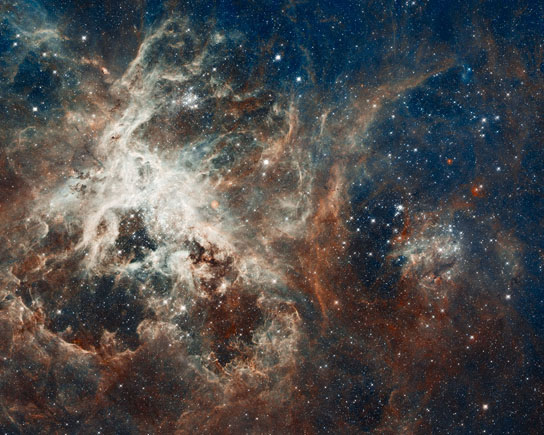
    Hubble Space Telescope image of a raucous stellar breeding ground in 30 Doradus
    Several million stars are vying for attention in this NASA/ESA Hubble Space Telescope image of a raucous stellar breeding ground in 30 Doradus, located in the heart of the Tarantula nebula. Credit: Hubble Space Telescope/ESA and NASA

    A new image of 30 Doradus was released by ESA and NASA to celebrate the Hubble Space Telescope’s 22nd anniversary. The panoramic image shows the heart of the Tarantula Nebula and is roughly 650 light-years across.

    30 Doradus is the brightest star-forming region in our galactic neighborhood and home to the most massive stars ever seen. The nebula resides 170,000 light-years away in the Large Magellanic Cloud, a small, satellite galaxy of our Milky Way. No known star-forming region in our galaxy is as large or as prolific as 30 Doradus.

    The image comprises one of the largest mosaics ever assembled from Hubble photos and consists of observations taken by Hubble’s Wide Field Camera 3 and Advanced Camera for Surveys, combined with observations from the European Southern Observatory’s MPG/ESO 2.2-meter telescope that trace the location of glowing hydrogen and oxygen.
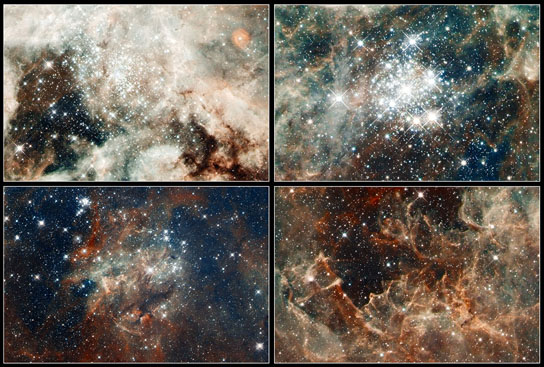
    Close-up images of features in the Tarantula Nebula
    Close-up images of features in the Tarantula Nebula. Credit: Hubble Space Telescope/ESA and NASA

    The image is being released to celebrate Hubble’s 22nd anniversary.

    The stars in this image add up to a total mass that is millions of times bigger than that of our Sun. The image is roughly 650 light-years across and contains some rambunctious stars, from one of the fastest rotating stars to the speediest and most massive runaway star.

    The nebula is close enough to Earth that Hubble can resolve individual stars, giving astronomers important information about the stars’ birth and evolution. Many small galaxies have more spectacular starbursts, but the Large Magellanic Cloud’s 30 Doradus is one of the only star-forming regions that astronomers can study in detail. The star-birthing frenzy in 30 Doradus may be partly fueled by its close proximity to its companion galaxy, the Small Magellanic Cloud.

    The image reveals the stages of star birth, from embryonic stars a few thousand years old still wrapped in dark cocoons of dust and gas to behemoths that die young in supernova explosions. 30 Doradus is a star-forming factory, churning out stars at a furious pace over millions of years. The Hubble image shows star clusters of various ages, from about 2 million to about 25 million years old.
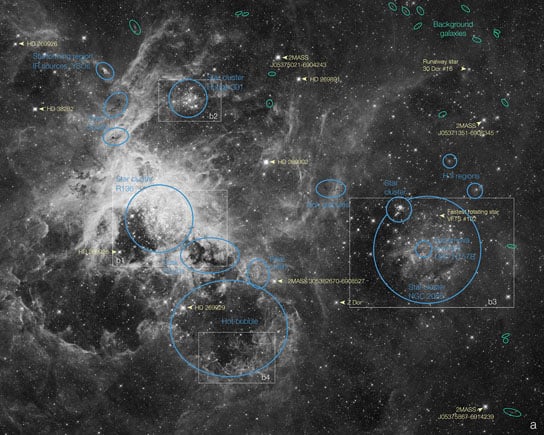
    Labelled view of the Tarantula Nebula
    Labeled view of the Tarantula Nebula. Credit: Hubble Space Telescope/ESA and NASA

    The region’s sparkling centerpiece is a giant, young star cluster named NGC 2070, only 2 million to 3 million years old. Its stellar inhabitants number roughly 500,000. The cluster is a hotbed for young, massive stars. Its dense core, known as RMC 136, is packed with some of the heftiest stars found in the nearby Universe, weighing more than 100 times the mass of our Sun.

    The massive stars are carving deep cavities in the surrounding material by unleashing a torrent of ultraviolet light, which is etching away the enveloping hydrogen gas cloud in which the stars were born. The image reveals a fantasy landscape of pillars, ridges, and valleys. Besides sculpting the gaseous terrain, the brilliant stars also may be triggering a successive generation of offspring.

    When the radiation hits dense walls of gas, it creates shocks, which may be generating a new wave of star birth.

    The colors come from the glowing hot gas that dominates regions of the image. Red signifies hydrogen gas and blue, oxygen.

    The image was made from 30 separate fields, 15 from each camera. Hubble made the observations in October 2011. Both cameras were making observations at the same time.

    Never miss a breakthrough: Join the SciTechDaily newsletter.
    Follow us on Google and Google News.

    European Space Agency Hubble Space Telescope NASA Nebula Stars
    Share. Facebook Twitter Pinterest LinkedIn Email Reddit

    Related Articles

    Hubble’s “Jellyfish” Portrait of Star’s Gaseous Glow

    Hubble Views a Giant, Smoldering Star

    Astronomers Find Bizarre Alignment of Planetary Nebulae in the Milky Way

    Hubble Views Planetary Nebula IC 289

    Hubble Views Planetary Nebula NGC 7026

    Hubble Captures New Image of Messier 9

    New Images of Orion Nebula Show Young Stars Hidden in Gas and Dust Clouds

    Researchers Discover First Intermediate-Mass Black Hole

    ESA’s Hershel Space Telescope Captures Incredible Views of Eagle Nebula

    Leave A Reply Cancel Reply

    • Facebook
    • Twitter
    • Pinterest
    • YouTube

    Don't Miss a Discovery

    Subscribe for the Latest in Science & Tech!

    Trending News

    Collapsing Plasma May Hold the Key to Cosmic Magnetism

    This Breakthrough Solar Panel Generates Power From Both Sunlight and Raindrops

    Scientists Uncover New Metabolic Effects Beyond Weight Loss of Mounjaro

    Scientists Discover Cancer Tumors Are “Addicted” to This Common Antioxidant

    1,800 Miles Down: Scientists Uncover Mysterious Movements at the Edge of Earth’s Core

    Scientists Discover Hidden “Good Fats” in Green Rice That Could Transform Nutrition

    Your Child’s Clothes Could Contain Toxic Lead, Study Finds

    Researchers Break a 150-Year-Old Math Law With a Surprising Donut Discovery

    Follow SciTechDaily
    • Facebook
    • Twitter
    • YouTube
    • Pinterest
    • Newsletter
    • RSS
    SciTech News
    • Biology News
    • Chemistry News
    • Earth News
    • Health News
    • Physics News
    • Science News
    • Space News
    • Technology News
    Recent Posts
    • Researchers Say That Eating Mango With Avocado Offers Surprising Heart Benefits
    • Are You Drinking Plastic? Study Raises Concerns About Bottled Water
    • Quantum Batteries Edge Closer to Reality With New Breakthrough
    • AI Is Rewriting History – With Outdated Neanderthal Facts
    • Physicists Observe Matter in Two Places at Once in Mind-Bending Quantum Experiment
    Copyright © 1998 - 2026 SciTechDaily. All Rights Reserved.
    • Science News
    • About
    • Contact
    • Editorial Board
    • Privacy Policy
    • Terms of Use

    Type above and press Enter to search. Press Esc to cancel.