
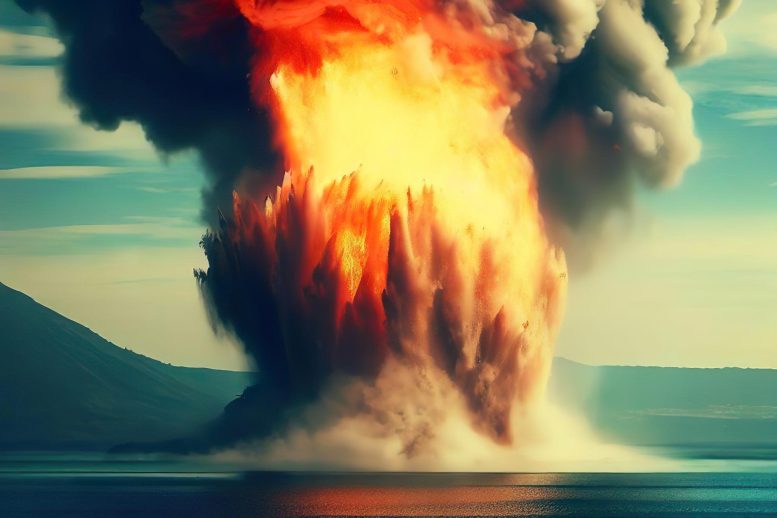
According to new research, the Campi Flegrei supervolcano in southern Italy has become weaker, making it more likely to erupt. Using a unique model to interpret patterns of earthquakes and ground uplift, the study found parts of the volcano have been stretched nearly to the breaking point. However, an eruption is not guaranteed, and more research is necessary for accurate predictions.
The Campi Flegrei volcano in southern Italy has become weaker and more prone to rupturing, making an eruption more likely, according to a new study by researchers at UCL (University College London) and Italy’s National Research Institute for Geophysics and Volcanology (INGV).
The volcano, which last erupted in 1538, has been restless for more than 70 years, with two-year spikes of unrest in the 1950s, 1970s, and 1980s, and a slower phase of unrest over the last decade. Tens of thousands of small earthquakes have occurred during these periods and the coastal town of Pozzuoli has been lifted by nearly 4 m (13 ft), roughly the height of a double-decker bus.
Understanding Volcano Fracturing with New Models
The new study, published today (June 9) in Nature’s Communications Earth & Environment journal, used a model of volcano fracturing, developed at UCL, to interpret the patterns of earthquakes and ground uplift, and concluded that parts of the volcano had been stretched nearly to breaking point.
Campi Flegrei, also known as the Phlegraean Fields, is a large volcanic area situated to the west of Naples, Italy. It’s considered a supervolcano due to the nature and history of its eruptions and its large caldera system. This caldera was formed 39,000 years ago in an eruption that was one of the largest in the history of Europe. Its eruption ejected so much material that it led to a volcanic winter, drastically affecting life across the planet.
Lead author Professor Christopher Kilburn (UCL Earth Sciences) said: “Our new study confirms that Campi Flegrei is moving closer to rupture. However, this does not mean an eruption is guaranteed. The rupture may open a crack through the crust, but the magma still needs to be pushing up at the right location for an eruption to occur.
“This is the first time we have applied our model, which is based on the physics of how rocks break, in real-time to any volcano.
“Our first use of the model was in 2017 and since then Campi Flegrei has behaved as we predicted, with an increasing number of small earthquakes indicating pressure from below.
“We will now have to adjust our procedures for estimating the chances of new routes being opened for magma or gas to reach the surface.
“The study is the first of its kind to forecast rupture at an active volcano. It marks a step change in our goal to improve forecasts of eruptions worldwide.”
Dr. Nicola Alessandro Pino from the Vesuvius Observatory, which represents the INGV in Naples, said: “Our results show that parts of the volcano are becoming weaker. This means that it might break even though the stresses pulling it apart are smaller than they were during the last crisis 40 years ago.”
A supervolcano refers to a volcano that has had an eruption of magnitude 8 on the Volcano Explosivity Index (VEI), meaning that it’s capable of erupting more than 1,000 cubic kilometers (240 cubic miles) of material. Supervolcanoes can produce devastation on a nearly unimaginable scale, and such eruptions could result in severe changes in the global climate.
Campi Flegrei is the closest active volcano to London. It is not an obvious volcano because, instead of growing into a traditional mountain, it has the shape of a gentle depression 12-14 km (7.5-8.5 miles) across (and thus is known as a caldera). This explains why 360,000 people now live on its roof.
For the past decade, the ground below Pozzuoli has been creeping upwards at about 10 cm (4 in) a year. Persistent small earthquakes have also been registered for the first time since the mid-1980s. More than 600 were recorded in April, the largest monthly number so far.
The disturbance has been caused by the movement of fluids about 3 km (2 miles) beneath the surface. Some of the fluids may be molten rock, or magma, and some may be natural volcanic gas. The latest phase of unrest appears likely to be caused by magmatic gas that is seeping into gaps in the rock, filling the 3 km-thick crust like a sponge.
The earthquakes occur when faults (cracks) slip due to the stretching of the crust. The pattern of earthquakes from 2020 suggests the rock is responding in an inelastic way, by breaking rather than bending.
Dr. Stefania Danesi from INGV Bologna said: “We cannot see what is happening underground. Instead, we have to decipher the clues the volcano gives us, such as earthquakes and uplift of the ground.”
Lessons from Global Supervolcanoes
In their paper, the team explained that the effect of the unrest since the 1950s is cumulative, meaning an eventual eruption could be preceded by relatively weak signals such as a smaller rate of ground uplift and fewer earthquakes. This was the case for the eruption of the Rabaul caldera in Papua New Guinea in 1994, which was preceded by small earthquakes occurring at a tenth of the rate than had occurred during a crisis a decade earlier.
Campi Flegrei’s current tensile strength (the maximum stress a material can bear before breaking when it is stretched) is likely to be about a third of what it was in 1984, the researchers said.
The team emphasized that an eruption was not inevitable. Dr. Stefano Carlino from the Vesuvius Observatory explained: “It’s the same for all volcanoes that have been quiet for generations. Campi Flegrei may settle into a new routine of gently rising and subsiding, as seen at similar volcanoes around the world, or simply return to rest. We can’t yet say for sure what will happen. The important point is to be prepared for all outcomes.”
Professor Kilburn and colleagues will now apply the UCL model of volcano fracturing to other volcanoes that have reawakened after a long period of time, seeking to establish more reliable criteria for deciding if an eruption is likely. Currently, eruptions are forecast using statistical data unique to each volcano, rather than drawing on fundamental principles that can be applied to multiple volcanoes.
Reference: “Potential for rupture before eruption at Campi Flegrei caldera, Southern Italy” by Christopher R. J. Kilburn, Stefano Carlino, Stefania Danesi and Nicola Alessandro Pino, 9 June 2023, Communications Earth & Environment.
DOI: 10.1038/s43247-023-00842-1
Never miss a breakthrough: Join the SciTechDaily newsletter.
Follow us on Google and Google News.
3 Comments
“For the past decade, the ground below Pozzuoli has been creeping upwards at about 10 cm (4 in) a year.”
Compare that to the less than 0.3 cm rise in sea level that people are excited about.
Indeed, except the sea level is an average over the whole globe while the Pozzuoli uplift is across atens if kilometers at most. Both are significant and both have the potential of catastrophic events.
“Last erupted in the year 1538 and has been restless for almost 70 years”
Say what???
2023-1538 = ????
Ya jokin???