
Close Menu
    Facebook X (Twitter) Instagram
    SciTechDaily
    • Biology
    • Chemistry
    • Earth
    • Health
    • Physics
    • Science
    • Space
    • Technology
    Facebook X (Twitter) Pinterest YouTube RSS
    SciTechDaily
    Home»Space»Hubble Captures Image of a Carbon Star
    Space

    Hubble Captures Image of a Carbon Star

    By NASAJuly 6, 20125 Comments2 Mins Read
    Facebook Twitter Pinterest Telegram LinkedIn WhatsApp Email Reddit
    Share
    Facebook Twitter LinkedIn Pinterest Telegram Email Reddit
    Bright Star U Camelopardalis Surrounded by Shell of Gas
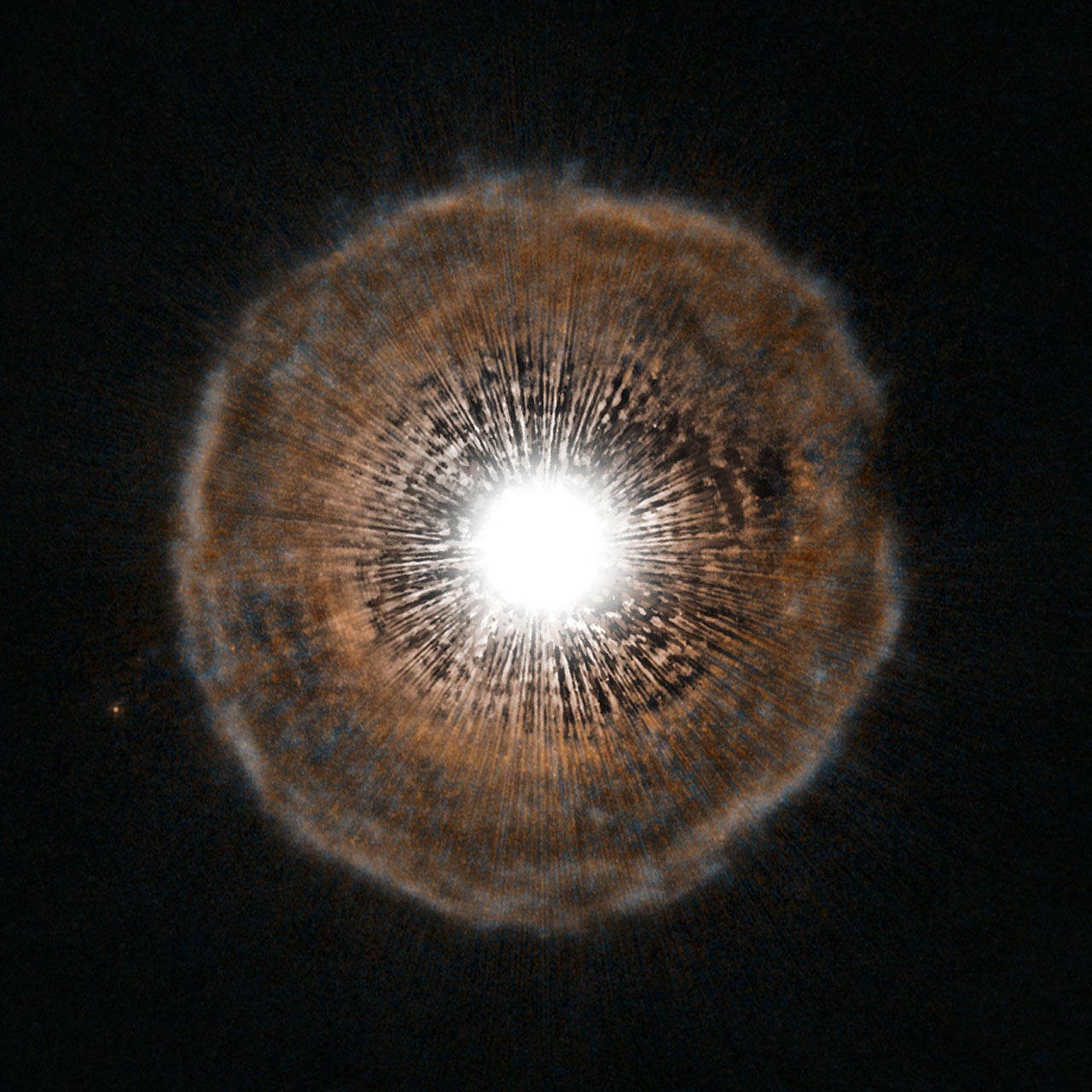
    Hubble Space Telescope image of U Camelopardalis, or U Cam for short, a star nearing the end of its life. Credit: ESA/NASA

    NASA’s Hubble Space Telescope captured an image of U Cam coughing out a spherical shell of gas as a layer of helium around its core began to fuse.

    Camelopardalis, or U Cam for short, is a star nearing the end of its life. As stars run low on fuel, they become unstable. Every few thousand years, U Cam coughs out a nearly spherical shell of gas as a layer of helium around its core begins to fuse. The gas ejected in the star’s latest eruption is clearly visible in this picture as a faint bubble of gas surrounding the star.

    U Cam is an example of a carbon star, a rare type of star with an atmosphere that contains more carbon than oxygen. Due to its low surface gravity, typically as much as half of the total mass of a carbon star may be lost by way of powerful stellar winds. Located in the constellation of Camelopardalis (The Giraffe), near the North Celestial Pole, U Cam itself is much smaller than it appears in this Hubble image. In fact, the star would easily fit within a single pixel at the center of the image. Its brightness, however, is enough to saturate the camera’s receptors, making the star look much larger than it is.

    The shell of gas, which is both much larger and much fainter than its parent star, is visible in intricate detail in Hubble’s portrait. This phenomenon is often quite irregular and unstable, but the shell of gas expelled from U Cam is almost perfectly spherical.

    Never miss a breakthrough: Join the SciTechDaily newsletter.
    Follow us on Google and Google News.

    Hubble Space Telescope NASA Stars
    Share. Facebook Twitter Pinterest LinkedIn Email Reddit

    Related Articles

    Hubble Confirms HD 140283 As the Oldest Known Star

    NASA Data Reveals Significant Changes in Exoplanet’s Atmosphere

    Hubble Views Planetary Nebula NGC 7026

    Looking Inside a Stellar Cloud

    Panoramic View of 30 Doradus – The Brightest Star-Forming Region in Our Galactic Neighborhood

    Hubble Captures New Image of Messier 9

    Stars of the Antlia Dwarf Galaxy

    Researchers Discover First Intermediate-Mass Black Hole

    Hubble Observes Rare Blue Stars in Andromeda’s Core

    5 Comments

    1. The science and techno world on July 6, 2012 6:05 pm

      More information:
      U Cam is a red giant, a star that was once like the Sun but has gone much further along its evolutionary path. Our Sun is fusing hydrogen steadily into helium in its core, providing warmth and light for us. U Cam ran out of hydrogen in its core long ago, and began fusing helium into carbon. Then it even ran out of helium as a fuel! The core is now essentially an extremely hot ball of carbon, squeezed by pressure to within an inch of its life. There’s still helium outside the core, and gets so much heat from the core’s radiation that it’s fusing in a thin shell. Think of it like a very hot skin around an orange.

      Reply
      • Uncle Demotivator on July 8, 2012 11:49 am

        Nice explanation – it should be added into article.

        Reply
      • eddy on July 8, 2012 4:48 pm

        Does that mean that there are Giant Diamonds being created in the hearts of these carbon stars, that Barack Obama and the Far Right are secretly conspiring to keep from us?

        Reply
    2. Madanagopal.V.C. on September 8, 2012 8:52 am

      We should remember that neptune is considered to be a carbon failed star in as much as it is a gas giant like Jupiter, Saturn, Uranus etc. Neptune is considered to be holding diamonds under great pressure of the planet`s atmosphere. U cam also seems to be such a failing star to throw out carbon from its core. As far as fusion is concerned atomic numbers 1, 2, 4, 6, 8, 10, 12, 14, 16, 18, 20, in arithmetic progression of nucleon combination represents Hydrogen, Helium, Beryllium, Carbon, Oxygen, Neon, Magnesium, Silicon, Argon, Calcium etc which are abundantly formed in the fusion core of the star excepting inert gases and Beryllium. Other combinations are less abundant. Hence spewing up of Carbon is no surprise. Next to follow in abundance are Nitrogen, Flourine, Phosphorous, Chlorine etc being the preceding and succeeding atomic numbers. Nasa`s photos are commendable. Thank you.

      Reply
    3. DaveS on April 11, 2014 10:36 am

      This picture looks almost exactly like the view down the throat of the Doomsday Machine from “Star Trek.”

      Reply
    Leave A Reply Cancel Reply

    • Facebook
    • Twitter
    • Pinterest
    • YouTube

    Don't Miss a Discovery

    Subscribe for the Latest in Science & Tech!

    Trending News

    The Strange “Spacetime Crystal” That Can Suddenly Turn Into a Black Hole

    The Surprising Way Asteroids May Have Helped Life Begin on Earth

    Vast Hidden Structure Discovered Under Miles of Ice in East Antarctica

    A Surprising Discovery Suggests Autism Is Not One Condition

    New Alzheimer’s Discovery Could Change How Scientists Fight the Disease

    Yale Discovery Overturns Long-Held “Evolutionary Dead End” Theory

    UCLA Scientists Uncover a “Hidden Weakness” in Some of the World’s Deadliest Cancers

    Humpback Whale Stuns Scientists With 15,000 Kilometer Journey Across Oceans

    Follow SciTechDaily
    • Facebook
    • Twitter
    • YouTube
    • Pinterest
    • Newsletter
    • RSS
    SciTech News
    • Biology News
    • Chemistry News
    • Earth News
    • Health News
    • Physics News
    • Science News
    • Space News
    • Technology News
    Recent Posts
    • Food Waste Becomes a Powerful Carbon Trap in Climate Breakthrough
    • Battery-Free Artificial Photosynthesis Turns Sunlight, Water, and CO2 Into Fuel
    • How Ancient People Moved a 6-Ton Stone 700 Kilometers to Stonehenge
    • Scientists Finally See How Antibodies Really Attack Viruses
    • The Unexpected Gut Health Risk of Cutting Out Sugar
    Copyright © 1998 - 2026 SciTechDaily. All Rights Reserved.
    • Science News
    • About
    • Contact
    • Editorial Board
    • Privacy Policy
    • Terms of Use

    Type above and press Enter to search. Press Esc to cancel.