
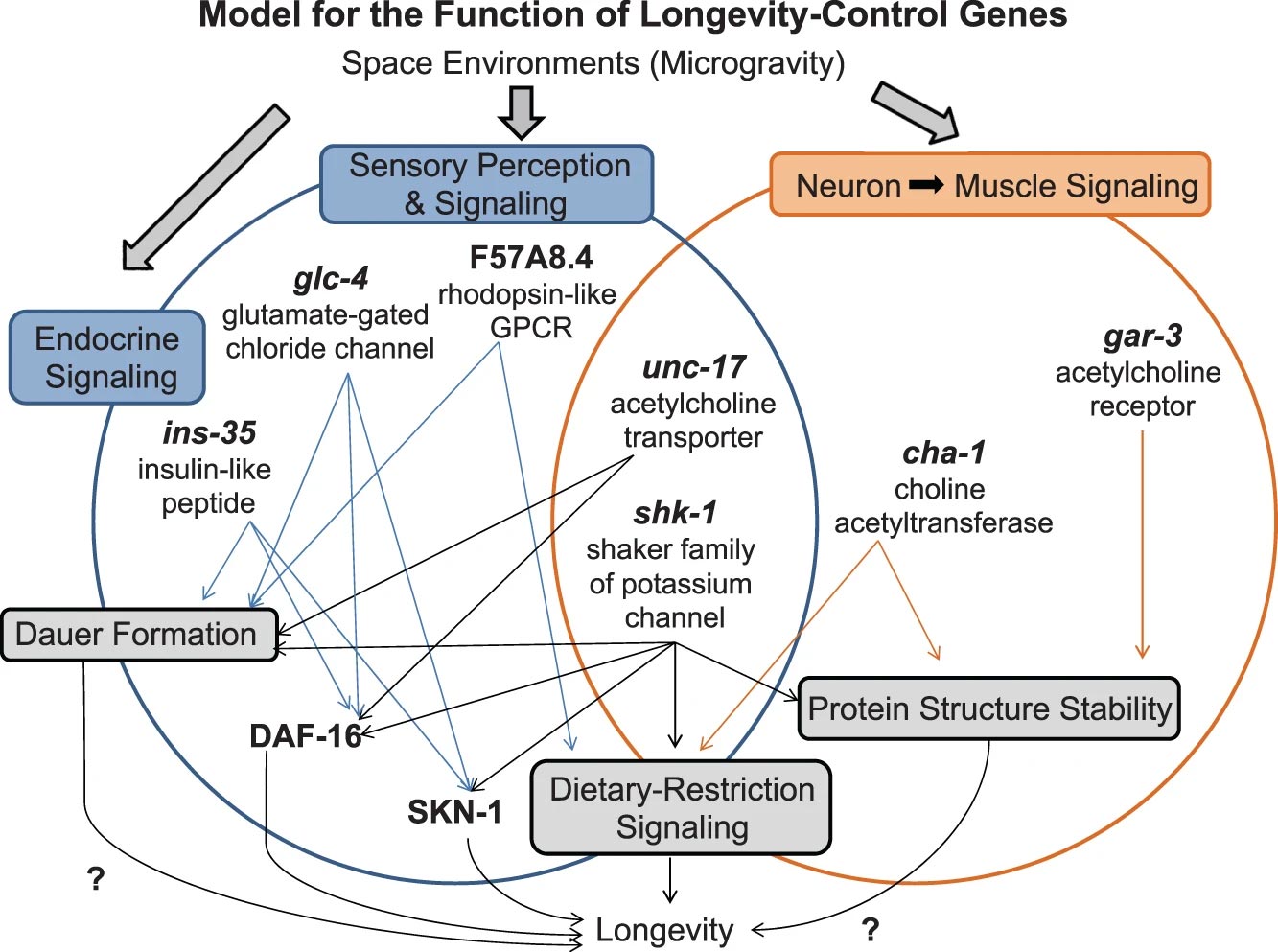
A team of scientists discovered that spaceflight suppressed the accumulation of toxic proteins and a group of genes, which when lowered in worms back on Earth, extended their lifespan under laboratory conditions.
The effect of spaceflight on a microscopic worm — Caenorhabditis elegans (C. elegans) — could help it to live longer.
The discovery was made by an international group of scientists studying the loss of bone and muscle mass experienced by astronauts after extended flights in space. The results of this research have been published today, July 5, 2012, in the online journal Scientific Reports.
Dr. Nathaniel Szewczyk, from The University of Nottingham, was part of the ICE-FIRST project which involved scientists from Japan, France, the US, and Canada. They discovered that spaceflight suppressed accumulation of toxic proteins that normally accumulate within aging muscle. They also discovered a group of genes that are expressed at lower levels during spaceflight. When the expression of these same genes were lowered in worms back on Earth the worms lived longer.
Dr. Szewczyk, an expert in muscle metabolism, said: “We identified seven genes, which were down-regulated in space and whose inactivation extended lifespan under laboratory conditions.”
How do these genes play a role in longevity control?
“We are not entirely certain, but it would appear that these genes are involved in how the worm senses the environment and signals changes in metabolism in order to adapt to the environment. For example, one of the genes we have identified encodes insulin which, because of diabetes, is well known to be associated with metabolic control. In worms, flies, and mice insulin is also associated with modulation of lifespan.”
What could this mean for space travelers?
“Well, most of us know that muscle tends to shrink in space. These latest results suggest that this is almost certainly an adaptive response rather than a pathological one. Counter-intuitively, muscle in space may age better than on Earth. It may also be that spaceflight slows the process of aging.”
Dr. Szewczyk’s role was to provide expertise in the culturing of worms in CeMM — a special liquid food for worms. Dr. Szewczyk transported the samples to and from the Russian launch site and ran a series of ‘health’ checks to ensure that the tiny astronauts were fit for flying. On their return, he helped with the analysis of the data.
Nottingham’s space biology lab
Dr. Szewczyk studies the signals that control muscle protein degradation in the human body. C. elegans is the perfect substitute for studying long-term changes in human physiology because they suffer from muscle atrophy — muscle loss — under many of the same conditions that people do.
C. elegans was the first multi-cellular organism to have its genetic structure completely mapped and many of its 20,000 genes perform the same functions as those in humans. Two thousand of these genes have a role in promoting muscle function and 50 to 60 percent of these have very obvious human counterparts.
When the research began Dr Szewczyk was working at NASA. He is now based at The University of Nottingham’s MRC and Arthritis Research UK Center for Musculoskeletal Aging Research. He is one of the leading scientists studying ‘worms in space’ and his lab is currently the most productive ‘space biology’ lab in the UK.
The experiment in 2004 involved a consignment of live worms being dispatched to the International Space Station (ISS) onboard the Dutch DELTA mission.
He uses worms that originate from a rubbish dump in Bristol. C. elegans often feed on decaying fruit and vegetable matter.
They have since taken part in five spaceflights to the ISS with the aim of learning more about the effect of microgravity on the physiology of the human body.
Notably, in 2003 Dr. Szewczyk’s C. elegans made the news when they survived the Space Shuttle Columbia disaster. Living in petri dishes and enclosed in aluminum canisters the worms survived re-entry and impact on the ground and were recovered weeks after the disaster.
This spaceflight work teaches us things about the body that we couldn’t learn on Earth. They have led to the publication of research into how to block muscle degradation using a form of gene therapy in PLoS ONE and publication of a muscle repair mechanism in PLoS Genetics. The work on C. elegans has also established that worms can live and reproduce for at least six months in space. This makes it an ideal and cost-effective experimental system to investigate the effects of long-duration and distance space exploration as recently reported in Interface, a journal of The Royal Society. Together these missions have established that the team is not only better able to understand how muscle works on Earth but they are also in a position to send worms to other planets and experiment on them along the way.
Astronaut now being studied
Another member of the Center team is currently examining the effects of spaceflight upon the muscles of the current European record holder for time spent in space.
Andre Kuipers, the Dutch astronaut who flew the mission in 2004, has just returned from ISS with yet another worm experiment from space for the team at Nottingham and is also, himself, being studied.
That experiment, led by Professor Marco Narici, is to study the effects of long-duration spaceflight on human muscle.
Reference: “Genes down-regulated in spaceflight are involved in the control of longevity in Caenorhabditis elegans” by Yoko Honda, Akira Higashibata, Yohei Matsunaga, Yukiko Yonezawa, Tsuyoshi Kawano, Atsushi Higashitani, Kana Kuriyama, Toru Shimazu, Masashi Tanaka, Nathaniel J. Szewczyk, Noriaki Ishioka and Shuji Honda, 5 July 2012, Scientific Reports.
DOI: 10.1038/srep00487
Never miss a breakthrough: Join the SciTechDaily newsletter.
Follow us on Google and Google News.