

A tiny chip that produces a precisely organized “rainbow” of light could help enable faster, higher-capacity 6G communications and more precise timing for quantum technologies.
A microchip about the size of a grain of rice can generate a carefully ordered spectrum of light and convert it into multiple high-frequency electromagnetic signals called millimeter waves. Physicists at Loughborough University and their international collaborators say the approach could eventually support technologies that require large amounts of bandwidth and exceptionally precise signals.
Millimeter waves are especially attractive for future communications because they provide far more bandwidth, effectively creating additional capacity for transmitting data. The challenge has been producing these frequencies with the precision and stability required for advanced systems.
“The world is becoming increasingly data hungry. We want to send and receive more information, faster and in higher resolution, and millimeter waves could help provide the capacity to do that,” said Dr. Luke Peters, of Loughborough University’s Emergent Photonics Research Center.
“They could ultimately contribute to faster, higher capacity 6G networks, but the potential goes far beyond communications. These frequencies could also be used in radar systems as well as spectroscopy and astronomical instruments, helping scientists study materials and make extremely precise measurements of the universe.
“These applications are still some way off, and there are challenges to overcome before the technology can be used in real-world systems – but our latest work has tackled a major one.”
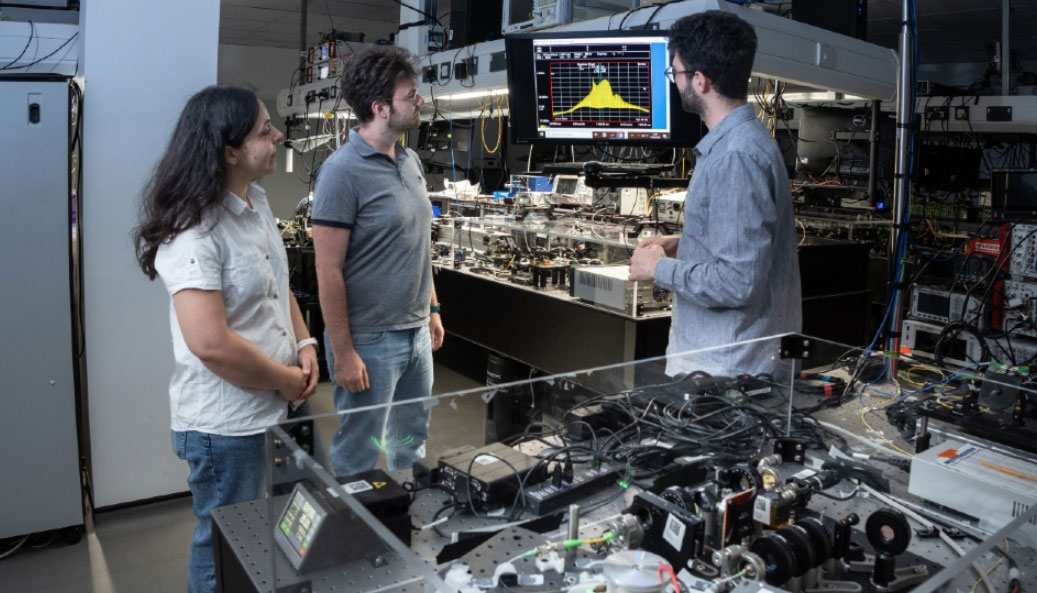
One chip generates many precise signals
The researchers produced the millimeter waves using a microcomb, a precisely arranged set of light frequencies that resembles the colors of a rainbow but lies outside what the human eye can see. A specialized antenna can then convert those optical frequencies into millimeter waves.
Earlier work showed that microcombs could produce one precise millimeter wave frequency. Generating many frequencies simultaneously could provide several channels for transmitting data at the same time, but achieving that requires a microcomb with unusually high stability and clarity.
In a paper published in Nature Communications, the Loughborough-led researchers demonstrated a system capable of producing that type of stable, high-quality microcomb. Its optical frequencies could then be converted into several precisely spaced millimeter-wave frequencies simultaneously.
The difference lies in how the microcomb is generated. Conventional systems typically direct laser light into a microresonator, a tiny structure fabricated on a chip that traps the light and allows it to circulate.

The Loughborough system combines this chip-based microresonator with a much larger loop of optical fiber. Laser light repeatedly travels through both components, helping the desired optical states develop and remain stable.
“We’ve essentially created an incredibly precise and stable ‘rainbow on a chip,’ where the loop keeps feeding the light back through the chip, allowing these states to build up efficiently, start on their own and remain stable even when the system is disturbed,” said Dr. Peters.
“It’s remarkably robust too. We’ve even had people jumping up and down next to the system, and the microcomb remains stable.”
Millimeter waves retain the original precision
The researchers also showed that individual frequencies within the microcomb “rainbow” could be adjusted, allowing some to be strengthened while others were weakened. Importantly, the precision and stability of the optical microcomb remained intact after the frequencies were converted into millimeter wave signals.
“Being able to make individual frequencies stronger or weaker gives us much more control over the signals we produce, because different applications will need different combinations of frequencies,” said Dr. Peters.
“Just as importantly, we’ve shown that the precision of the microcomb carries through to the millimeter waves. That gives us a whole set of highly controlled signals, which is exactly what you need for applications where accuracy and stability matter.
“That same level of precision is valuable for timing. Precision timing sits at the core of emerging quantum technologies, where extreme accuracy is a requirement.”
The researchers are now investigating how the technology could move beyond laboratory experiments.
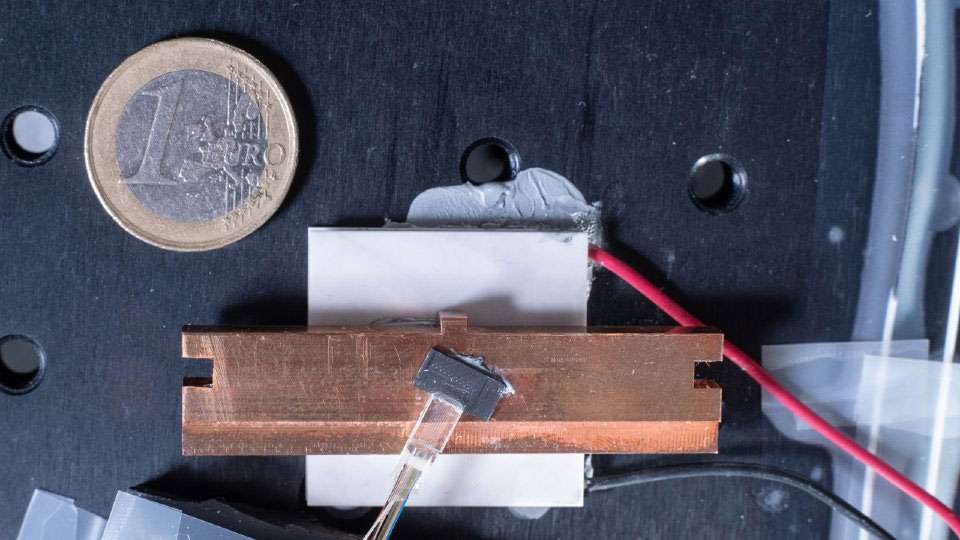
Although the central microchip is only about the size of a grain of rice, the complete apparatus currently occupies a tabletop. Future versions could use less energy and take up considerably less space, potentially reducing the entire system to roughly the size of a shoebox.
One possibility the researchers want to investigate is placing the technology on satellites, where minimizing size, weight, and power consumption is particularly important.
The next challenge is shrinking the system
The researchers are also testing the limits of the microcomb’s accuracy. Through collaborations with the National Physical Laboratory, they are comparing the system with precision clocks and investigating possible uses in timing, navigation, and positioning. The work also contributes to efforts involving the National Physical Laboratory and the UK Hub for Quantum Enabled Position, Navigation, and Timing (QEPNT).
“We’re really excited to see how far we can take the precision and stability of these microcombs, particularly for technologies that rely on extremely accurate timing,” said Dr. Antonio Cutrona, who led the microcomb stability measurements.
“We hope this study and our system open up new ways of bringing the extraordinary precision of atomic clocks into more compact technologies for timing, navigation, and position, and it is particularly exciting to explore these possibilities through our wider collaborations with the National Physical Laboratory and the UK Hub for Quantum Enabled Position, Navigation, and Timing.”
Reference: “Millimetre-wave comb generated by an optical microcomb” by L. Peters, A. Cutrona, A. R. Cooper, L. Olivieri, F. Getman, V. Cecconi, N. Paul, D. Das, M. Rowley, S. T. Chu, B. E. Little, R. Morandotti, D. J. Moss, J. S. Totero Gongora, A. Pasquazi and M. Peccianti, 20 August 2026, Nature Communications.
DOI: 10.1038/s41467-026-76747-2
This project received funding from the European Research Council (ERC) under the European Union’s Horizon 2020 Research and Innovation Programme Grant No. 725046.
Never miss a breakthrough: Join the SciTechDaily newsletter.
Follow us on Google and Google News.
5 Comments
So it’s horribly inefficient? Heat spreader + Peltier cooler making the “grain of rice” chip quite the cube.
May be they need just a temperature stability, not a heatsink?
Possible….. the Peltier might need the heatsink more than the chip.
The color spectrum is one octave wide – and slow. (that’s the hint)
Across aerospace, thermal dynamics, power electronics, photonics, and computing architecture, these six discoveries demonstrate a single universal principle: peak energy efficiency is achieved by replacing rigid boundary resistance with organized, low-drag micro-geometry.
Mainstream engineering consistently hits operational limits when forcing energy through static, non-aligned materials:
Aircraft waste massive fuel fighting turbulent boundary-layer drag.
Power electronics breakdown when forced into mismatched crystal structures.
Computing platforms burn thousands of times more energy simply shuffling data across physical transport gaps between memory and processing units.
Each breakthrough overcomes a historic efficiency barrier by aligning system mechanics with natural, low-resistance pathways:
Aerospace & Thermal Flow: Micro-vibrations on aircraft wings and nanoscale polymer nucleation sites on heat exchangers replace chaotic, static turbulence with synchronized, low-impedance transport.
Semiconductor & Memory Architecture: In-memory computing arrays and SiC bottom-gate JFETs eliminate transport distance and lattice mismatch, operating directly within native physical structures.
Photonics & Material Science: Frequency combs and relaxor ferroelectrics replace brute-force resistance with continuous, parallel energy distribution.
Whether managing airflow over a wing, thermal transport across a copper surface, or data flow through a silicon chip, the path to next-generation performance relies on organizing micro-scale geometry to eliminate systemic drag.