
Close Menu
    Facebook X (Twitter) Instagram
    SciTechDaily
    • Biology
    • Chemistry
    • Earth
    • Health
    • Physics
    • Science
    • Space
    • Technology
    Facebook X (Twitter) Pinterest YouTube RSS
    SciTechDaily
    Home»Technology»Using Air to Amplify Light in Hollow-Core Optical Fibers
    Technology

    Using Air to Amplify Light in Hollow-Core Optical Fibers

    By EPFLAugust 13, 2020No Comments3 Mins Read
    Facebook Twitter Pinterest Telegram LinkedIn WhatsApp Email Reddit
    Share
    Facebook Twitter LinkedIn Pinterest Telegram Email Reddit
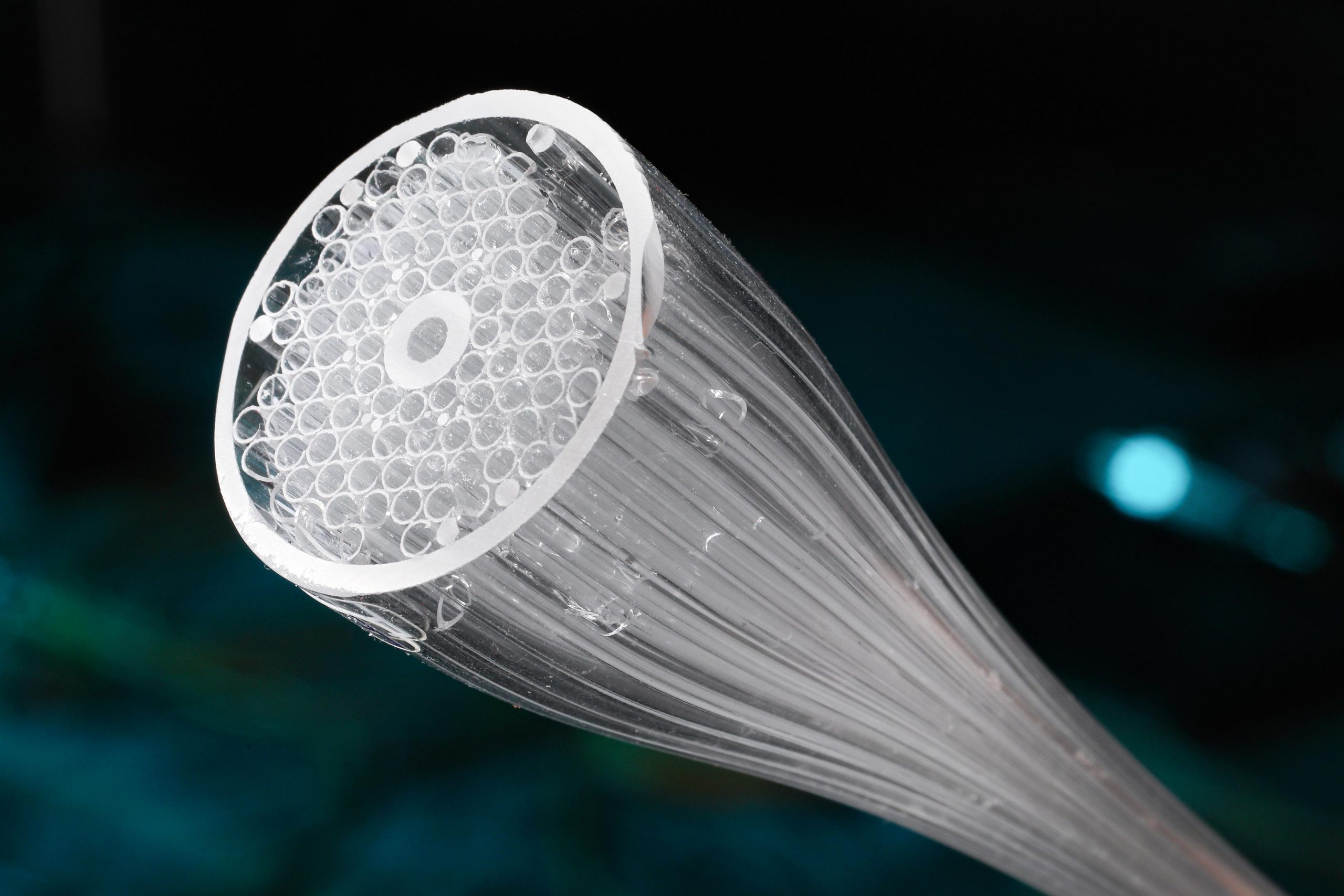
    Air Light Hollow Core Optical Fibers
    New hollow-core optical fibers that are filled with either air or gas. Credit: Alain Herzog/2020 EPFL

    “The idea had been going around my head for about 15 years, but I never had the time or the resources to do anything about it.” But now Luc Thévenaz, the head of the Fiber Optics Group in EPFL’s School of Engineering, has finally made it happen: his lab has developed a technology to amplify light inside the latest hollow-core optical fibers.

    Squaring the circle

    Today’s optical fibers usually have a solid glass core, so there’s no air inside. Light can travel along the fibers but loses half of its intensity after 15 kilometers (9 miles). It keeps weakening until it can hardly be detected at 300 kilometers (180 miles). So to keep the light moving, it has to be amplified at regular intervals.

    Thévenaz’s approach is based on new hollow-core optical fibers that are filled with either air or gas. “The air means there’s less attenuation, so the light can travel over a longer distance. That’s a real advantage,” says the professor. But in a thin substance like air, the light is harder to amplify. “That’s the crux of the problem: light travels faster when there’s less resistance, but at the same time it’s harder to act on. Luckily, our discovery has squared that circle.”

    From infrared to ultraviolet

    So what did the researchers do? “We just added pressure to the air in the fiber to give us some controlled resistance,” explains Fan Yang, postdoctoral student. “It works in a similar way to optical tweezers — the air molecules are compressed and form into regularly spaced clusters. This creates a sound wave that increases in amplitude and effectively diffracts the light from a powerful source towards the weakened beam so that it is amplified up to 100,000 times.” Their technique therefore makes the light considerably more powerful. “Our technology can be applied to any type of light, from infrared to ultraviolet, and to any gas,” he explains. Their findings have just been published in Nature Photonics.

    An extremely accurate thermometer

    Going forward, the technology could serve other purposes in addition to light amplification. Hollow-core or compressed-gas optical fibers could, for instance, be used to make extremely accurate thermometers. “We’ll be able to measure temperature distribution at any point along the fiber. So if a fire starts along a tunnel, we’ll know exactly where it began based on the increased temperature at a given point,” says Flavien Gyger, Ph.D. student. The technology could also be used to create a temporary optical memory by stopping the light in the fiber for a microsecond — that’s ten times longer than is currently possible.

    Reference: “Intense Brillouin amplification in gas using hollow-core waveguides” by Fan Yang, Flavien Gyger and Luc Thévenaz, 10 August 2020, Nature Photonics.
    DOI: 10.1038/s41566-020-0676-z

    Never miss a breakthrough: Join the SciTechDaily newsletter.
    Follow us on Google and Google News.

    Electrical Engineering EPFL Fiber Optics Photonics Telecommunications
    Share. Facebook Twitter Pinterest LinkedIn Email Reddit

    Related Articles

    Revolutionizing Photonics: Lithium Tantalate Powers Next-Gen Optical Circuits

    Topological Circuits That Force Photons To Never Bounce Back

    A Laser Breakthrough: First Commercially Scalable Integrated Laser and Microcomb on a Single Chip

    Innovative Technology for Building Ultralow-Loss Integrated Photonic Circuits

    AI Boosted by Parallel Convolutional Light-Based Processors

    World’s First Transmission of 1 Petabit/S Using a Single-Core Multimode Optical Fiber

    New Internet Speed World Record: 178 Terabits a Second

    Light, Fantastic: The Path Ahead for Faster, Nanoscale Photonic Computer Processors

    UC Engineers Break Distance Barriers for Fiber Optic Signals

    Leave A Reply Cancel Reply

    • Facebook
    • Twitter
    • Pinterest
    • YouTube

    Don't Miss a Discovery

    Subscribe for the Latest in Science & Tech!

    Trending News

    Breakthrough Bowel Cancer Trial Leaves Patients Cancer-Free for Nearly 3 Years

    Natural Compound Shows Powerful Potential Against Rheumatoid Arthritis

    100,000-Year-Old Neanderthal Fossils in Poland Reveal Unexpected Genetic Connections

    Simple “Gut Reset” May Prevent Weight Gain After Ozempic or Wegovy

    2.8 Days to Disaster: Scientists Warn Low Earth Orbit Could Suddenly Collapse

    Common Food Compound Shows Surprising Power Against Superbugs

    5 Simple Ways To Remember More and Forget Less

    The Atomic Gap That Could Cost the Semiconductor Industry Billions

    Follow SciTechDaily
    • Facebook
    • Twitter
    • YouTube
    • Pinterest
    • Newsletter
    • RSS
    SciTech News
    • Biology News
    • Chemistry News
    • Earth News
    • Health News
    • Physics News
    • Science News
    • Space News
    • Technology News
    Recent Posts
    • ADHD Isn’t Just a Deficit: Study Reveals Powerful Hidden Strengths
    • Scientists Uncover “Astonishing” Hidden Property of Light
    • Scientists Discover Stem Cells That Could Regrow Teeth and Bone
    • Scientists Discover Natural Molecule That Stops Alzheimer’s Protein Clumps From Forming
    • Early Cannabis Use May Stall Key Brain Skills in Teens
    Copyright © 1998 - 2026 SciTechDaily. All Rights Reserved.
    • Science News
    • About
    • Contact
    • Editorial Board
    • Privacy Policy
    • Terms of Use

    Type above and press Enter to search. Press Esc to cancel.