
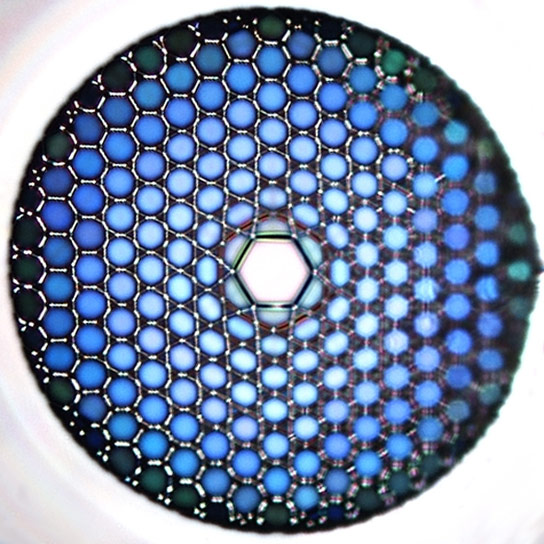
Scientists at the Max Planck Institute have tested a new type of optical fiber with a hollow core, revealing that this type of optical fiber was able to guide UV laser light without being damaged and with acceptable loss. The new optical waveguides will improve precision investigations in physics, chemistry, and life sciences.
If you want to send light on a trip through optical fibers – with as little loss as possible, you should opt for infrared light, as is the case, for example, in the telecommunication networks worldwide. For certain applications, such as spectroscopic investigations on ions or atoms, however, (laser) light in the ultraviolet range is required. But this type of light would quickly damage conventional optical fibers. Researchers from the Max Planck Institute for the Science of Light in Erlangen/Germany and of the QUEST Institute, based at the Physikalisch-Technische Bundesanstalt (PTB), have tested a new type of optical fiber with a hollow core and have found out that this type of optical fiber was able to guide UV laser light without being damaged and with acceptable loss. Their investigations, which they have recently published in the journal “Optics Express”, are interesting for numerous applications: besides precision spectroscopy on atoms or ions and their use in optical atomic clocks or quantum computers, fluorescence microscopy in biology, the investigation of process plasmas, combustion studies on soot or the spectroscopy of greenhouse gases would be other possible fields of application.
Optical fibers usually have a solid glass core. This glass core is coated with an optically thinner material. The laws of physics ensure that a light beam is kept inside such a fiber thanks to total reflection and that it can be transported over long distances without significant loss. Such optical fibers are therefore widely used worldwide to transport light of different spectral ranges – from the infrared up to the visible light range. UV light, however, has a shorter wavelength and is therefore strongly absorbed by the glass used in most types of optical fibers, and the fibers are quickly damaged by UV light.
At the Max Planck Institute for the Science of Light (MPL) in Erlangen, experiments with other types of optical fiber have been carried out for a few years. Now, it has turned out that a certain type of optical fiber is particularly well-suited for UV light: a microstructured photonic crystal fiber (PCF) with a so-called “Kagome structure” – a special pattern consisting of triangles and hexagons in a regular arrangement – and a hollow core of 20 µm in diameter. This core ensures a single-mode guiding of the light – i.e. with a spatial intensity distribution similar to the shape of a Gaussian bell-shaped curve. The crucial question was whether this transport was really single-mode and damage-free, and this is what the metrological experts from the QUEST Institute at PTB had to find out. Their investigations have shown that in the case of the UV beam used, with a wavelength of 280 nm, single-mode transmission was possible and that even after more than 100 hours in operation at a power of 15 mW, no UV-induced damage could be detected.
The optical fibers have even passed a first application test: the researchers at the QUEST Institute have used them successfully for their spectroscopic investigations on trapped ions. Stabilized by the new fiber, the UV laser beam allows an improved interrogation of the ions’ internal state. Besides the users of such spectroscopic methods (for example in astronomy, chemistry or fundamental research in physics), this could also be useful for researchers who are developing quantum computers, since in that field, the internal states of a particle are the new digital 0s and 1s.
Reference: “Damage-free single-mode transmission of deep-UV light in hollow-core PCF” by F. Gebert, M. H. Frosz, T. Weiss, Y. Wan, A. Ermolov, N. Y. Joly, P. O. Schmidt and P. St.J. Russell, 24 April 2014, Optics Express.
DOI: 10.1364/OE.22.015388
arXiv: 1404.6159
Never miss a breakthrough: Join the SciTechDaily newsletter.
Follow us on Google and Google News.