
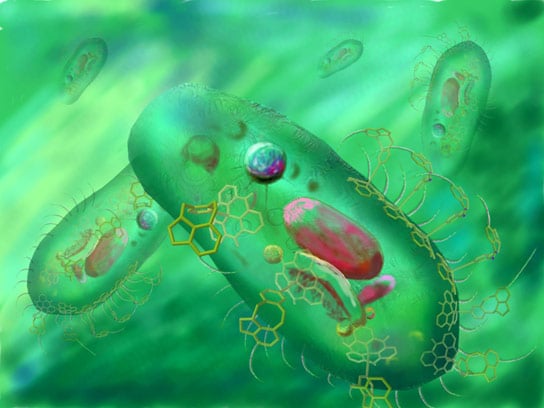
A newly published study details how scientists from Kiel University developed a nano-structured transportation system using artificial cilia.
For billions of years, bacteria move along using cilia. These propelling organelles are ubiquitous and they are even found in almost any human cell. Following the natural paragon scientists at the Kiel University constructed molecules that imitate these tiny, hair-like structures. Autonomously moving artificial organelles and a more efficient production of chemical compounds might now be within reach. The researchers recently published their results in the scientific journal European Journal of Organic Chemistry.
Cilia, or ciliated epithelia, cover our respiratory tract like a lawn. In our pharynx and nasal mucosa they are responsible for continuously transporting mucus and particles embedded therein towards our throat. (except for heavy smokers, whose cilia were destroyed by nicotine and tar.) Tobias Tellkamp and Professor Rainer Herges have now come one step closer to their aim of artificially reproducing this biological transport system with switchable molecules.
Molecules that wiggle when exposed to light are known for a long time. But directed movement had not been possible up until now because back-and-forth movements cancel each other. To achieve a net displacement, the cilia should beat only to one side. Applying a trick within the molecular construction, the chemists of Kiel University’s Collaborative Research Center 677 “Function by Switching” solved this problem: Moreover, to get those molecular cilia up and running, the scientists fixed them on a surface. “We attached a kind of molecular suction cup onto the switches”, project leader Herges explains.
Studies have shown that this suction cup adheres very well to gold surfaces. The team of scientists observed that the molecules self-assemble autonomously on the surface, densely packed, side by side like oranges on a shelf. “The suction cups adhere to the surface but they are still mobile and attract one another”, explains doctoral candidate Tellkamp. In this way, an artificial epithelium is formed.
The next logical step is to find out if the artificial epithelium works much in the same way as our nasal mucosa. In collaboration with Prof. Olaf Magnussen in the Physics Department of Kiel University atomic force microscopy (AFM) will be used to visualize the light-driven, directed transport of nanoscopic particles.
The recent findings are particularly interesting, not only with respect to fundamental research. With artificially ciliated epithelia, a molecular nano-fabrication seems possible – machines of molecular size would build other machines by positioning chemical products specifically and precisely. Entire production plants could thus fit onto a tiny chip. Other conceivable fields of application include artificial organelles equipped with molecular cilia that are controlled by an external stimulus; or in the more distant future, they could operate autonomously within the bloodstream and carry drugs to the site of a disease.
Reference: “Diazocines on Molecular Platforms” by Tobias Tellkamp, Jun Shen, Yoshio Okamoto and Rainer Herges, 24 June 2014, European Journal of Organic Chemistry.
DOI: 10.1002/ejoc.201402541
Never miss a breakthrough: Join the SciTechDaily newsletter.
Follow us on Google and Google News.
1 Comment
It is a well known fact that hormones are transmitted by ‘chemotaxi’ in the blood stream to the target organs. Sperm is wagging its tail towards the egg in the process called ‘thermotaxi’, sensing the temperature difference. So, wagging a tail in the cilia is an immobile form, and moving the cilia in a fixed direction is by ‘thermotaxi’. Hence the movement is made by a fixed gene or molecule which is responsible for it. There is also a ‘phototaxi’ method in primitive bacteria and fishes where the movement is towards the light. Why? Even in plants there is a ‘phototaxi’ method for ‘heliotropism’ and towards water as ‘geotropism’, which is nothing but a chemotaxi towards the water affinity. Even the falling of the leaves is by abscisic acid is by chemical means only. The primitive organs were not hands or legs for mobility, but only through molecules which got embedded as genes in DNA when the organisms evolve and develop. Hence, this process of delivering pharmacy through artificial cilia developed in nano-particles and molecules is in right direction to the target organs, which can be utilized in case of cancer tissues. Thank You.