
Close Menu
    Facebook X (Twitter) Instagram
    SciTechDaily
    • Biology
    • Chemistry
    • Earth
    • Health
    • Physics
    • Science
    • Space
    • Technology
    Facebook X (Twitter) Pinterest YouTube RSS
    SciTechDaily
    Home»Space»Gemini Reveals a Hidden Gravitational Wave Source
    Space

    Gemini Reveals a Hidden Gravitational Wave Source

    By Harvard-Smithsonian Center for AstrophysicsJuly 9, 2014No Comments3 Mins Read
    Facebook Twitter Pinterest Telegram LinkedIn WhatsApp Email Reddit
    Share
    Facebook Twitter LinkedIn Pinterest Telegram Email Reddit
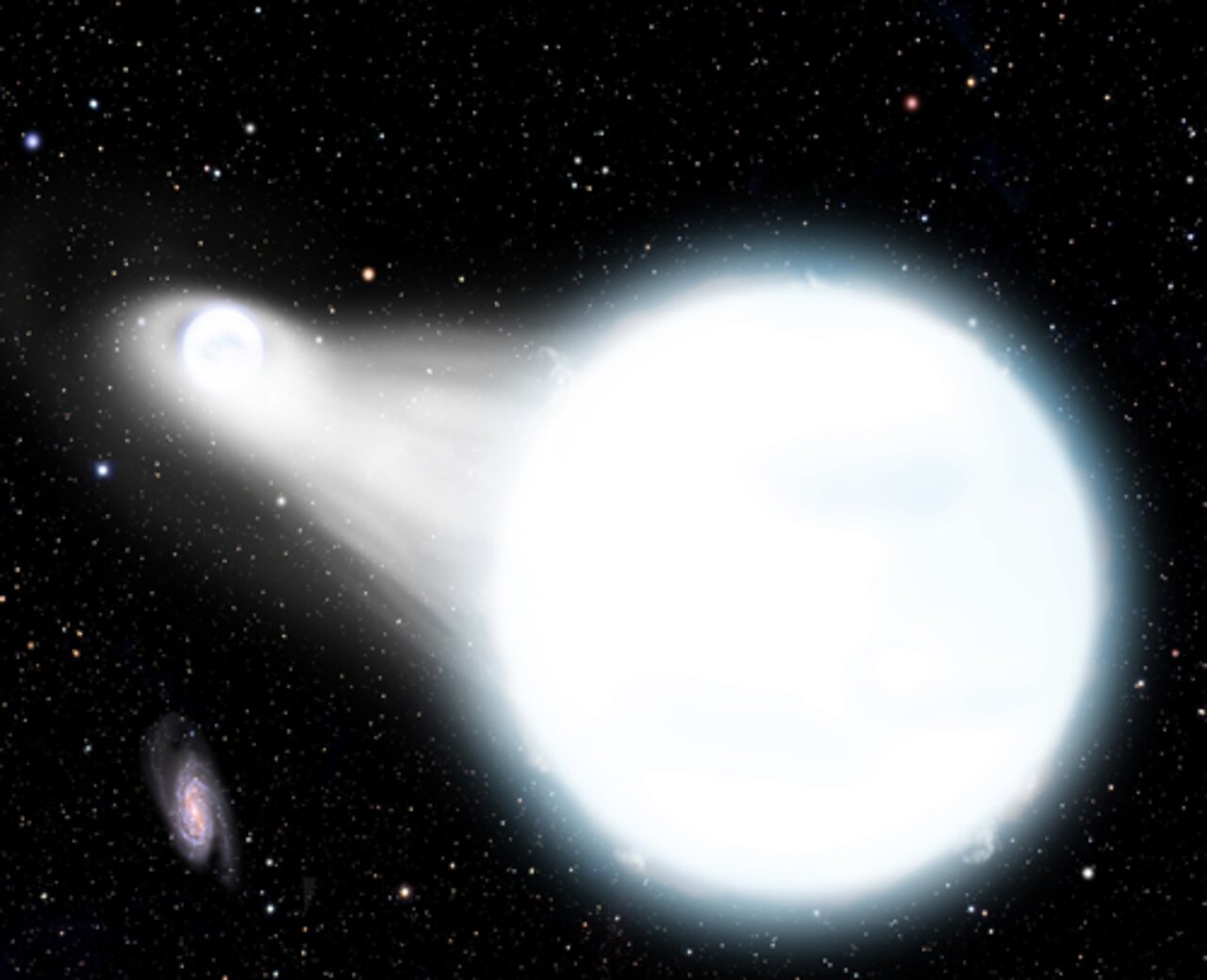
    Artist's rendition of the future evolution of the WD 0931+444
    Artist’s rendition of the future evolution of the WD 0931+444 system.

    Using the Gemini Multi-Object Spectrograph on the Gemini North telescope and the Blue Channel spectrograph on the 6.5-meter MMT Telescope, astronomers have identified one of the best (and perhaps the most powerful) gravitational wave sources.

    Einstein’s Theory of General Relativity predicts that accelerated masses emit gravitational waves, or ripples in space-time. Even though gravitational waves have yet to be detected directly, we expect that there are more than a hundred million gravitational wave sources in our own galaxy. However, as of today, we know of only a few such sources.

    A team of researchers, led by Dr. Mukremin Kilic of the University of Oklahoma and Dr. Warren Brown of the Smithsonian Astrophysical Observatory, have recently identified one of the best (and perhaps the most powerful) gravitational wave sources currently known using the Gemini Multi-Object Spectrograph (GMOS) on the Gemini North telescope and the Blue Channel spectrograph on the 6.5-meter MMT Telescope. Known as WD 0931+444, the object was first identified in 1982, and classified as a white dwarf with a low-mass M-dwarf stellar companion.
    Gemini time resolved spectroscopy of H gamma and H beta lines ov
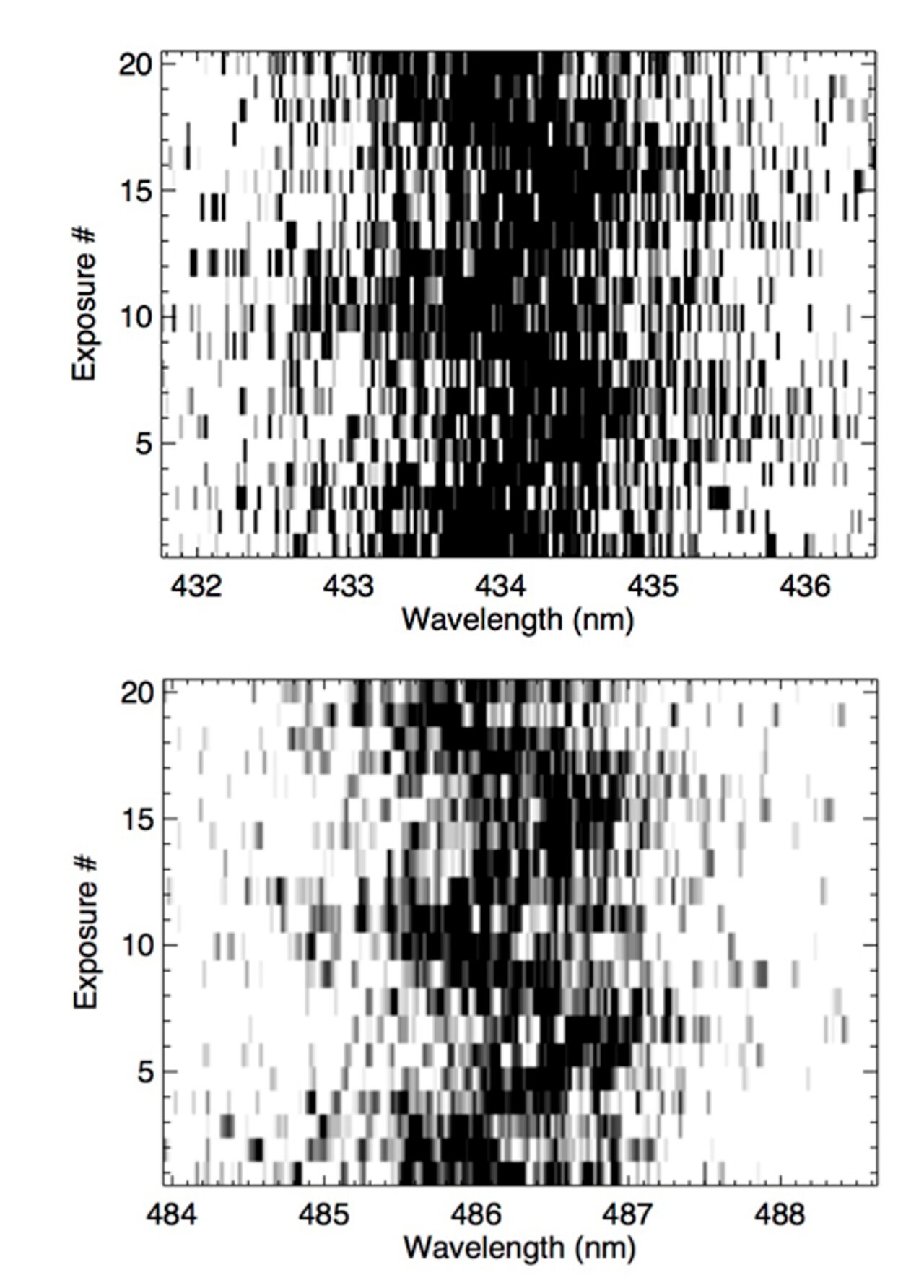
    Gemini time-resolved spectroscopy of H-gamma (top) and H-beta lines (bottom) over 45 minutes. Both lines clearly show a 20 minute periodicity.

    This new data from Gemini and MMT reveal that the white dwarf in this system is not in a binary with the M dwarf. Instead, it is orbiting another invisible white dwarf every 20 minutes. Thanks to the large collecting area of the Gemini and MMT telescopes, the team was able to obtain high-quality optical spectroscopy of this system every 2 minutes and resolve the 20-minute orbital period.

    The orbital separation of the two stars is only 20 percent of the size of the Sun. These two stars will lose angular momentum through gravitational wave radiation and merge in less than nine million years. Depending on the inclination angle (which is currently unknown) the pair may merge even faster, in only a few million years. This previously unknown source is believed to be stretching everything around us (due to gravity waves) by a factor of 10-22 (or more) every 10 minutes!

    The discovery of the true nature of WD 0931+444 indicates that there are likely many other strong gravitational wave sources hiding in plain sight. Some of these hidden sources can be identified through further optical follow-up observations as in this work. However, the direct detection of gravitational waves from these sources has to wait for a space-based gravitational wave mission like the evolved Laser Interferometer Space Antenna, which will likely not be operational until 2034 as currently envisioned.”

    Reference: A New Gravitational Wave Verification Source” by Mukremin Kilic, Warren R. Brown, A. Gianninas, J. J. Hermes, Carlos Allende Prieto and S. J. Kenyon, 23 July 2014, MNRAS Letters.
    DOI: 10.1093/mnrasl/slu093
    arXiv: 1406.3346


    Never miss a breakthrough: Join the SciTechDaily newsletter.
    Follow us on Google and Google News.

    Astronomy Astrophysics Gravitational Waves Harvard-Smithsonian Center for Astrophysics
    Share. Facebook Twitter Pinterest LinkedIn Email Reddit

    Related Articles

    Astronomers Use a Single Gravitational Wave Event to Measure the Age of the Universe

    Scientists Use Atomic Clocks to Detect Gravitational Waves

    New Research Shows LIGO’s Twin Black Holes Might Have Been Born Inside a Single Star

    DES Results of First Search for Visible Light Associated with Gravitational Waves

    A New Calibration Source for Gravitational Wave Missions

    Researchers Discover the First Direct Evidence of Cosmic Inflation

    Pair of Eclipsing White Dwarfs Produce Gravitational Waves

    Supernova Shock Wave Breaks Through a Cocoon of Gas

    Origins of Type Ia Supernovae

    Leave A Reply Cancel Reply

    • Facebook
    • Twitter
    • Pinterest
    • YouTube

    Don't Miss a Discovery

    Subscribe for the Latest in Science & Tech!

    Trending News

    AI Could Detect Early Signs of Alzheimer’s in Under a Minute – Far Before Traditional Tests

    What if Dark Matter Has Two Forms? Bold New Hypothesis Could Explain a Cosmic Mystery

    This Metal Melts in Your Hand – and Scientists Just Discovered Something Strange

    Beef vs. Chicken: Surprising Results From New Prediabetes Study

    Alzheimer’s Breakthrough: Scientists Discover Key Protein May Prevent Toxic Protein Clumps in the Brain

    Quantum Reality Gets Stranger: Physicists Put a Lump of Metal in Two Places at Once

    Scientists May Have Found the Key to Jupiter and Saturn’s Moon Mystery

    Scientists Uncover Brain Changes That Link Pain to Depression

    Follow SciTechDaily
    • Facebook
    • Twitter
    • YouTube
    • Pinterest
    • Newsletter
    • RSS
    SciTech News
    • Biology News
    • Chemistry News
    • Earth News
    • Health News
    • Physics News
    • Science News
    • Space News
    • Technology News
    Recent Posts
    • Scientists Discover Enzyme That Could Supercharge Ozempic-Like Weight Loss Drugs
    • Asthma and Depression Don’t Mix the Way Scientists Expected
    • Why Promising Cancer Drugs Failed: Scientists Uncover the Missing Piece
    • Popular Sweetener Linked to DNA Damage – “It’s Something You Should Not Be Eating”
    • Ancient “Rock” Microbes May Reveal How Complex Life Began
    Copyright © 1998 - 2026 SciTechDaily. All Rights Reserved.
    • Science News
    • About
    • Contact
    • Editorial Board
    • Privacy Policy
    • Terms of Use

    Type above and press Enter to search. Press Esc to cancel.