
Close Menu
    Facebook X (Twitter) Instagram
    SciTechDaily
    • Biology
    • Chemistry
    • Earth
    • Health
    • Physics
    • Science
    • Space
    • Technology
    Facebook X (Twitter) Pinterest YouTube RSS
    SciTechDaily
    Home»Space»Scientists Use Atomic Clocks to Detect Gravitational Waves
    Space

    Scientists Use Atomic Clocks to Detect Gravitational Waves

    By Harvard-Smithsonian Center for AstrophysicsMarch 3, 20171 Comment2 Mins Read
    Facebook Twitter Pinterest Telegram LinkedIn WhatsApp Email Reddit
    Share
    Facebook Twitter LinkedIn Pinterest Telegram Email Reddit
    Astronomers Use Optical Lattice Atomic Clocks to Detect Gravitational Waves
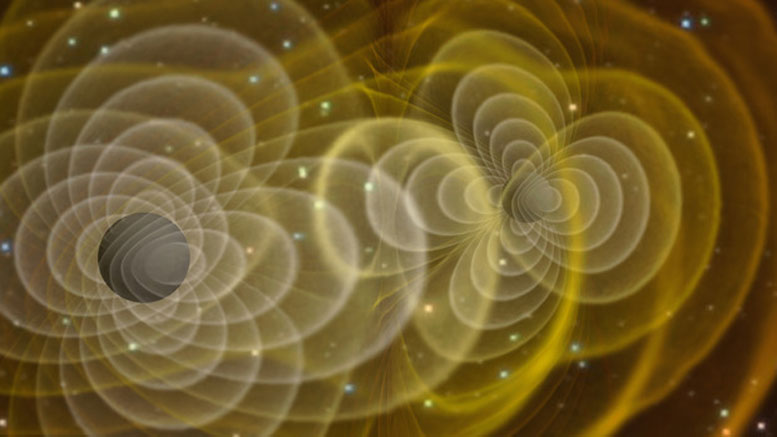
    Illustration of gravitational waves produced by two orbiting black holes.

    In a newly published study, scientists from the Harvard-Smithsonian Center for Astrophysics detail a sensitive new method for detecting gravitational waves.

    The recent detection of gravitation waves (GW) from the merger of two black holes of about thirty solar-masses each with the ground-based LIGO facility has generated renewed enthusiasm for developing even more sensitive measurement techniques. Ground-based GW instruments have widely spaced sensors that can detect sub-microscopic changes in their separation — better than one part in a billion trillion, They suffer, however, from the noise produced by small ground tremors — vibrations from natural or man-made sources that ripple through the precisely tuned detectors. The vibrations most difficult to compensate for are those that change relatively slowly, at frequencies around once a second or less, yet astronomers predict that GW sources producing these slow variations should be interesting and abundant, from compact stellar-mass binary stars to gravitational events in the early universe.

    The CfA has long been renowned for its laboratory work producing some of the best precision devices in the world. In particular are its timekeeping hydrogen-maser clocks, used by NASA to track its satellites as well as by radio astronomers around the world to make precision measurements of cosmic phenomena using Very Long Baseline Interferometry. The CfA maser group has continued to develop advanced clock technologies over the years, and to turn them into new tools to probe the heavens, including recently the so-called “laser-combs” for ultraprecise measurement of stellar velocity shifts induced by extrasolar planets.

    CfA scientists Igor Pokovski, Nick Langellier, Ron Walsworth, and two colleagues have published a new GW detector concept to study in particular the low frequency GWs. Their technique precisely measures not the separation of the sensors but their minuscule motions via the Doppler effect as a gravitational waves passes by. The device uses a finely controlled laser and precise atomic clocks mounted in two satellites (unlike other space GW concepts that require three satellites, this system needs only two). The technology for this capability requires only realistic improvements to implement, and offers an important extension to current GW systems.

    Reference: “Gravitational Wave Detection with Optical Lattice Atomic Clocks” S. Kolkowitz, I. Pikovski, N. Langellier, M. D. Lukin, R. L. Walsworth and J. Ye, 27 December 2016, Physical Review D.
    DOI: 10.1103/PhysRevD.94.124043

    Never miss a breakthrough: Join the SciTechDaily newsletter.
    Follow us on Google and Google News.

    Astronomy Astrophysics Gravitational Waves Harvard-Smithsonian Center for Astrophysics Popular
    Share. Facebook Twitter Pinterest LinkedIn Email Reddit

    Related Articles

    New Research Shows LIGO’s Twin Black Holes Might Have Been Born Inside a Single Star

    DES Results of First Search for Visible Light Associated with Gravitational Waves

    Researchers Discover the First Direct Evidence of Cosmic Inflation

    Earth-like Planets May Have Older and More Evolved Life

    Centaurus a Hides a Gaseous Spiral at Its Core

    Pr0201b and Pr0211b Orbiting Sun-Like Stars in the Beehive Cluster

    Cloud of Hydrogen and Helium Plunging Toward the Galactic Center

    Pair of Eclipsing White Dwarfs Produce Gravitational Waves

    Examining the Dust Absorption of Active Galactic Nuclei

    1 Comment

    1. Valeriy on March 4, 2017 12:20 pm

      In search of black holes and dark matter astrophysicists are relying on indirect observations. Only the measurement of the event horizon of a black hole directly would be a direct evidence. However nobody done it yet, so for now an existence of BH is a hypothesis.

      Reply
    Leave A Reply Cancel Reply

    • Facebook
    • Twitter
    • Pinterest
    • YouTube

    Don't Miss a Discovery

    Subscribe for the Latest in Science & Tech!

    Trending News

    Millions Take These IBS Drugs, But a New Study Finds Serious Risks

    Scientists Unlock Hidden Secrets of 2,300-Year-Old Mummies Using Cutting-Edge CT Scanner

    Bread Might Be Making You Gain Weight Even Without Eating More Calories

    Scientists Discover Massive Magma Reservoir Beneath Tuscany

    Europe’s Most Active Volcano Just Got Stranger – Here’s Why Scientists Are Rethinking It

    Alzheimer’s Symptoms May Start Outside the Brain, Study Finds

    Millions Take This Popular Supplement – Scientists Discover a Concerning Link to Heart Failure

    The Universe Is Expanding Too Fast and Scientists Can’t Explain Why

    Follow SciTechDaily
    • Facebook
    • Twitter
    • YouTube
    • Pinterest
    • Newsletter
    • RSS
    SciTech News
    • Biology News
    • Chemistry News
    • Earth News
    • Health News
    • Physics News
    • Science News
    • Space News
    • Technology News
    Recent Posts
    • Scientists Say a Hidden Structure May Exist Inside Earth’s Core
    • Doctors Surprised by the Power of a Simple Drug Against Colon Cancer
    • Why Popular Diabetes Drugs Like Ozempic Don’t Work for Everyone: The “Genetic Glitch”
    • Scientists Create Improved Insulin Cells That Reverse Diabetes in Mice
    • Scientists Stunned After Finding Plant Thought Extinct for 60 Years
    Copyright © 1998 - 2026 SciTechDaily. All Rights Reserved.
    • Science News
    • About
    • Contact
    • Editorial Board
    • Privacy Policy
    • Terms of Use

    Type above and press Enter to search. Press Esc to cancel.