
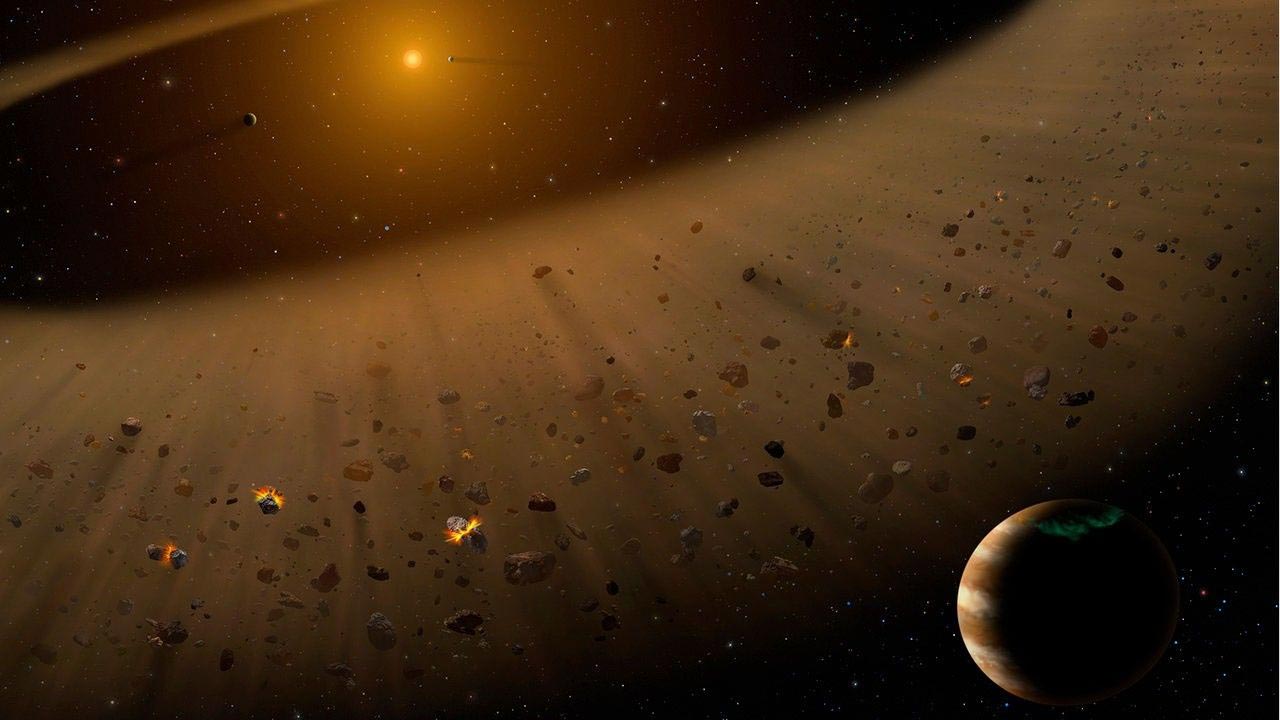
JWST placed new limits on planets around Epsilon Eridani and demonstrated an improved technique for spotting faint signals.
In science, a negative finding can be just as valuable as a positive one. Even the most advanced observatories are sometimes challenged by data artifacts, and this was the case with the James Webb Space Telescope’s recent study of Epsilon Eridani.
This nearby star has long been at the center of debate over whether it hosts planets. While JWST’s NIRCam detected intriguing signals, they were positioned too close to instrumental noise to be confirmed as a true “planet.” The team’s results, published on arXiv, may seem inconclusive, but they demonstrate how scientific progress is often made through careful testing and refinement.
These observations were part of a JWST program dedicated to targeted astronomical investigations and focused on the search for two possible planets around Epsilon Eridani, located just 10.5 light years away and only about 400 million years old. The first candidate, proposed in 2000 using radial velocity measurements, was estimated to be about the size of Jupiter and orbiting 3.5 AU from the star. The second, still unconfirmed, has been suggested as the body responsible for shaping the star’s striking ring system and would be situated roughly 45 AU from its host star.
A promising signal hindered by noise
When searching for the first candidate planet, Epsilon Eridani b, NIRCam detected a “blob” of light in exactly the position where a planet was predicted. However, the signal appeared close to a “hexpeckle,” an artifact created by the coronagraph that introduced significant noise in that region. Because of this interference, the researchers could not confirm the detection with statistical confidence, even though the feature resembled a planetary signal.
The second potential candidate was much more convincingly ruled out. While the statistics weren’t enough to definitively rule out all planets, they were conclusive enough to say there are no Saturn-sized planets any further out the 16 AU from the star. In other words, there doesn’t appear to be a ring shepherd around Epsilon Eridani.
Peering at the dust disk itself, NIRCam found a faint signal on the “eastern” side of the star. That appears to be the side facing us directly, and therefore, the signal is most likely just the dust from the disc scattering the light from the star rather than a planet, similar to how gas and dust can shroud stars themselves in some parts of space.
Testing a new observational technique
All of this work was done using a new technique for JWST called a “three-roll” observing strategy. So far during its observations, the telescope had “rolled” to two different angles to make sure it captured light coming from its observational target in slightly different ways. For these observations, it tried doing so a third time, and had a pretty significant gain in observational capacity as well. The authors suggest that the technique could improve JWST’s ability to see faint objects by between 20-30% than the traditional two-roll method.
While some might consider the lack of a definitive planet detection a bust, science still moves forward on constraints, and this observational effort by JWST did put some constraints both on the potential of a planet in the outreaches of Epsilon Eridani’s system as well as the size and location of the inner Jupiter-like planet candidate. But perhaps most importantly, it also opened up a new methodology to allow for increased observational capacity of faint objects in the future. Given JWST’s long operational life ahead, that is definitely worth celebrating.
Reference: “Searching for Planets Orbiting ε~Eridani with JWST/NIRCam” by Jorge Llop-Sayson, Charles Beichman, Geoffrey Bryden, Marie Ygouf, Andras Gaspar, William Thompson, Aniket Sanghi, Dimitri Mawet, Alexandra Z. Greenbaum, Jarron Leisenring, Schuyler Wolff, Marcia Rieke and George Rieke, 11 August 2025, arXiv.
DOI: 10.48550/arXiv.2508.08463
Adapted from an article originally published on Universe Today.
Never miss a breakthrough: Join the SciTechDaily newsletter.
Follow us on Google and Google News.