
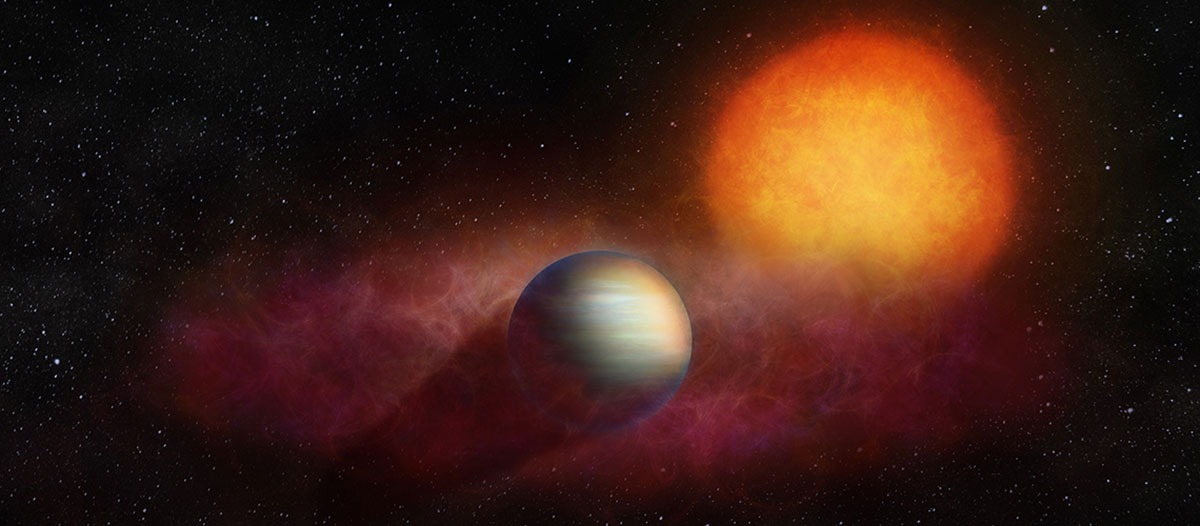
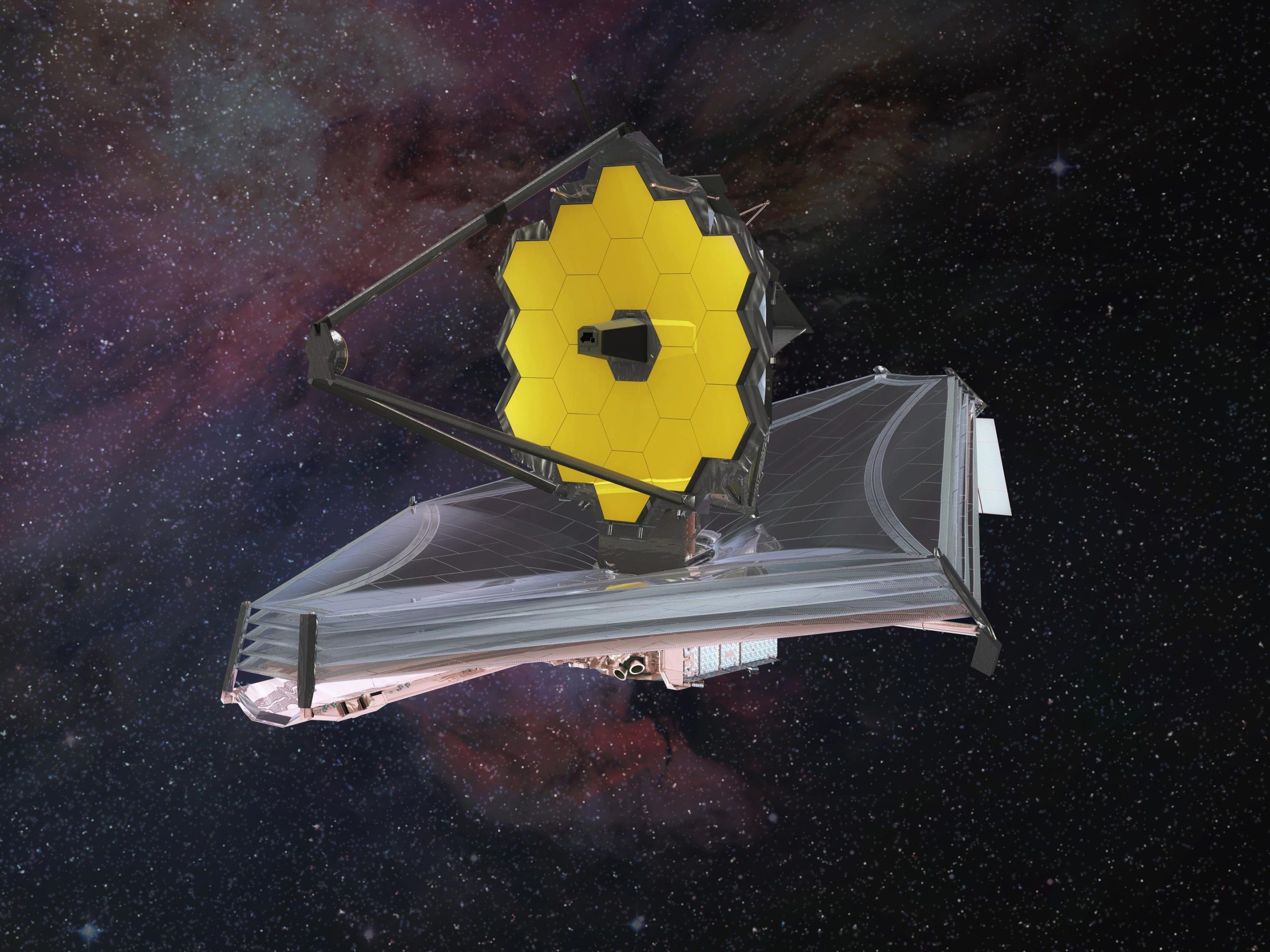
Using the JWST, an international team featuring UNIGE scientists has detected enormous clouds of helium streaming away from the exoplanet WASP-107b.
An international collaboration that includes astronomers from the University of Geneva (UNIGE) and the National Centre of Competence in Research PlanetS has detected enormous clouds of helium drifting away from the exoplanet WASP-107b.
The observations were collected with the James Webb Space Telescope and then analyzed using modeling tools created at UNIGE. The results, published in Nature Astronomy, offer important insights into how atmospheric escape works and how it affects the long-term development of exoplanets and some of their defining features.
Planetary atmospheres can sometimes leak into space. Earth experiences this as well, losing a little more than 3 kg of material every second (mainly hydrogen), and this loss cannot be reversed. The process, known as “atmospheric escape,” is especially significant for worlds that orbit extremely close to their star, where intense heating makes the effect much stronger. Understanding this process is crucial because it can influence how these planets change over time.
Using the James Webb Space Telescope, researchers from the Observatory of the University of Geneva (UNIGE), along with colleagues from McGill, Chicago, and Montreal universities, were able to identify large flows of helium gas streaming away from WASP-107b, which lies more than 210 light-years from our solar system. This marks the first detection of this element on an exoplanet with JWST, making it possible to study the escape process with exceptional detail.
Super-puff exoplanets
WASP-107b, discovered in 2017, orbits its star at a distance seven times smaller than Mercury’s distance from the Sun. The planet is about the size of Jupiter yet contains only one-tenth of Jupiter’s mass, giving it an unusually low density. This places it within the group of “super-puff” exoplanets, which are known for their extremely lightweight atmospheres.
The vast helium flow was detected in the extension of its atmosphere, called the “exosphere.” This cloud partially blocks the star’s light even before the planet passes in front of it. “Our atmospheric escape models confirm the presence of helium flows, both ahead and behind the planet, extending in the direction of its orbital motion to nearly ten times the planet’s radius,” explains Yann Carteret, a doctoral student in the Department of Astronomy at the Faculty of Science of the University of Geneva and co-author of the study.
Valuable clues
In addition to helium, astronomers were able to confirm the presence of water and traces of chemical mixtures (including carbon monoxide, carbon dioxide, and ammonia) in the planet’s atmosphere, while noting the absence of methane, which the JWST is capable of detecting. These are valuable clues for reconstructing the history of WASP-107b’s formation and migration: the planet formed far from its current orbit, then moved closer to its star, which would explain its bloated atmosphere and loss of gas.
The study on WASP-107b is a key reference for better understanding the evolution and dynamics of these distant worlds. “Observing and modeling atmospheric escape is a major research area at the UNIGE Department of Astronomy because it is thought to be responsible for some of the characteristics observed in the exoplanet population,” explains Vincent Bourrier, senior lecturer and research fellow in the Department of Astronomy at the UNIGE Faculty of Science and co-author of the study.
“On Earth, atmospheric escape is too weak to drastically influence our planet. But it would be responsible for the absence of water on our close neighbor, Venus. It is therefore essential to fully understand the mechanisms at work in this phenomenon, which could erode the atmosphere of certain rocky exoplanets,” he concludes.
Reference: “Continuous helium absorption from both the leading and trailing tails of WASP-107 b” by Vigneshwaran Krishnamurthy, Yann Carteret, Caroline Piaulet-Ghorayeb, Jared Splinter, Dhvani Doshi, Michael Radica, Louis-Philippe Coulombe, Romain Allart, Vincent Bourrier, Nicolas B. Cowan, René Doyon, David Lafrenière, Loïc Albert, Björn Benneke, Lisa Dang, Ray Jayawardhana, Doug Johnstone, Lisa Kaltenegger, Adam B. Langeveld, Stefan Pelletier, Jason F. Rowe, Pierre-Alexis Roy, Jake Taylor and Jake D. Turner, 1 December 2025, Nature Astronomy.
DOI: 10.1038/s41550-025-02710-8
Never miss a breakthrough: Join the SciTechDaily newsletter.
Follow us on Google and Google News.
2 Comments
There are multiple scientists who claim. We still don’t know how many planets are truly in our own solar system. I don’t believe for a minute that we have discovered a planet and can tell that it’s at this fear is pulling away….
There are multiple scientists who claim. We still don’t know how many planets are truly in our own solar system. I don’t believe for a minute that we have discovered a planet and can tell that it’s atmosphere is pulling away….