
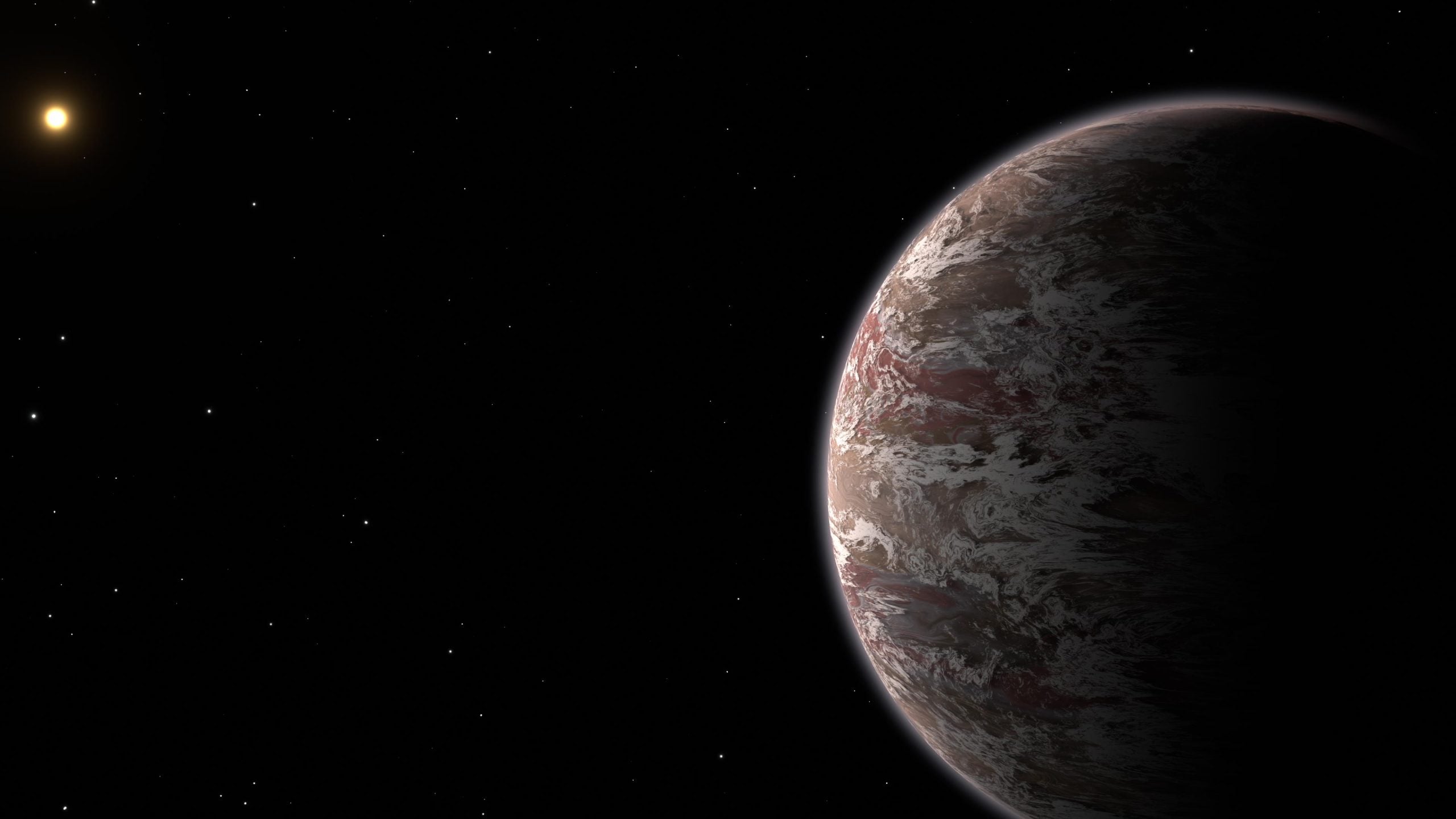
A distant Jupiter-like planet has revealed an unexpected secret: water-ice clouds hiding in its atmosphere. The discovery, made with JWST, shows these alien worlds are more complex than scientists thought.
Astronomers have identified an unexpected feature on a distant gas giant: water ice clouds. The finding comes from a team led by Elisabeth Matthews at the Max Planck Institute for Astronomy (MPIA), and it highlights a major gap in how scientists model exoplanet atmospheres. The planet, Epsilon Indi Ab, is similar to Jupiter, yet its atmosphere appears more complex than predicted. The observing approach used in this study also represents an important step toward the long-term goal of detecting and studying Earth-like planets.
The Search for Life Beyond Our Solar System
One of the biggest goals in astronomy is to eventually detect signs of life on planets orbiting other stars. Researchers hope this could happen within the next few decades. Progress toward that goal has come in stages. From 1995 to about 2022, scientists focused mainly on discovering exoplanets using indirect techniques. These methods revealed key properties such as mass and size, and sometimes both.
The launch of the James Webb Space Telescope (JWST) in 2022 marked the start of a new phase. Astronomers can now study the atmospheres of many exoplanets in detail, gaining insights into their composition and structure. Even so, this level of analysis is still a step away from directly searching for life, which will likely require future, more advanced telescopes.
The new study explores some of these more advanced techniques, though not yet for Earth-like planets. Elisabeth Matthews (Max Planck Institute for Astronomy), the study’s lead author, explains: “JWST is finally allowing us to study solar-system analog planets in detail. If we were aliens, several light-years away, and looking back at the Sun, JWST is the first telescope that would allow us to study Jupiter in detail. For studying Earth in detail, we would need much more advanced telescopes, though.”
Why Jupiter Like Worlds Are Hard to Observe
Despite JWST’s capabilities, studying planets similar to Jupiter has been challenging. Most gas giants observed so far are much hotter than Jupiter. This is because the most common technique for analyzing exoplanet atmospheres requires the planet to pass in front of its star as seen from Earth. Planets that orbit close to their stars are more likely to align this way, but they are also significantly hotter.
To overcome this limitation, Matthews and her team used a different method. Their work provides one of the closest looks yet at a true Jupiter analog, and it revealed a surprising result.
Using JWST’s mid-infrared instrument MIRI, the researchers directly imaged Epsilon Indi Ab. The naming indicates that it is the first planet discovered orbiting the star Epsilon Indi A in the constellation Indus (in the southern sky). Bhavesh Rajpoot, a PhD student at MPIA who contributed to the study, says: “This planet has a considerably greater mass than Jupiter – the new study fixes its mass at 7.6 Jupiter masses – but the diameter is about the same as for its solar-system cousin.”
A Cold Giant With Residual Heat
Epsilon Indi Ab orbits about four times farther from its star than Jupiter does from the Sun. Its host star is slightly smaller and cooler than the Sun, which keeps the planet’s temperature relatively low. Its surface temperature is estimated to be between 200 and 300 Kelvin (between –70 and +20 degrees Celsius).
The planet is still warmer than Jupiter, which has a temperature of about 140 K, because it retains heat from its formation. Over billions of years, it is expected to cool and eventually become colder than Jupiter.
To observe the planet, astronomers used a coronagraph on the MIRI instrument to block the bright light from the host star. This allowed them to detect the much fainter light coming from the planet. They captured images using a filter at 11.3 μm, which lies just outside a wavelength associated with ammonia molecules NH3. By comparing these observations with earlier data taken at 10.6 μm in 2024, the team was able to estimate the amount of ammonia in the atmosphere. (Incidentally, both the mechanical filter wheels placing the coronagraph and the filter in front of the MIRI camera were constructed at MPIA, one of the German contributions to the JWST.)
Missing Ammonia Points to Ice Clouds
In Jupiter’s atmosphere, ammonia gas and ammonia clouds dominate the visible upper layers. Based on its characteristics, Epsilon Indi Ab was expected to contain large amounts of ammonia gas, but not ammonia clouds. Instead, the observations showed less ammonia than predicted.
The most likely explanation is the presence of thick but uneven water ice clouds, similar to cirrus clouds high in Earth’s atmosphere – an unexpected complication!
Astronomers interpret such observations by comparing them with computer simulations of planetary atmospheres. However, many existing models do not include clouds because they are difficult to simulate. This discovery shows that those models need to be improved. James Mang (University of Texas at Austin), a co-author of the study, says: “It’s a great problem to have, and it speaks to the immense progress we’re making thanks to JWST. What once seemed impossible to detect is now within reach, allowing us to probe the structure of these atmospheres, including the presence of clouds. This reveals new layers of complexity that our models are now beginning to capture, and opens the door to even more detailed characterization of these cold, distant worlds.”
Future Telescopes and the Path to Earth-Like Planets
Upcoming missions could provide even clearer observations of these clouds. NASA’s Nancy Grace Roman Space Telescope, where MPIA is a partner, is scheduled for launch in 2026–2027 and is expected to be well-suited for detecting reflective water ice clouds.
Meanwhile, Matthews and her team are applying for additional JWST observation time to study more cold Jupiter-like planets. As astronomers refine their techniques, they are building the foundation for studying Earth-like worlds in the future and eventually searching for signs of life beyond our solar system.
Reference: “A Second Visit to Eps Ind Ab with JWST: New Photometry Confirms Ammonia and Suggests Thick Clouds in the Exoplanet Atmosphere of the Closest Super-Jupiter” by Elisabeth C. Matthews, James Mang, Aarynn L. Carter, Mathlide Mâlin, Caroline V. Morley, Bhavesh Rajpoot, Leindert A. Boogaard, Jennifer A. Burt, Ian J. M. Crossfield, Fabo Feng, Anne- Marie Lagrange and Mark W. Phillips, 22 April 2026, The Astrophysical Journal Letters.
DOI: 10.3847/2041-8213/ae5823
The MPIA researchers involved are Elisabeth Matthews and Bhavesh Rajpoot, in collaboration with James Mang and Caroline Morley (University of Texas at Austin), Aarynn Carter and Mathilde Mâlin (Space Telescope Science Institute), and others.
Never miss a breakthrough: Join the SciTechDaily newsletter.
Follow us on Google and Google News.
2 Comments
Hmmm, there’s something odd here. Multiple sources (not just this article) peg the radius at about 10% bigger the Jupiter (give or take) and the mass at about 6 times Jupiter (g or t). That implies a density about 4 times Jupiter (relative M/ relative r^3), which puts it in the VERY roughly 5 range. In other words, the density of a rocky planet.
OK, so a very large rocky world with a thick-ish atmosphere, certainly not impossible… But all the articles imply it’s a gas giant.
What am I getting wrong?
Pax / Ctein
OK, got a planetary scientist to explain it to me. Core density of a gas planet can get high enough. Jupiter is 25. This would be a lot higher.
So… Never mind 😉