
Close Menu
    Facebook X (Twitter) Instagram
    SciTechDaily
    • Biology
    • Chemistry
    • Earth
    • Health
    • Physics
    • Science
    • Space
    • Technology
    Facebook X (Twitter) Pinterest YouTube RSS
    SciTechDaily
    Home»Space»New Ultima Thule Discoveries from New Horizons Spacecraft
    Space

    New Ultima Thule Discoveries from New Horizons Spacecraft

    By Johns Hopkins University Applied Physics LaboratoryJanuary 5, 20191 Comment3 Mins Read
    Facebook Twitter Pinterest Telegram LinkedIn WhatsApp Email Reddit
    Share
    Facebook Twitter LinkedIn Pinterest Telegram Email Reddit
    New Ultima Thule Discoveries from NASA's New Horizons
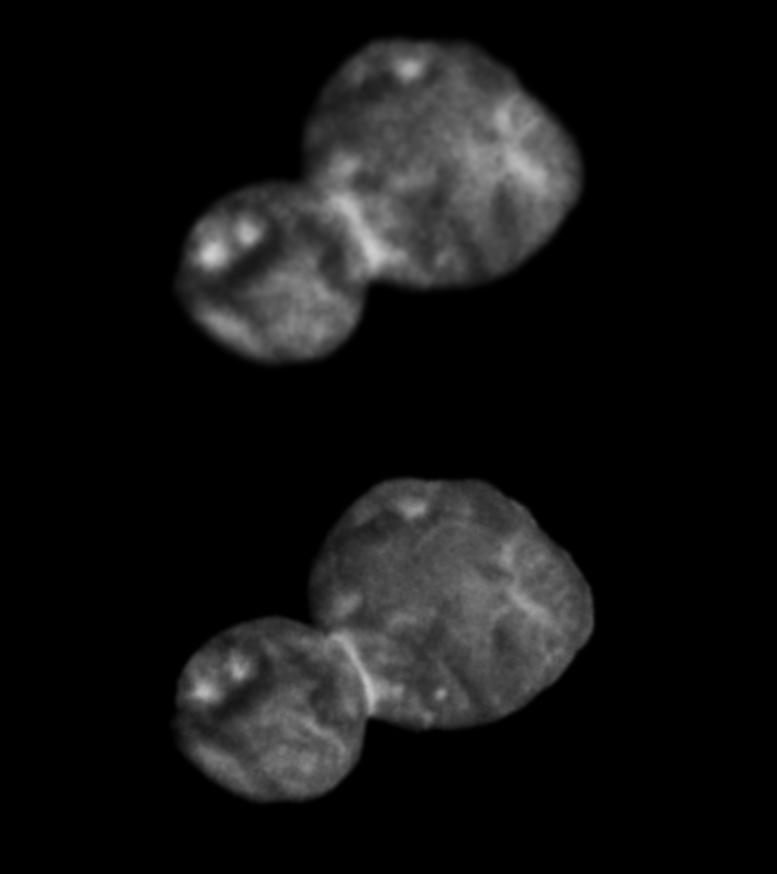
    In this animated GIF of Kuiper Belt object Ultima Thule made from two images taken 38 minutes apart, the “Thule” lobe is closest to the New Horizons spacecraft. As Ultima Thule is seen to rotate, hints of the topography can be perceived. The images were taken by the Long-Range Reconnaissance Imager (LORRI) at 4:23 and 5:01 Universal Time on January 1, 2019 from respective ranges of 38,000 miles (61,000 kilometers) and 17,000 miles (28,000 kilometers), with respective original scales of 1017 feet (310 meters) and 459 feet (140 meters) per pixel. Credit: NASA/Johns Hopkins University Applied Physics Laboratory/Southwest Research Institute

    Data from NASA’s New Horizons spacecraft, which explored the Kuiper Belt object Ultima Thule earlier this week, is yielding scientific discoveries daily. Among the findings made by the mission science team in the past day are:

    • Initial data analysis has found no evidence of rings or satellites larger than one mile in diameter orbiting Ultima Thule.
    • Data analysis has also not yet found any evidence of an atmosphere.
    • The color of Ultima Thule matches the color of similar worlds in the Kuiper Belt, as determined by telescopic measurements.
    • The two lobes of Ultima Thule — the first Kuiper Belt contact binary visited — are nearly identical in color. This matches what we know about binary systems which haven’t come into contact with each other, but rather orbit around a shared point of gravity.

    “The first exploration of a small Kuiper Belt object and the most distant exploration of any world in history is now history, but almost all of the data analysis lies in the future,” said Alan Stern of the Southwest Research Institute in Boulder, Colorado.
    New Ultima Thule Discoveries from New Horizons
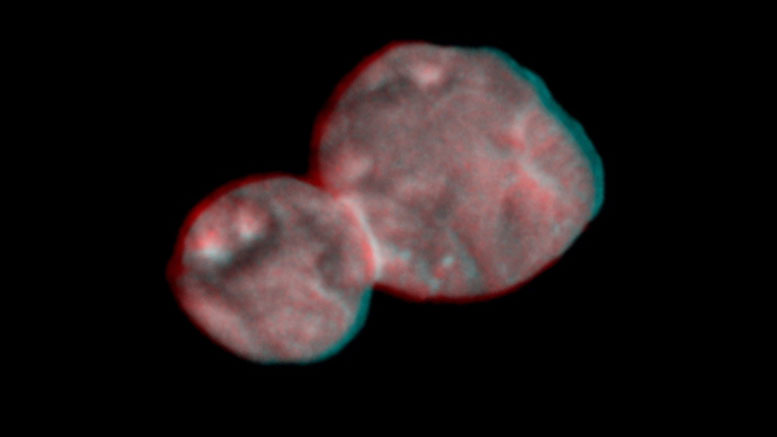
    The New Horizons science team created the first stereo image pair of Ultima Thule. This image can be viewed with stereo glasses to reveal the Kuiper Belt object’s three-dimensional shape. The images that created the stereo pair were taken by the Long-Range Reconnaissance Imager (LORRI) at 4:23 and 5:01 Universal Time on January 1, 2019 from respective ranges of 38,000 miles (61,000 kilometers) and 17,000 miles (28,000 kilometers), with respective original scales of 1017 feet (310 meters) and 459 feet (140 meters) per pixel. Credit: NASA/Johns Hopkins University Applied Physics Laboratory/Southwest Research Institute

    Data transmission from New Horizons will pause for about a week while the spacecraft passes behind the sun as seen from here on Earth. Data transmission resumes on Jan. 10, starting a 20-month download of the spacecraft’s remaining scientific treasures.

    “Those of us on the science team can’t wait to begin to start digging into that treasure trove,” said Stern. New Horizons completed the farthest flyby in history when it came within about 2,200 miles (3,500 kilometers) of Ultima Thule at 12:33 a.m. EST on Jan. 1, zooming past the object at more than 32,000 miles (51,000 kilometers) per hour.

    Never miss a breakthrough: Join the SciTechDaily newsletter.
    Follow us on Google and Google News.

    Astronomy Johns Hopkins APL New Horizons Ultima Thule
    Share. Facebook Twitter Pinterest LinkedIn Email Reddit

    Related Articles

    New Horizons Spacecraft Reveals Amazing Views of Ultima Thule

    New Horizons Captures Incredible Image Sequence of Ultima Thule

    New Movie Shows the Propeller-Like Rotation of Ultima Thule

    NASA’s New Horizons Spacecraft Halfway to KBO 2014 MU69

    NASA Reveals New Pluto Images from New Horizons Spacecraft

    New Horizons Completes Pluto Flyby, Moving Deeper Into the Kuiper Belt

    New Pluto Images from New Horizons

    New Horizons Spacecraft Awakens for Encounter with Pluto System

    Pluto-Bound New Horizons Gets a Distant Look at Neptune and Triton

    1 Comment

    1. Levani on October 20, 2020 1:13 pm

      very interesting

      Reply
    Leave A Reply Cancel Reply

    • Facebook
    • Twitter
    • Pinterest
    • YouTube

    Don't Miss a Discovery

    Subscribe for the Latest in Science & Tech!

    Trending News

    One of the Universe’s Largest Stars May Be Getting Ready To Explode

    Scientists Discover Enzyme That Could Supercharge Ozempic-Like Weight Loss Drugs

    Popular Sweetener Linked to DNA Damage – “It’s Something You Should Not Be Eating”

    Ancient “Rock” Microbes May Reveal How Complex Life Began

    Researchers Capture Quantum Interference in One of Nature’s Rarest Atoms

    “A Plague Is Upon Us”: The Mass Death That Changed an Ancient City Forever

    Scientists Discover Game-Changing New Way To Treat High Cholesterol

    This Small Change to Your Exercise Routine Could Be the Secret to Living Longer

    Follow SciTechDaily
    • Facebook
    • Twitter
    • YouTube
    • Pinterest
    • Newsletter
    • RSS
    SciTech News
    • Biology News
    • Chemistry News
    • Earth News
    • Health News
    • Physics News
    • Science News
    • Space News
    • Technology News
    Recent Posts
    • Natural Compounds Boost Bone Implant Success While Killing Bacteria and Cancer Cells
    • After 60 Years, Scientists Uncover Unexpected Brain Effects of Popular Diabetes Drug Metformin
    • New Research Uncovers Hidden Side Effects of Popular Weight-Loss Drugs
    • Scientists Rethink Extreme Warming After Surprising Ocean Discovery
    • The Surprising Role of Asteroids in the Origin of Life
    Copyright © 1998 - 2026 SciTechDaily. All Rights Reserved.
    • Science News
    • About
    • Contact
    • Editorial Board
    • Privacy Policy
    • Terms of Use

    Type above and press Enter to search. Press Esc to cancel.