
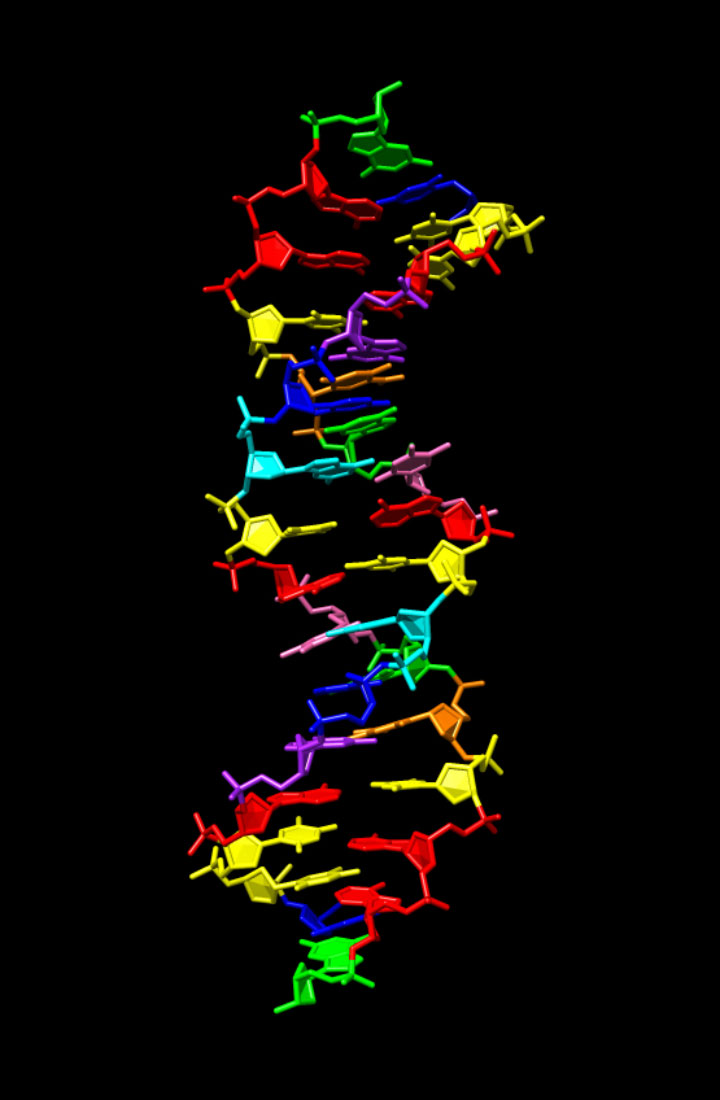
In a research breakthrough funded by NASA, scientists have synthesized a molecular system that, like DNA, can store and transmit information. This unprecedented feat suggests there could be an alternative to DNA-based life, as we know it on Earth – a genetic system for life that may be possible on other worlds.
This new molecular system, which is not a new life form, suggests scientists looking for life beyond Earth may need to rethink what they are looking for. The research appears in Thursday’s edition of Science Magazine.
DNA is a complex molecule that stores and transmits genetic information, is passed from parent to offspring in all living organisms on Earth, and its components include four key ingredients called nucleotides – all standard for life as we know it. But, what about life on other worlds?
“Life detection is an increasingly important goal of NASA’s planetary science missions, and this new work will help us to develop effective instruments and experiments that will expand the scope of what we look for,” said Lori Glaze, acting director of NASA’s Planetary Science Division.
One way to imagine the kinds of foreign structures found on other worlds is to try to create something foreign on Earth. A team of researchers, led by Steven Benner at the Foundation for Applied Molecular Evolution in Alachua, Florida, successfully achieved the fabrication of a new informational molecular system that is like DNA, except in one key area: The new molecule has eight informational ingredients instead of four.
The synthetic DNA includes the four nucleotides present in Earth life – adenine, cytosine, guanine, and thymine – but also four others that mimic the structures of the informational ingredients in regular DNA. The result is a double-helix structure that can store and transfer information.
Benner’s team, which collaborated with laboratories at the University of Texas in Austin, Indiana University Medical School in Indianapolis, and DNA Software in Ann Arbor, Michigan, dubbed their creation “hachimoji” DNA (from the Japanese “hachi,” meaning “eight,” and “moji,” meaning “letter”). Hachimoji DNA meets all the structural requirements that allow our DNA to store, transmit and evolve information in living systems.
“By carefully analyzing the roles of shape, size, and structure in hachimoji DNA, this work expands our understanding of the types of molecules that might store information in extraterrestrial life on alien worlds,” said Benner.
Scientists have much more to do on the question of what other genetic systems could serve as the foundation for life, and where such exotic organisms could be found. However, this study opens the door to further research on ways life could structure itself in environments that we consider inhospitable, but which might be teeming with forms of life we haven’t yet imagined.
“Incorporating a broader understanding of what is possible in our instrument design and mission concepts will result in a more inclusive and, therefore, more effective search for life beyond Earth,” said Mary Voytek, senior scientist for Astrobiology at NASA Headquarters.
One of NASA’s goals is to search for life on other planets like Mars, where there was once flowing water and a thick atmosphere, or moons of the outer solar system like Europa and Enceladus, where vast water oceans churn under thick layers of ice. What if life on those worlds doesn’t use our DNA? How could we recognize it? This new DNA may be the key to answering these questions and many more.
This work also interests those interested in information as part of life.
“The discovery that DNA with eight nucleotide letters is suitable for storing and transmitting information is a breakthrough in our knowledge of the range of possibilities necessary for life,” said Andrew Serazin, president of Templeton World Charity Foundation in Nassau, The Bahamas, which also supported this work. “This makes a major contribution to the quest supported by Templeton World Charity Foundation to understand the fundamental role that information plays in both physics and biology.”
Reference: “DNA and RNA: A genetic system with eight building blocks” by Shuichi Hoshika, Nicole A. Leal, Myong-Jung Kim, Myong-Sang Kim, Nilesh B. Karalkar, Hyo-joong Kim, Alison M. Bates, Norman E. Watkins Jr., Holly A. Santalucia, Adam J. Meyer, Saurja Dasgupta, Joseph A. Piccirilli, Andrew D. Ellington, John Santalucia Jr., Xmillie M. Georgiadis and Steven A. Benner, 22 February 2019, Science.
DOI: 10.1126/science.aat0971
This research was supported by NASA’s Astrobiology Program through the Exobiology Program.
Never miss a breakthrough: Join the SciTechDaily newsletter.
Follow us on Google and Google News.