

An evocative new image sequence from NASA’s New Horizons spacecraft offers a departing view of the Kuiper Belt object (KBO) nicknamed Ultima Thule – the target of its New Year’s 2019 flyby and the most distant world ever explored.
These aren’t the last Ultima Thule images New Horizons will send back to Earth – in fact, many more are to come — but they are the final views New Horizons captured of the KBO (officially named 2014 MU69) as it raced away at over 31,000 miles per hour (50,000 kilometers per hour) on January 1. The images were taken nearly 10 minutes after New Horizons crossed its closest approach point.
“This really is an incredible image sequence, taken by a spacecraft exploring a small world four billion miles away from Earth,” said mission Principal Investigator Alan Stern, of Southwest Research Institute. “Nothing quite like this has ever been captured in imagery.”
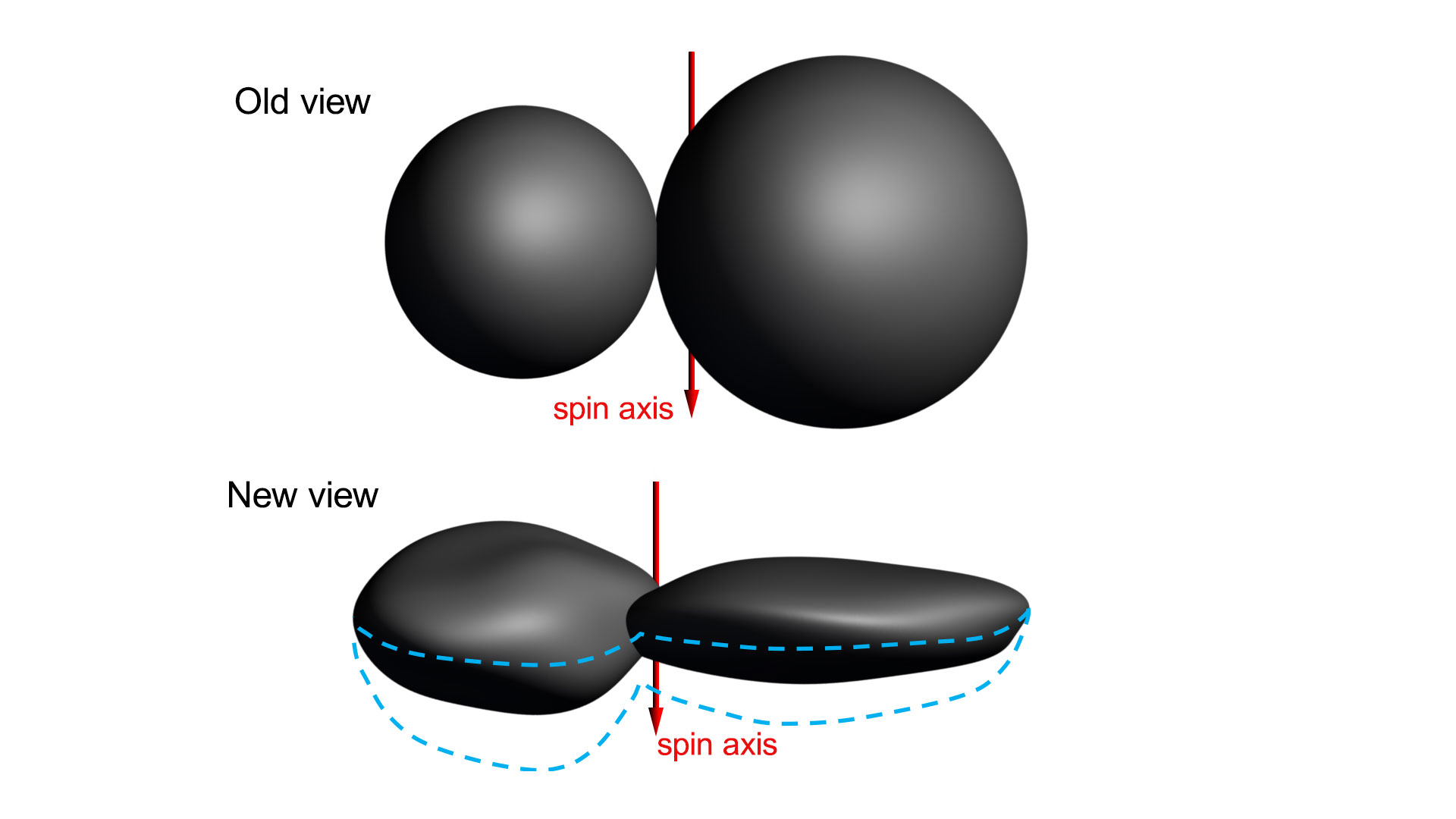
The newly released images also contain important scientific information about the shape of Ultima Thule, which is turning out to be one of the major discoveries from the flyby.
The first close-up images of Ultima Thule – with its two distinct and, apparently, spherical segments – had observers calling it a “snowman.” However, more analysis of approach images and these new departure images have changed that view, in part by revealing an outline of the portion of the KBO that was not illuminated by the Sun but could be “traced out” as it blocked the view to background stars.
Stringing 14 of these images into a short departure movie, New Horizons scientists can confirm that the two sections (or “lobes”) of Ultima Thule are not spherical. The larger lobe, nicknamed “Ultima,” more closely resembles a giant pancake, and the smaller lobe, nicknamed “Thule,” is shaped like a dented walnut.
“We had an impression of Ultima Thule based on the limited number of images returned in the days around the flyby, but seeing more data has significantly changed our view,” Stern said. “It would be closer to reality to say Ultima Thule’s shape is flatter, like a pancake. But more importantly, the new images are creating scientific puzzles about how such an object could even be formed. We’ve never seen something like this orbiting the Sun.”
The departure images were taken from a different angle than the approach photos and revealed complementary information on Ultima Thule’s shape. The central frame of the sequence was taken on Jan. 1 at 05:42:42 UT (12:42 a.m. EST), when New Horizons was 5,494 miles (8,862 kilometers) beyond Ultima Thule and 4.1 billion miles (6.6 billion kilometers) from Earth. The object’s illuminated crescent is blurred in the individual frames because a relatively long exposure time was used during this rapid scan to boost the camera’s signal level – but the science team combined and processed the images to remove the blurring and sharpen the thin crescent.
This animation depicts a shape model of Ultima Thule created by the New Horizons science team based on its analysis of all the pre-flyby images sent to Earth so far. The first half of the movie mimics the view from the New Horizons spacecraft as it approached Ultima Thule and has the “snowman” shape that was so frequently mentioned in the days surrounding the New Year’s 2019 flyby. The movie then rotates to a side-view that illustrates what New Horizons might have seen had its cameras been pointing toward Ultima Thule only a few minutes after closest approach. While that wasn’t the case, mission scientists have been able to piece together a model of this side-view, which has been at least partially confirmed by a set of crescent images of Ultima Thule (link). There is still considerable uncertainty in the sizes of “Ultima” (the larger section, or lobe) and “Thule” (the smaller) in the vertical dimension, but it’s now clear that Ultima looks more like a pancake than a sphere, and that Thule is also very non-spherical. The rotation in this animation is not the object’s actual rotation, but is used purely to illustrate its shape. Credit: NASA/Johns Hopkins Applied Physics Laboratory/Southwest Research Institute
Many background stars are also seen in the individual images; watching which stars “blinked out” as the object passed in front of them allowed scientists to outline the shape of both lobes, which could then be compared to a model assembled from analyzing pre-flyby images and ground-based telescope observations. “The shape model we have derived from all of the existing Ultima Thule imagery is remarkably consistent with what we have learned from the new crescent images,” says Simon Porter, a New Horizons co-investigator from the Southwest Research Institute, who leads the shape-modeling effort.
“While the very nature of a fast flyby in some ways limits how well we can determine the true shape of Ultima Thule, the new results clearly show that Ultima and Thule are much flatter than originally believed, and much flatter than expected,” added Hal Weaver, New Horizons project scientist from the Johns Hopkins Applied Physics Laboratory. “This will undoubtedly motivate new theories of planetesimal formation in the early solar system.”
The images in this sequence will be available on the New Horizons LORRI website this week. Raw images from the camera are posted to the site each Friday.
Mission scientists created this “departure movie” from 14 different images taken by the New Horizons Long Range Reconnaissance Imager (LORRI) shortly after the spacecraft flew past the Kuiper Belt object nicknamed Ultima Thule (officially named 2014 MU69) on Jan. 1, 2019. The central frame of this sequence was taken on Jan. 1 at 05:42:42 UT (12:42 a.m. EST), when New Horizons was 5,494 miles (8,862 kilometers) beyond Ultima Thule, some 4.1 billion miles (6.6 billion kilometers) from Earth. The object’s illuminated crescent is blurred in the individual frames because a relatively long exposure time was used during this rapid scan to boost the camera’s signal level – but the science team combined and processed the images to remove the blurring and sharpen the thin crescent. This is the farthest movie of any object in our Solar System ever made by any spacecraft. The images reveal an outline of the “hidden” portion of the Ultima Thule that was not illuminated by the Sun as the spacecraft zipped by, but can be “traced out” because it blocked the view to background stars also in the image. Credit: NASA/Johns Hopkins Applied Physics Laboratory/Southwest Research Institute/National Optical Astronomy Observatory
Never miss a breakthrough: Join the SciTechDaily newsletter.
Follow us on Google and Google News.
3 Comments
The perfect place to exile Team Trump to.
no bro, who will MAGA when he gone
Always a few neuronless individuals bringing in their left wing politics to a place where science should be the discussion.