
Close Menu
    Facebook X (Twitter) Instagram
    SciTechDaily
    • Biology
    • Chemistry
    • Earth
    • Health
    • Physics
    • Science
    • Space
    • Technology
    Facebook X (Twitter) Pinterest YouTube RSS
    SciTechDaily
    Home»Space»Kuiper Belt Object Ultima Thule Reveals First Stages of Solar System’s History
    Space

    Kuiper Belt Object Ultima Thule Reveals First Stages of Solar System’s History

    By Johns Hopkins University Applied Physics LaboratoryJanuary 2, 2019No Comments3 Mins Read
    Facebook Twitter Pinterest Telegram LinkedIn WhatsApp Email Reddit
    Share
    Facebook Twitter LinkedIn Pinterest Telegram Email Reddit
    New Horizons Mission Reveals Entirely New Kind of World
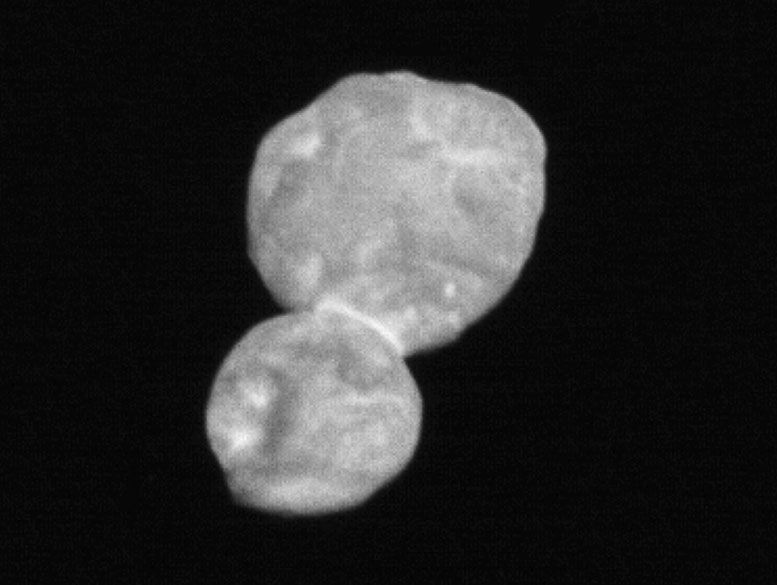
    This image taken by the Long-Range Reconnaissance Imager (LORRI) is the most detailed of Ultima Thule returned so far by the New Horizons spacecraft. It was taken at 5:01 Universal Time on January 1, 2019, just 30 minutes before the closest approach from a range of 18,000 miles (28,000 kilometers), with an original scale of 459 feet (140 meters) per pixel. Credit: NASA/Johns Hopkins University Applied Physics Laboratory/Southwest Research Institute

    Scientists from NASA’s New Horizons mission released the first detailed images of the most distant object ever explored — the Kuiper Belt object nicknamed Ultima Thule. Its remarkable appearance, unlike anything we’ve seen before, illuminates the processes that built the planets four and a half billion years ago.

    “This flyby is a historic achievement,” said New Horizons Principal Investigator Alan Stern of the Southwest Research Institute in Boulder, Colorado. “Never before has any spacecraft team tracked down such a small body at such high speed so far away in the abyss of space. New Horizons has set a new bar for state-of-the-art spacecraft navigation.”

    The new images — taken from as close as 17,000 miles (27,000 kilometers) on approach — revealed Ultima Thule as a “contact binary,” consisting of two connected spheres. End to end, the world measures 19 miles (31 kilometers) in length. The team has dubbed the larger sphere “Ultima” (12 miles/19 kilometers across) and the smaller sphere “Thule” (9 miles/14 kilometers across).

    Images of the Kuiper Belt Object Ultima Thule
    The first color image of Ultima Thule, taken at a distance of 85,000 miles (137,000 kilometers) at 4:08 Universal Time on January 1, 2019, highlights its reddish surface. At left is an enhanced color image taken by the Multispectral Visible Imaging Camera (MVIC), produced by combining the near-infrared, red and blue channels. The center image taken by the Long-Range Reconnaissance Imager (LORRI) has a higher spatial resolution than MVIC by approximately a factor of five. At right, the color has been overlaid onto the LORRI image to show the color uniformity of the Ultima and Thule lobes. Note the reduced red coloring at the neck of the object. Credit: NASA/Johns Hopkins University Applied Physics Laboratory/Southwest Research Institute

    The team says that the two spheres likely joined as early as 99 percent of the way back to the formation of the solar system, colliding no faster than two cars in a fender-bender.

    “New Horizons is like a time machine, taking us back to the birth of the solar system. We are seeing a physical representation of the beginning of planetary formation, frozen in time,” said Jeff Moore, New Horizons Geology and Geophysics team lead. “Studying Ultima Thule is helping us understand how planets form — both those in our own solar system and those orbiting other stars in our galaxy.”

    Data from the New Year’s Day flyby will continue to arrive over the next weeks and months, with much higher resolution images yet to come.

    “In the coming months, New Horizons will transmit dozens of data sets to Earth, and we’ll write new chapters in the story of Ultima Thule — and the solar system,” said Helene Winters, New Horizons Project Manager.

    The Johns Hopkins Applied Physics Laboratory in Laurel, Maryland, designed, built and operates the New Horizons spacecraft, and manages the mission for NASA’s Science Mission Directorate. The Southwest Research Institute, based in San Antonio, leads the science team, payload operations and encounter science planning. New Horizons is part of the New Frontiers Program managed by NASA’s Marshall Space Flight Center in Huntsville, Alabama.

    View slides from the press conference

    Never miss a breakthrough: Join the SciTechDaily newsletter.
    Follow us on Google and Google News.

    Astronomy Cosmology Johns Hopkins APL
    Share. Facebook Twitter Pinterest LinkedIn Email Reddit

    Related Articles

    New Horizons Reaches Most Distant Target in History

    Chandra Detects X-Rays from Pluto

    ESA’s Euclid Mission Receives Final Approval

    Calculations Show the Ideal Time to Study the Cosmos

    New Model May Rule Out the Presence of Dark Matter

    Lyman-Alpha Blobs are Some of the Largest Individual Objects in the Observable Universe

    Links Between Core Collapse Supernovae and Star Formation Established

    The Bolshoi Simulation: Boxing the Universe

    Baryon Oscillation Spectroscopic Survey Measures the Universe’s Expansion and Dark Energy

    Leave A Reply Cancel Reply

    • Facebook
    • Twitter
    • Pinterest
    • YouTube

    Don't Miss a Discovery

    Subscribe for the Latest in Science & Tech!

    Trending News

    FDA-Approved Drug Shows Promise for Reversing Osteoarthritis Damage

    11,000-Year-Old Grains Reveal a Surprise About the Origins of Agriculture

    This Common Type of Medication Is Linked to Slower Cognitive Decline

    Quantum Computer Solves a Problem in 15 Minutes That Classical Methods Can’t Practically Compute

    Taking the Stairs Could Cut Your Risk of Heart-Related Death by 39%

    Scientists Uncover a Surprising New Route for Stonehenge’s Most Mysterious Stone

    A Star Near the Milky Way’s Black Hole Is Losing Mass at an Astonishing Rate

    Scientists Solve a Vitamin B12 Mystery With an Unexpected Culprit

    Follow SciTechDaily
    • Facebook
    • Twitter
    • YouTube
    • Pinterest
    • Newsletter
    • RSS
    SciTech News
    • Biology News
    • Chemistry News
    • Earth News
    • Health News
    • Physics News
    • Science News
    • Space News
    • Technology News
    Recent Posts
    • Scientists Find a Hidden Biological Link Across Different Forms of Autism
    • Scientists Discover a 3.7-Billion-Year-Old Secret of Early Life
    • Scientists Revisited a Forest Experiment That Was Forgotten for 30 Years. What They Found Was Astounding
    • Astronomers Discover a Ghostly River of Stars That Could Reveal Dark Matter
    • NASA Is Building a Moon Base – and the First Pieces Are Already Coming Together
    Copyright © 1998 - 2026 SciTechDaily. All Rights Reserved.
    • Science News
    • About
    • Contact
    • Editorial Board
    • Privacy Policy
    • Terms of Use

    Type above and press Enter to search. Press Esc to cancel.