
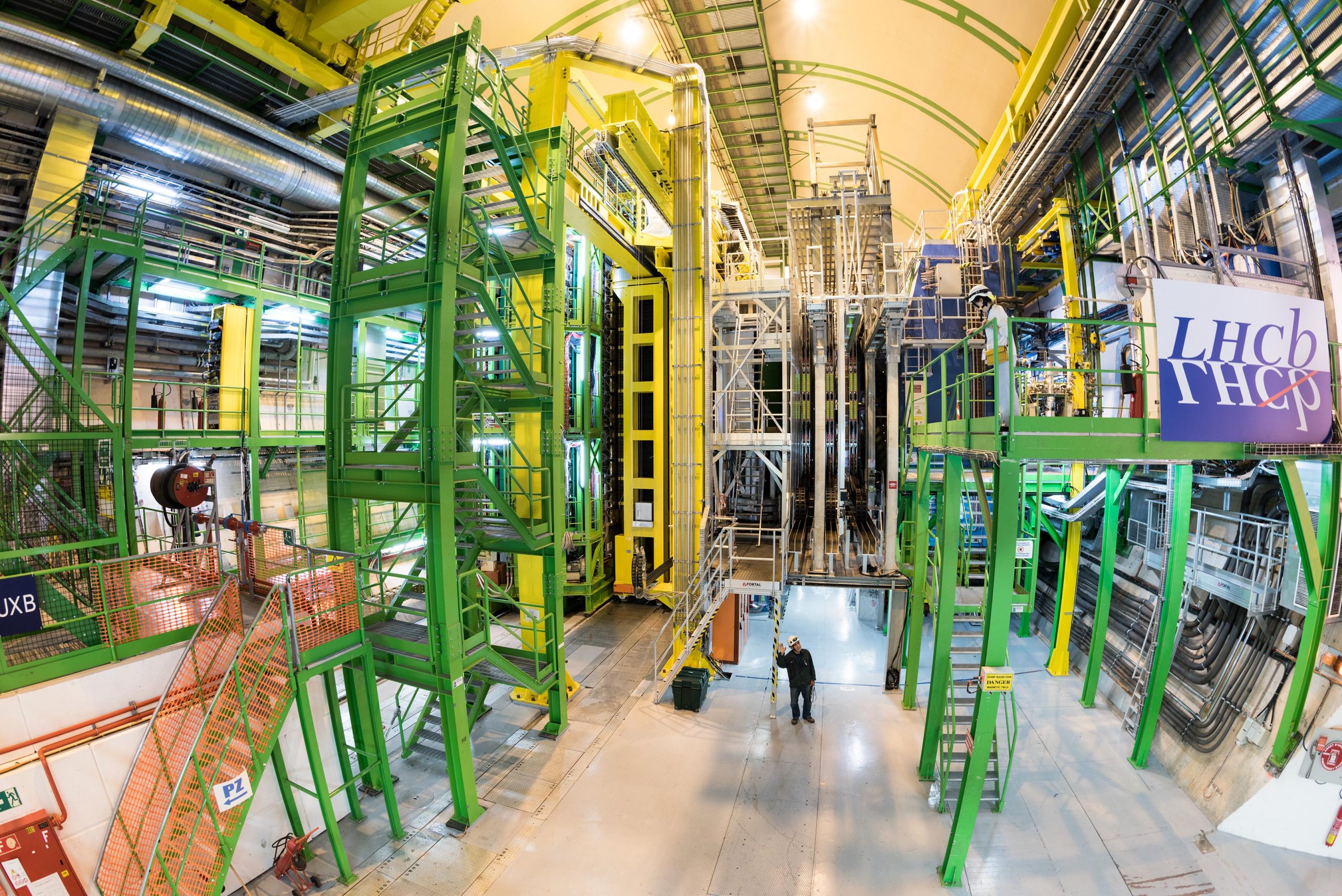
For the first time, LHCb uses beauty baryons to test this key principle of the Standard Model.
The Large Hadron Collider beauty experiment (LHCb) collaboration has reported an intriguing new result in its quest to test a key principle of the Standard Model called lepton universality. Although not statistically significant, the finding – a possible difference in the behavior of different types of lepton particles – chimes with other previous results. If confirmed, as more data are collected and analyzed, the results would signal a crack in the Standard Model.
Lepton universality is the idea that all three types of charged lepton particles – electrons, muons, and taus – interact in the same way with other particles. As a result, the different lepton types should be created equally often in particle transformations, or “decays,” once differences in their mass are accounted for. However, some measurements of particle decays made by the LHCb team and other groups over the past few years have indicated a possible difference in their behavior. Taken separately, these measurements are not statistically significant enough to claim a breaking of lepton universality and hence a crack in the Standard Model, but it is intriguing that hints of a difference have been popping up in different particle decays and experiments.
The latest LHCb result is the first test of lepton universality made using the decays of beauty baryons – three-quark particles containing at least one beauty quark. Sifting through proton–proton collision data at energies of 7, 8, and 13 TeV, the LHCb researchers identified beauty baryons called Λb0 and counted how often they decayed to a proton, a charged kaon and either a muon and antimuon or an electron and antielectron.
The team then took the ratio between these two decay rates. If lepton universality holds, this ratio should be close to 1. A deviation from this prediction could therefore signal a violation of lepton universality. Such a violation could be caused by the presence in the decays of a never-before-spotted particle not predicted by the Standard Model.
The team obtained a ratio slightly below 1 with a statistical significance of about 1 standard deviation, well below the 5 standard deviations needed to claim a real difference in the decay rates. The researchers say that the result points in the same direction as other results, which have observed hints that decays to a muon–antimuon pair occur less often than those to an electron–antielectron pair, but they also stress that much more data is needed to tell whether this oddity in the behavior of leptons is here to stay or not.
Reference: “Test of lepton universality with Λ0b→pK−ℓ+ℓ− decays” by LHCb collaboration: R. Aaij, C. Abellán Beteta, T. Ackernley, B. Adeva, M. Adinolfi, H. Afsharnia, C.A. Aidala, S. Aiola, Z. Ajaltouni, S. Akar, P. Albicocco, J. Albrecht, F. Alessio, M. Alexander, A. Alfonso Albero, G. Alkhazov, P. Alvarez Cartelle, A.A. Alves Jr, S. Amato, Y. Amhis, L. An, L. Anderlini, G. Andreassi, M. Andreotti, F. Archilli, J. Arnau Romeu, A. Artamonov, M. Artuso, K. Arzymatov, E. Aslanides, M. Atzeni, B. Audurier, S. Bachmann, J.J. Back, S. Baker, V. Balagura, W. Baldini, A. Baranov, R.J. Barlow, S. Barsuk, W. Barter, M. Bartolini, F. Baryshnikov, G. Bassi, V. Batozskaya, B. Batsukh, A. Battig, A. Bay, M. Becker, F. Bedeschi, I. Bediaga, A. Beiter, L.J. Bel, V. Belavin, S. Belin, N. Beliy, V. Bellee, K. Belous, I. Belyaev, G. Bencivenni, E. Ben-Haim, S. Benson, S. Beranek, A. Berezhnoy, R. Bernet, D. Berninghoff, H.C. Bernstein, C. Bertella, E. Bertholet, A. Bertolin, C. Betancourt, F. Betti, M.O. Bettler, Ia. Bezshyiko, S. Bhasin, J. Bhom, M.S. Bieker, S. Bifani, P. Billoir, A. Bizzeti, M. Bjørn, M.P. Blago, T. Blake, F. Blanc, S. Blusk, D. Bobulska, V. Bocci, O. Boente Garcia, T. Boettcher, A. Boldyrev, A. Bondar, N. Bondar, S. Borghi, M. Borisyak, M. Borsato, J.T. Borsuk, T.J.V. Bowcock, C. Bozzi, M.J. Bradley, S. Braun, A. Brea Rodriguez, M. Brodski, J. Brodzicka, A. Brossa Gonzalo, D. Brundu, E. Buchanan, A. Buonaura, C. Burr, A. Bursche, J.S. Butter, J. Buytaert, W. Byczynski, S. Cadeddu, H. Cai, R. Calabrese, L. Calero Diaz, S. Cali, R. Calladine, M. Calvi, M. Calvo Gomez, P. Camargo Magalhaes, A. Camboni, P. Campana, D.H. Campora Perez, L. Capriotti, A. Carbone, G. Carboni, et al., 17 December 2019, High Energy Physics – Experiment.
DOI: 10.1007/JHEP05(2020)040
arXiv:1912.08139
Never miss a breakthrough: Join the SciTechDaily newsletter.
Follow us on Google and Google News.
4 Comments
They are called bottom quarks.
Ref: M. Tanabashi et al. (Particle Data Group), Phys. Rev. D 98, 030001 (2018) and 2019 update.
“Beauty quark” has pretty much fallen out of use, yeah.
the article is really very helpful.
Hi thanks for the helpful information shared.