
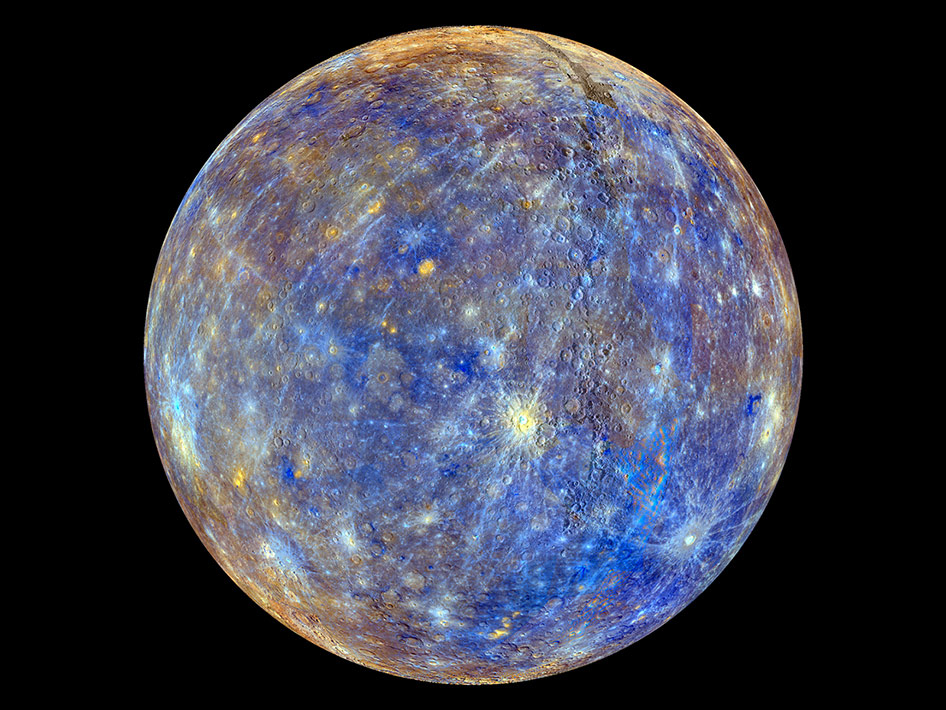
Scientists used data from NASA’s Messenger spacecraft to reveal how Mercury’s core is different from Earth’s, explaining why the planet has such a bizarre magnetic field.
Earth and Mercury are both rocky planets with iron cores, but Mercury’s interior differs from Earth’s in a way that explains why the planet has such a bizarre magnetic field, UCLA planetary physicists and colleagues report.
Measurements from NASA’s Messenger spacecraft have revealed that Mercury’s magnetic field is approximately three times stronger at its northern hemisphere than its southern one. In the current research, scientists led by Hao Cao, a UCLA postdoctoral scholar working in the laboratory of Christopher T. Russell, created a model to show how the dynamics of Mercury’s core contribute to this unusual phenomenon.
The magnetic fields that surround and shield many planets from the sun’s energy-charged particles differ widely in strength. While Earth’s is powerful, Jupiter’s is more than 12 times stronger, and Mercury has a rather weak magnetic field. Venus likely has none at all. The magnetic fields of Earth, Jupiter, and Saturn show very little difference between the planets’ two hemispheres.
Within Earth’s core, iron turns from a liquid to a solid at the inner boundary of the planet’s liquid outer core; this results in a solid inner part and a liquid outer part. The solid inner core is growing, and this growth provides the energy that generates Earth’s magnetic field. Many assumed, incorrectly, that Mercury would be similar.
“Hao’s breakthrough is in understanding how Mercury is different from the Earth so we could understand Mercury’s strongly hemispherical magnetic field,” said Russell, a co-author of the research and a professor in the UCLA College’s department of Earth, planetary and space sciences. “We had figured out how the Earth works, and Mercury is another terrestrial, rocky planet with an iron core, so we thought it would work the same way. But it’s not working the same way.”
Mercury’s peculiar magnetic field provides evidence that iron turns from a liquid to a solid at the core’s outer boundary, say the scientists, whose research currently appears online in the journal Geophysical Research Letters and will be published in an upcoming print edition.
“It’s like a snow storm in which the snow formed at the top of the cloud and middle of the cloud and the bottom of the cloud too,” said Russell. “Our study of Mercury’s magnetic field indicates iron is snowing throughout this fluid that is powering Mercury’s magnetic field.”
The research implies that planets have multiple ways of generating a magnetic field.
Hao and his colleagues conducted mathematical modeling of the processes that generate Mercury’s magnetic field. In creating the model, Hao considered many factors, including how fast Mercury rotates and the chemistry and complex motion of fluid inside the planet.
The cores of both Mercury and Earth contain light elements such as sulfur, in addition to iron; the presence of these light elements keeps the cores from being completely solid and “powers the active magnetic field–generation processes,” Hao said.
Hao’s model is consistent with data from Messenger and other research on Mercury and explains Mercury’s asymmetric magnetic field in its hemispheres. He said the first important step was to “abandon assumptions” that other scientists make.
“Planets are different from one another,” said Hao, whose research is funded by a NASA fellowship. “They all have their individual character.”
Co-authors include Jonathan Aurnou, professor of planetary science and geophysics in UCLA’s Department of Earth, Planetary and Space Sciences, and Johannes Wicht, a research scientist at Germany’s Max Planck Institute for Solar System Research.
Reference: “A dynamo explanation for Mercury’s anomalous magnetic field” by Hao Cao, Jonathan M. Aurnou, Johannes Wicht, Wieland Dietrich, Krista M. Soderlund and Christopher T. Russell, 2 June 2014, Geophysical Research Letters.
DOI: 10.1002/2014GL060196
Never miss a breakthrough: Join the SciTechDaily newsletter.
Follow us on Google and Google News.
2 Comments
Mercury is already close to the Sun and tidal effect of immense gravitation should percolate to the molten iron core of Mercury, and may be the reason for different magnetic field in northern and southern pole. By the by we know that Mercury is also gravitationally locked like our Moon by Earth. In Earth the tidal effect of gravitation is visible only the large body of SEA and the molten iron core propelling tectonic movements of land masses and earthquakes. Moreover Earth is also very big compared to Mercury to even out the magnetic fields. Thank You.
thanks for explanation