
Close Menu
    Facebook X (Twitter) Instagram
    SciTechDaily
    • Biology
    • Chemistry
    • Earth
    • Health
    • Physics
    • Science
    • Space
    • Technology
    Facebook X (Twitter) Pinterest YouTube RSS
    SciTechDaily
    Home»Space»NASA Research Reveals That Mercury is Active
    Space

    NASA Research Reveals That Mercury is Active

    By NASASeptember 26, 20161 Comment3 Mins Read
    Facebook Twitter Pinterest Telegram LinkedIn WhatsApp Email Reddit
    Share
    Facebook Twitter LinkedIn Pinterest Telegram Email Reddit
    Mercury is Active After All
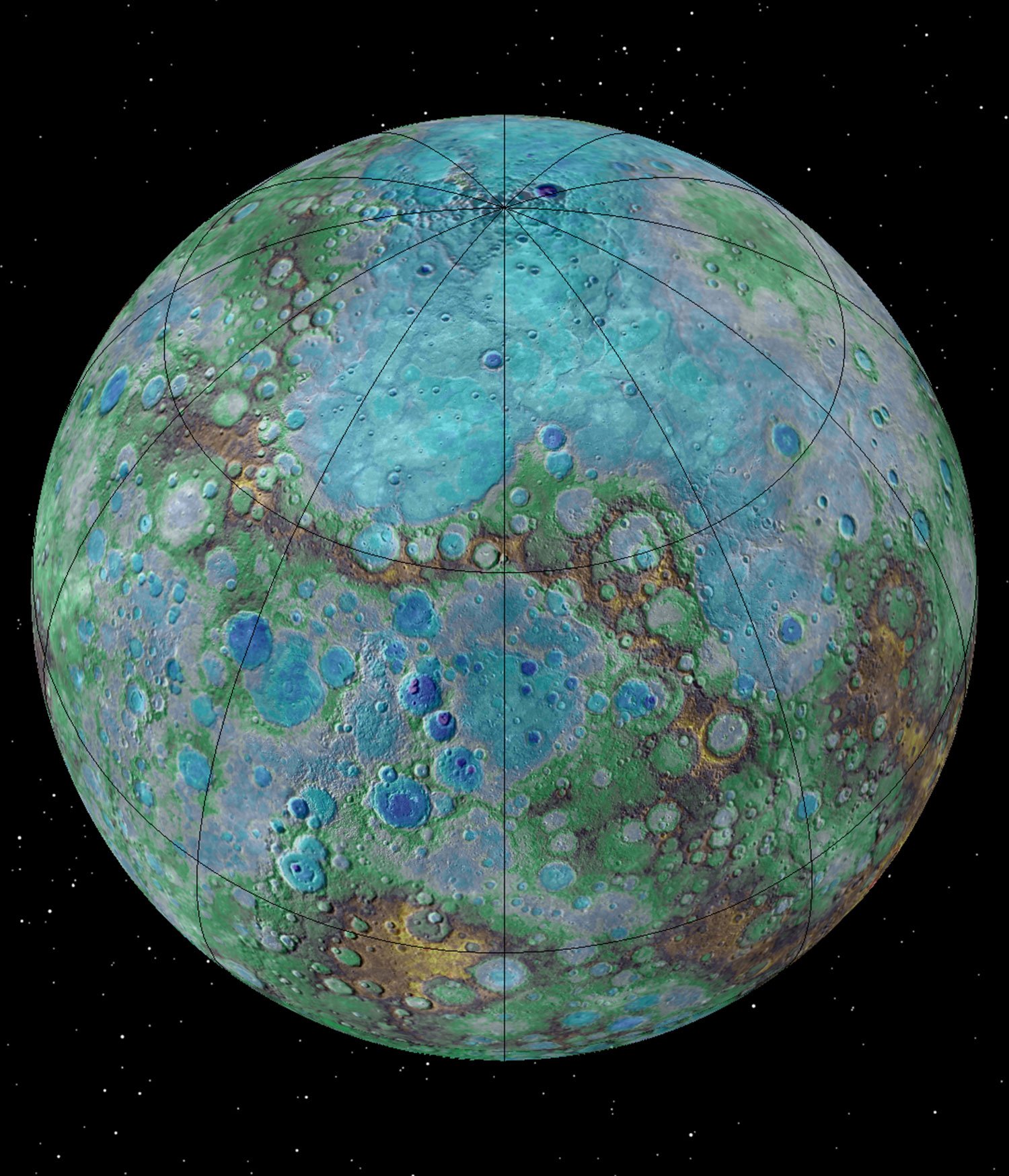
    It’s small, it’s hot, and it’s shrinking. Surprising new NASA-funded research suggests that Mercury is contracting even today, joining Earth as a tectonically active planet. Credit: NASA/JHUAPL/Carnegie Institution of Washington/USGS/Arizona State University

    New research suggests that Mercury is contracting even today, joining Earth as a tectonically active planet.

    Images obtained by NASA’s MErcury Surface, Space ENvironment, GEochemistry, and Ranging (MESSENGER) spacecraft reveal previously undetected small fault scarps— cliff-like landforms that resemble stair steps. These scarps are small enough that scientists believe they must be geologically young, which means Mercury is still contracting and that Earth is not the only tectonically active planet in our solar system, as previously thought.

    The findings will be reported in a paper in the October issue of Nature Geoscience.

    “The young age of the small scarps means that Mercury joins Earth as a tectonically active planet, with new faults likely forming today as Mercury’s interior continues to cool and the planet contracts,” said lead author Tom Watters, Smithsonian senior scientist at the National Air and Space Museum in Washington, D.C.

    Large fault scarps on Mercury were first discovered in the flybys of Mariner 10 in the mid-1970s and confirmed by MESSENGER, which found the planet closest to the sun was shrinking. The large scarps were formed as Mercury’s interior cooled, causing the planet to contract and the crust to break and thrust upward along faults making cliffs up to hundreds of miles long and some more than a mile (over one-and-a-half kilometers) high.
    Shrinking Mercury is Active After All
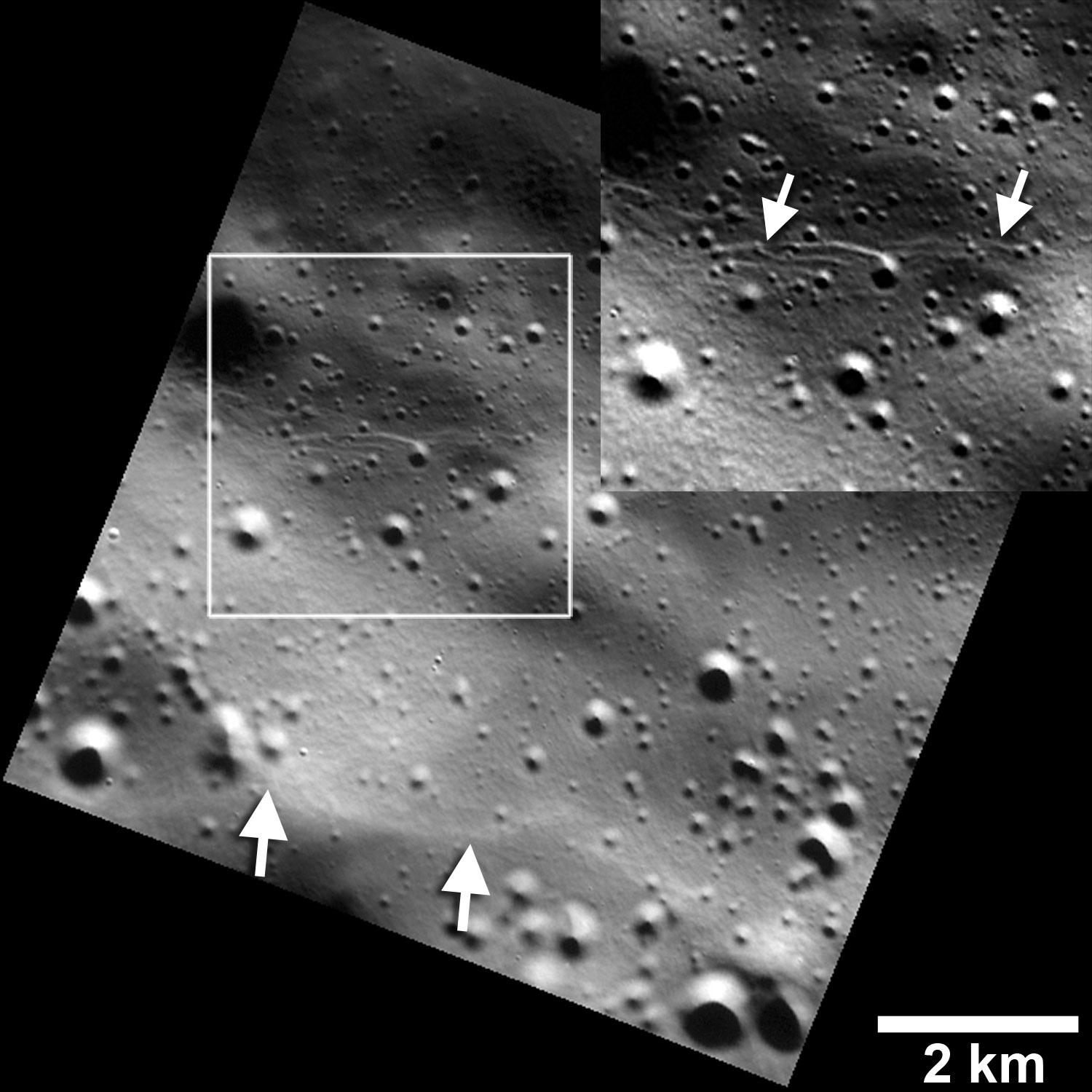
    Small graben, or narrow linear troughs, have been found associated with small fault scarps (lower white arrows) on Mercury, and on Earth’s moon. The small troughs, only tens of meters wide (inset box and upper white arrows), likely resulted from the bending of the crust as it was uplifted, and must be very young to survive continuous meteoroid bombardment.

    In the last 18 months of the MESSENGER mission, the spacecraft’s altitude was lowered, which allowed the surface of Mercury to be seen at much higher resolution. These low-altitude images revealed small fault scarps that are orders of magnitude smaller than the larger scarps. The small scarps had to be very young, investigators say, to survive the steady bombardment of meteoroids and comets. They are comparable in scale to small, young lunar scarps that are evidence Earth’s moon is also shrinking.

    This active faulting is consistent with the recent finding that Mercury’s global magnetic field has existed for billions of years and with the slow cooling of Mercury’s still hot outer core. It’s likely that the smallest of the terrestrial planets also experiences Mercury-quakes—something that may one day be confirmed by seismometers.

    “This is why we explore,” said NASA Planetary Science Director Jim Green at Headquarters in Washington, D.C. “For years, scientists believed that Mercury’s tectonic activity was in the distant past. It’s exciting to consider that this small planet – not much larger than Earth’s moon – is active even today.”

    Never miss a breakthrough: Join the SciTechDaily newsletter.
    Follow us on Google and Google News.

    Astronomy Geoscience Mercury NASA NASA MESSENGER Planetary Science Popular
    Share. Facebook Twitter Pinterest LinkedIn Email Reddit

    Related Articles

    Scientists Unveil the First Global Topographic Model of Mercury

    NASA’s Mars Reconnaissance Orbiter Confirms Evidence That Liquid Water Flows on Mars

    MESSENGER Spacecraft Reveals New Details about Mercury

    MESSENGER Collects Important Data on Mercury During Its Orbital Decay

    Messenger Spacecraft Reveals Mercury’s Bizarre Magnetic Field

    NASA’s Messenger Discovers Hot Flow Anomalies at Mercury

    New Study Resolves a Decades-Old Paradox between Thermal History Models and Estimates of Mercury’s Contraction

    Scientists Find Evidence for Granite on Mars

    A Multi-Colored Mercury

    1 Comment

    1. Madanagopal.V.C. on October 2, 2016 12:47 am

      Mercury is still very hot and it is no doubt that tectonic activity should be more vigorous here rather than our cold Earth. Moreover tectonic plate movements are common in all the spherical planets since its core should be very hot and this is the reason why they blow into a sphere just like blowing a glass bulb in the factory. Thank You.

      Reply
    Leave A Reply Cancel Reply

    • Facebook
    • Twitter
    • Pinterest
    • YouTube

    Don't Miss a Discovery

    Subscribe for the Latest in Science & Tech!

    Trending News

    Artificial Sweeteners May Harm Future Generations, Study Suggests

    Splashdown! NASA Artemis II Returns From Record-Breaking Moon Mission

    What If Consciousness Exists Beyond Your Brain

    Scientists Finally Crack the 100-Million-Year Evolutionary Mystery of Squid and Cuttlefish

    Beyond “Safe Levels”: Study Challenges What We Know About Pesticides and Cancer

    Researchers Have Found a Dietary Compound That Increases Longevity

    Scientists Baffled by Bizarre “Living Fossil” From 275 Million Years Ago

    Your IQ at 23 Could Predict Your Wealth at 27, Study Finds

    Follow SciTechDaily
    • Facebook
    • Twitter
    • YouTube
    • Pinterest
    • Newsletter
    • RSS
    SciTech News
    • Biology News
    • Chemistry News
    • Earth News
    • Health News
    • Physics News
    • Science News
    • Space News
    • Technology News
    Recent Posts
    • What if Dark Matter Has Two Forms? Bold New Hypothesis Could Explain a Cosmic Mystery
    • Researchers Expose Hidden Chemistry of “Ore-Forming” Elements in Biology
    • Geologists Reveal the Americas Collided Earlier Than We Thought
    • 20x Difference: Study Reveals True Source of Airborne Microplastics
    • Scientists Uncover Hidden Force Powering Yellowstone’s Supervolcano
    Copyright © 1998 - 2026 SciTechDaily. All Rights Reserved.
    • Science News
    • About
    • Contact
    • Editorial Board
    • Privacy Policy
    • Terms of Use

    Type above and press Enter to search. Press Esc to cancel.