
Close Menu
    Facebook X (Twitter) Instagram
    SciTechDaily
    • Biology
    • Chemistry
    • Earth
    • Health
    • Physics
    • Science
    • Space
    • Technology
    Facebook X (Twitter) Pinterest YouTube RSS
    SciTechDaily
    Home»Space»Presence of Ice on Mercury Confirmed by MESSENGER Probe
    Space

    Presence of Ice on Mercury Confirmed by MESSENGER Probe

    By SciTechDailyNovember 30, 2012No Comments3 Mins Read
    Facebook Twitter Pinterest Telegram LinkedIn WhatsApp Email Reddit
    Share
    Facebook Twitter LinkedIn Pinterest Telegram Email Reddit
    polar-craters-mercury
    MESSENGER images polar craters. Credit: NASA

    While the surface of Mercury is hot enough in some places to melt lead, the MESSENGER probe confirmed that there are about a trillion tonnes of water ice trapped inside craters.

    The scientists published their findings in the journal Science (1, 2, 3) in three papers. The ice, which was long suspected, seems to be much purer than ice trapped in similar craters on Earth’s Moon. This could mean that Mercury is a better place to trap icy materials delivered by asteroids and comets.
    nasa-ice-crater-mercury
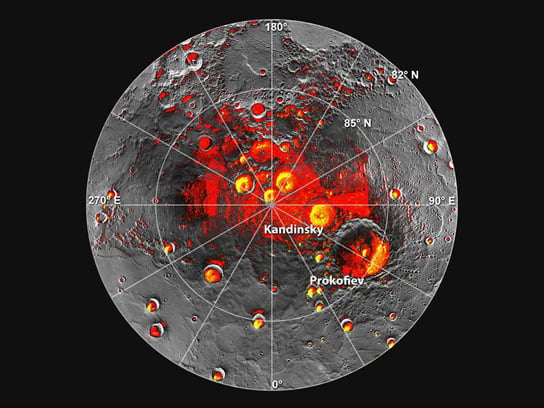
    Shown in red are areas of Mercury’s north polar region that are in shadow in all images acquired by MESSENGER to date. Image coverage, and mapping of shadows, is incomplete near the pole. The polar deposits imaged by Earth-based radar are in yellow (from Image 2.1), and the background image is the mosaic of MESSENGER images from Image 2.2. This comparison indicates that all of the polar deposits imaged by Earth-based radar are located in areas of persistent shadow as documented by MESSENGER images. Credit: NASA/Johns Hopkins University Applied Physics Laboratory/Carnegie Institution of Washington/National Astronomy and Ionosphere Center, Arecibo Observatory

    The floors of many of Mercury’s polar craters are cast in permanent shadow, despite the planet’s blistering 400 °C (750 °F) temperatures. This is caused by the fact that the planet’s rotational axis is perpendicular to its orbital plane, so the poles never tip towards Sol. There are bright regions near the poles that contain meter-thick slabs of pure ice.

    IR pulses fired at the planet from MESSENGER revealed that the bright regions inside darkened craters line up perfectly with ultra-cold spots on the planet, which never get warmer than –170 °C (-274 °F).

    MESSENGER’s Neutron Spectrometer has spotted the signature of hydrogen, which astronomers think is locked up in ice, in those same regions. The bright spots are surrounded by darker terrain that receives more sunlight and heat. This material is a layer of about 10 centimeters that lies on top of the ice, insulating it.

    The darker material could be made up of complex hydrocarbons expelled from planetary impacts. When icy bodies collide with Mercury, their components migrate over time to the cooler poles by repeatedly vaporizing and precipitating, where they get stuck in frigid polar craters. Sunlight will sometimes strike parts of the craters’ interiors, vaporizing the ice and leaving behind deposits of hydrocarbons that gradually become thicker and darker as they are chemically altered by sunlight.

    Never miss a breakthrough: Join the SciTechDaily newsletter.
    Follow us on Google and Google News.

    Astronomy Mercury NASA MESSENGER Planetary Science
    Share. Facebook Twitter Pinterest LinkedIn Email Reddit

    Related Articles

    Scientists Unveil the First Global Topographic Model of Mercury

    MESSENGER Spacecraft Reveals New Details about Mercury

    MESSENGER Collects Important Data on Mercury During Its Orbital Decay

    NASA’s MESSENGER Spacecraft Seeks to Unmask the Secrets of Mercury

    New Surface Composition Maps of Mercury Provide Clues to the Planet’s History

    MESSENGER Reveals Possible Source of Surge of Calcium in Mercury Exosphere

    Messenger Spacecraft Reveals Mercury’s Bizarre Magnetic Field

    NASA’s Messenger Discovers Hot Flow Anomalies at Mercury

    New Study Resolves a Decades-Old Paradox between Thermal History Models and Estimates of Mercury’s Contraction

    Leave A Reply Cancel Reply

    • Facebook
    • Twitter
    • Pinterest
    • YouTube

    Don't Miss a Discovery

    Subscribe for the Latest in Science & Tech!

    Trending News

    Massive Study Warns Marijuana Use in Teens Is Linked to Serious Mental Illness

    Scientists Discover a Completely Unexpected Way T Cells Kill Cancer

    Scientists Just Found the Solar System’s Original “Planet Factory”

    Study Warns Widely Used Food Preservatives Linked to High Blood Pressure and Heart Disease

    New Treatment Could Reverse Osteoarthritis Within Weeks

    Physicists Have Measured “Negative Time” in Bizarre Quantum Experiment

    The Deadly Tapeworm Spreading Across America Has Reached the Pacific Northwest

    Could Low Vitamin D Be Making Your Pain Worse?

    Follow SciTechDaily
    • Facebook
    • Twitter
    • YouTube
    • Pinterest
    • Newsletter
    • RSS
    SciTech News
    • Biology News
    • Chemistry News
    • Earth News
    • Health News
    • Physics News
    • Science News
    • Space News
    • Technology News
    Recent Posts
    • Streetlights Are Trapping Thousands of Isopods in Mysterious “Death Spirals”
    • Scientists Have Discovered These Deadly Parasites Are Secretly Swapping DNA
    • What Scientists Found Inside a 117-Year-Old Woman Reveals New Clues to Long Life
    • Breakthrough Technique Reveals Atomic Secrets of Record-Breaking Superconductors
    • The Future of Work Belongs to People Who Master AI
    Copyright © 1998 - 2026 SciTechDaily. All Rights Reserved.
    • Science News
    • About
    • Contact
    • Editorial Board
    • Privacy Policy
    • Terms of Use

    Type above and press Enter to search. Press Esc to cancel.