
Close Menu
    Facebook X (Twitter) Instagram
    SciTechDaily
    • Biology
    • Chemistry
    • Earth
    • Health
    • Physics
    • Science
    • Space
    • Technology
    Facebook X (Twitter) Pinterest YouTube RSS
    SciTechDaily
    Home»Technology»First Electron Microscope Image of DNA Double Helix
    Technology

    First Electron Microscope Image of DNA Double Helix

    By SciTechDailyNovember 30, 20121 Comment2 Mins Read
    Facebook Twitter Pinterest Telegram LinkedIn WhatsApp Email Reddit
    Share
    Facebook Twitter LinkedIn Pinterest Telegram Email Reddit
    dna-double-helix
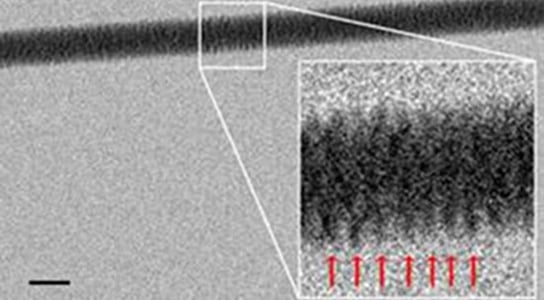
    Electron microscope photograph of DNA’s double-helix structure. Credit: Enzo di Fabrizio

    The structure of DNA was originally discovered by using X-ray crystallography, which involves scattering X-rays off atoms in crystallized arrays of DNA to form complex patterns of dots on photographic film. Images were then interpreted using complex mathematics. These new images are now direct pictures of DNA strands, seen through an electron microscope, which sees electrons rather than photons.

    The scientists published their findings in the journal Nanoletters. Enzo di Fabrizio, from the University of Genoa, Italy, and his team were able to snag DNA threads out of a dilute solution and lay them on a bed of nanoscopic silicon pillars.
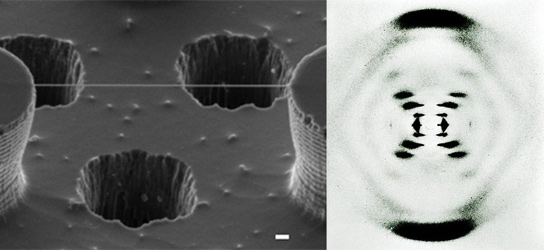
    Left: A tightrope of DNA between two silicon nanopillars. Right: X -ray diffraction image of DNA looks like. Credit: Enzo di Fabrizio

    The pattern of pillars is extremely water-repellent, causing the moisture to evaporate quickly and leave behind strands of DNA stretched out and easily viewed. Tiny holes were drilled into the base of the nanopillar bed to allow beams of electrons to shine through, creating the high-resolution images where the corkscrew thread of the DNA double helix is clearly visible.

    This technique will allow researchers to view single molecules of DNA interacting with other molecules. For now, the method only works with cords of DNA, made up of six molecules wrapped around a seventh acting like a core. This was needed because the energy of the electron streams could break apart a single DNA molecule.

    More sensitive detectors, which respond to lower-energy electrons, should allow the visualization of individual double helices, and even unwound single strands of DNA. This could allow them to see DNA at the level of single bases.

    Reference: “Direct Imaging of DNA Fibers: The Visage of Double Helix” by Francesco Gentile, Manola Moretti, Tania Limongi, Andrea Falqui, Giovanni Bertoni, Alice Scarpellini, Stefania Santoriello, Luca Maragliano, Remo Proietti Zaccaria and Enzo di Fabrizio, 22 November 2012, Nanoletters.
    DOI: 10.1021/nl3039162

    Never miss a breakthrough: Join the SciTechDaily newsletter.
    Follow us on Google and Google News.

    Bionanotechnology DNA Electron Microscope Nanotechnology
    Share. Facebook Twitter Pinterest LinkedIn Email Reddit

    Related Articles

    DNA Origami Nanostructures: Reprogramming the Shape of Virus Capsids To Advance Biomedicine

    Single-Stranded DNA and RNA Origami That Can Autonomously Fold Into Defined Structures

    Fast DNA Origami Allows Molecules to be Folded in Minutes

    Bacteria-Resistant Hospital Fabrics That Actively Fight Microbes

    Magnetic Nanoparticles Control Thousands of Cells Simultaneously

    Cancer-Fighting DNA Nanorobots Could Target Specific Cells for Repair

    Amplifier Chip Measures Nanopores With High Speed Precision

    Researchers Develop DNA Nanorobot to Seek Specific Cell Targets

    Researchers Study the Use of Photosystem-I as Photovoltaic Panels

    1 Comment

    1. Hsiao Hsian Li on March 10, 2015 6:46 pm

      If the memorial particles are chromosomes,during the smoker’s hallucination ,the helix of chromosomes must be observed in different pattern of composition.

      Reply
    Leave A Reply Cancel Reply

    • Facebook
    • Twitter
    • Pinterest
    • YouTube

    Don't Miss a Discovery

    Subscribe for the Latest in Science & Tech!

    Trending News

    Scientists May Have Discovered How To Heal Damaged Kidneys

    Interstellar Visitor 3I/ATLAS Is Bursting With an Unexpected Chemical

    Scientists Just Found All 5 Genetic “Letters” of DNA and RNA on an Asteroid

    The 4,000-Year-Old City That Defied History’s Rules on Wealth and Power

    The World’s Biggest Population Fear Has Flipped – and It Could Change Everything

    This “Fake” Pill Improved Memory and Physical Performance in Just 3 Weeks

    Scientists Say Frequent Ejaculation May Improve Sperm Quality and Fertility

    Scientists Have Found “The Heaven Sword” After Years of Looking

    Follow SciTechDaily
    • Facebook
    • Twitter
    • YouTube
    • Pinterest
    • Newsletter
    • RSS
    SciTech News
    • Biology News
    • Chemistry News
    • Earth News
    • Health News
    • Physics News
    • Science News
    • Space News
    • Technology News
    Recent Posts
    • Critically Endangered Monkey Defies the Odds With New Baby After Surgery
    • 17-Million-Year-Old Ape Fossil in Egypt Could Change What We Know About Human Origins
    • NASA’s Orbiting Quantum Lab Pushes Deeper Into the Unknown
    • NASA’s James Webb Discovers Bizarre Salt Clouds on the Pink Planet
    • Mysterious Signals Keep Coming From Space. Scientists May Finally Know Why
    Copyright © 1998 - 2026 SciTechDaily. All Rights Reserved.
    • Science News
    • About
    • Contact
    • Editorial Board
    • Privacy Policy
    • Terms of Use

    Type above and press Enter to search. Press Esc to cancel.