
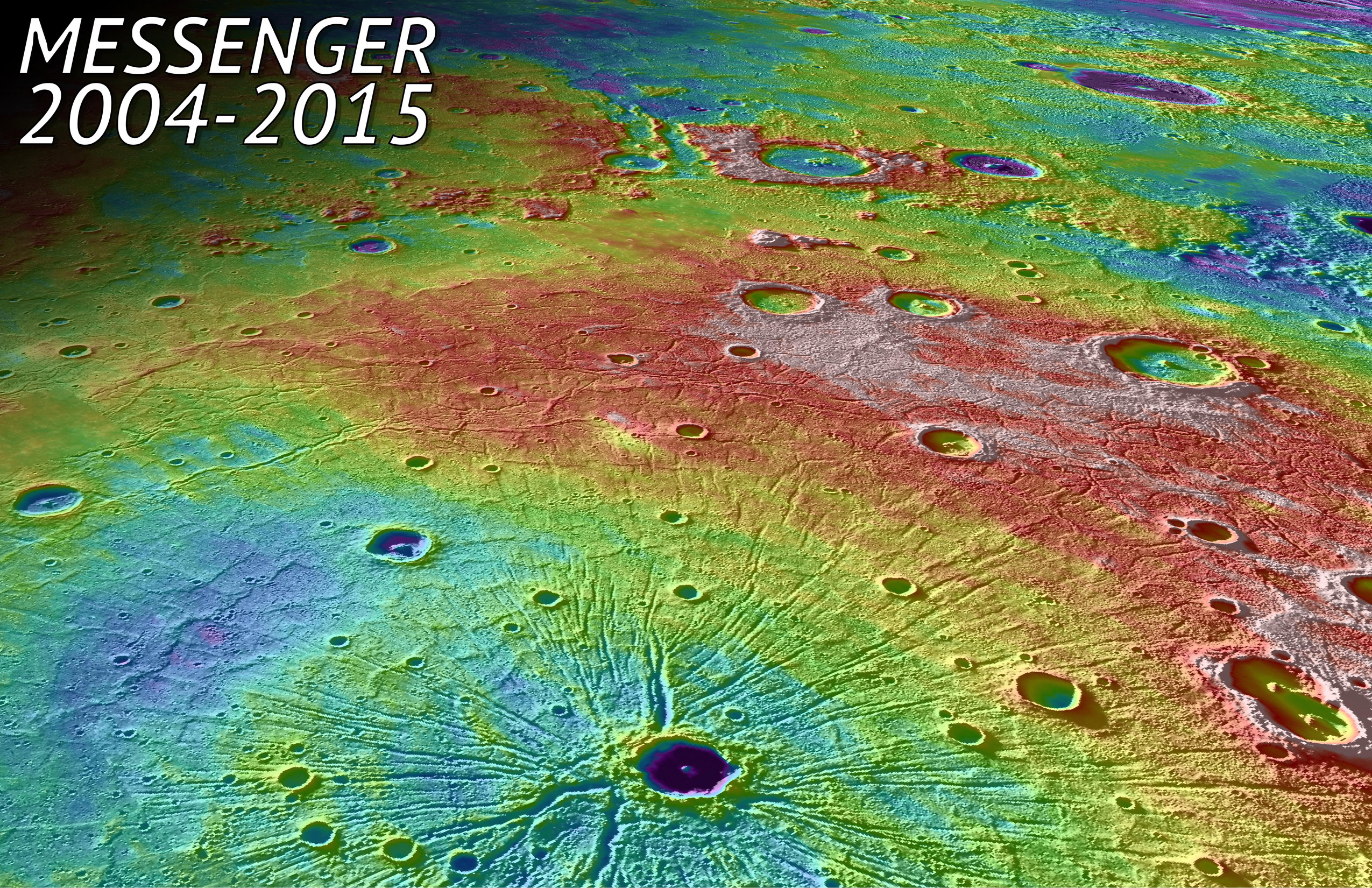
NASA’s MESSENGER spacecraft collected low-altitude magnetic field measurements during its orbital decay, revealing that magnetism generated by the Mercury’s core dates to the very early history of the planet.
Providence, Rhode Island (Brown University) — Though the MESSENGER mission to Mercury ended late last month with a planned collision into the planet’s surface, analysis of the data collected during the mission rolls on.
New research published recently in the journal Science reveals new details about Mercury’s magnetic field. MESSENGER had already helped to confirm that Mercury has a magnetic field that is likely generated by the slow churning of a liquid-metal core. This latest work detected signatures of ancient magnetism in Mercury’s crust, suggesting that Mercury’s liquid core has existed for most of its history.
Jim Head, the Louis and Elizabeth Scherck Distinguished Professor of Geological Sciences and one of the paper’s authors, discussed the findings with writer Kevin Stacey.
Why do we want to know about Mercury’s magnetic field?
A planet’s magnetic field tells you a lot about what’s going on in its interior — whether it’s solid or liquid, and if liquid, how it’s convecting. We learned from the Mariner 10 mission in the 1970s that Mercury had a magnetic field, but that mission couldn’t give us much detail. MESSENGER has revealed much more. It helped confirm that the field detected by Mariner was likely generated by a liquid metal outer core. That was a bit of a surprise. Mercury is small, about a third the size of the Earth, so it was thought that Mercury’s core would have cooled and solidified very quickly after the planet formed. But MESSENGER showed us that isn’t necessarily the case.
What does this latest finding add to that?
We were looking specifically at the crustal magnetic field, which can tell us something about the history of Mercury’s magnetic field. When molten material containing iron cools, it records both the presence and nature of any magnetic field that might have been present at the time. What we found in this study was that there is a distinct magnetic signature in Mercury’s smooth plains. In 2011, a group of us here at Brown and other MESSENGER team members showed that those plains were volcanic in origin and date back to between 3.7 and 3.9 billion years ago. So by detecting a magnetic signature in that unit, we’re able to say that Mercury’s magnetic field is at least that old. That tells us that Mercury has had this convecting liquid core for essentially its entire history.
It’s worth noting the heroic effort on the part of NASA engineers that made these measurements possible. The crustal magnetic field can only be detected at low altitudes. These measurements were made in late 2014, toward the very end of the mission when MESSENGER had begun its orbital decay — its slow descent toward the surface of Mercury. The NASA and Johns Hopkins University Applied Physics Lab team did an amazing job of keeping the spacecraft active and operating during the orbital decay so we could collect these data.
What are some of the implications of this in terms of Mercury’s early history?
We are on a quest to understand our own home planet, Earth. Mercury is a very unusual planet, Earth-like in its interior with a large iron core, but Moon-like in its exterior, with an ancient surface heavily modified by impact craters. As we analyze the MESSENGER mission data further, we are searching for clues as to how the Earth transitioned from what it was in the past to what we see today.
Reference: “Low-altitude magnetic field measurements by MESSENGER reveal Mercury’s ancient crustal field” by Catherine L. Johnson, Roger J. Phillips, Michael E. Purucker, Brian J. Anderson, Paul K. Byrne, Brett W. Denevi, Joshua M. Feinberg, Steven A. Hauck, Ii, James W. Head, Iii, Haje Korth, Peter B. James, Erwan Mazarico, Gregory A. Neumann, Lydia C. Philpott, Matthew A. Siegler, Nikolai A. Tsyganenko and Sean C. Solomon, Science.
DOI: 10.1126/science.aaa8720
Never miss a breakthrough: Join the SciTechDaily newsletter.
Follow us on Google and Google News.
1 Comment
Good job Nasa. Dumping your space junk on planets no human has set foot on yet (again). A shining testament to our disrespectful and irresponsible nature. What if you left some microbes on that thing? What if there is life on Mercury, however unlikely? What if you just crushed some tiny Mercurian church with your molten metal monstrosity? Yeah the research you are doing is awesome, but really, NASA needs to have more respect. Questions?