
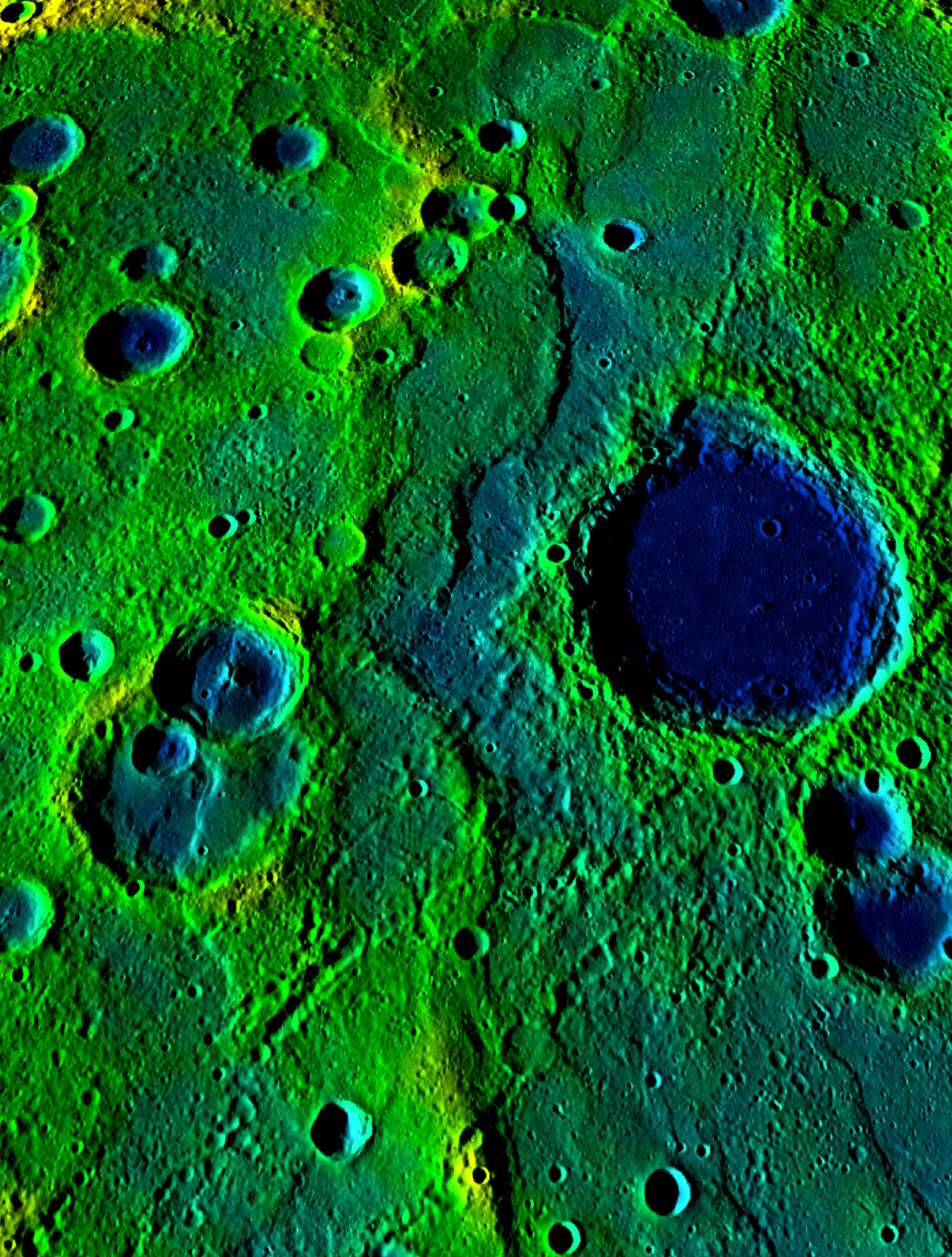
A newly published study from the Carnegie Institute resolves a decades-old paradox between thermal history models and estimates of Mercury’s contraction, showing that Mercury contracted substantially more than the old estimates.
Washington, D.C. — New global imaging and topographic data from MESSENGER* show that the innermost planet has contracted far more than previous estimates. The results are based on a global study of more than 5,900 geological landforms, such as curving cliff-like scarps and wrinkle ridges, that have resulted from the planet’s contraction as Mercury cooled. The findings, published online in Nature Geoscience, are key to understanding the planet’s thermal, tectonic, and volcanic history, and the structure of its unusually large metallic core.
Unlike Earth, with its numerous tectonic plates, Mercury has a single rigid, top rocky layer. Prior to the MESSENGER mission only about 45% of Mercury’s surface had been imaged by a spacecraft. Old estimates, based on this non-global coverage, suggested that the planet had contracted radially by about ½ to 2 miles (0.8 to 3 kilometers) substantially less than that indicated by models of the planet’s thermal history. Those models predicted a radial contraction of about 3 to 6 miles (5 to 10 kilometers) starting from the late heavy bombardment of the Solar System, which ended about 3.8 billion years ago.
The new results, which are based on the first comprehensive survey of the planet’s surface, show that Mercury contracted radially by as much as 4.4 miles (7 kilometers) — substantially more than the old estimates, but in agreement with the thermal models. Mercury’s modern radius is 1,516 miles (2,440 kilometers).
“These new results resolved a decades-old paradox between thermal history models and estimates of Mercury’s contraction,” remarked lead author of the study, Paul Byrne, a planetary geologist and MESSENGER visiting investigator at Carnegie’s Department of Terrestrial Magnetism. “Now the history of heat production and loss and global contraction are consistent. Interestingly, our findings are also reminiscent of now-obsolete models for how large-scale geological deformation occurred on Earth when the scientific community thought that the Earth only had one tectonic plate. Those models were developed to explain mountain building and tectonic activity in the nineteenth century, before plate tectonics theory.”
Byrne and his coauthors identified a much greater number and variety of geological structures on the planet than had been recognized in previous research. They identified 5,934 ridges and scarps attributed to global contraction, which ranged from 5 to 560 miles (9 to 900 kilometers) in length.
The researchers used two complementary techniques to estimate the contraction from their global survey of structures. Although the two estimates of radius change differed by 0.6 to 1 mile (1 to 1.6 kilometers), both were substantially greater than the old estimates.
“I became interested in the thermal evolution of Mercury’s interior when the Mariner 10 spacecraft sent back images of the planet’s great scarps in 1974–75, but the thermal history models predicted much more global contraction than the geologists inferred from the scarps then observed, even correcting for the fact that Mariner 10 imaged less than half of Mercury’s surface,” noted Sean Solomon, principal investigator of the mission, former director of Carnegie’s Department of Terrestrial Magnetism, and current director of the Lamont-Doherty Earth Observatory at Columbia University. “This discrepancy between theory and observation, a major puzzle for four decades, has finally been resolved. It is wonderfully affirming to see that our theoretical understanding is at last matched by geological evidence.”
Reference: “Mercury’s global contraction much greater than earlier estimates” by Paul K. Byrne, Christian Klimczak, A. M. Celâl Şengör, Sean C. Solomon, Thomas R. Watters and Steven A. Hauck, II, 16 March 2014, Nature Geoscience.
DOI: 10.1038/ngeo2097
Never miss a breakthrough: Join the SciTechDaily newsletter.
Follow us on Google and Google News.