
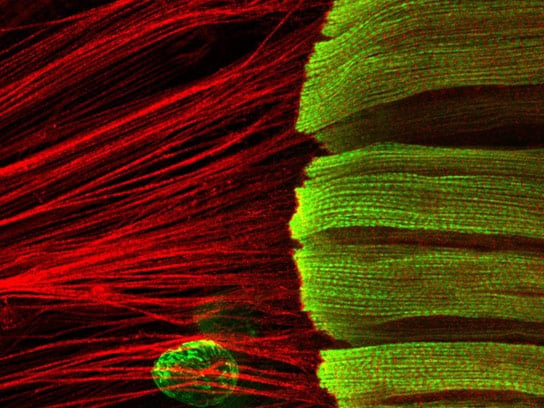
Researchers identify a key mechanism to how basic muscle architecture is built, finding that mechanical tension is the essential trigger.
Skeletal muscles are built from small contractile units, the sarcomeres. Many of these sarcomeres are connected in a well-ordered series to form myofibrils that span from one muscle end to the other. Contractions of these sarcomeres result in the contraction of the entire muscle. Scientists at the Max Planck Institute (MPI) of Biochemistry in Munich-Martinsried (Germany) recently identified a key mechanism how this basic muscle architecture is built during development. “Mechanical tension is the essential trigger” explains Frank Schnorrer, head of the research group Muscle Dynamics. “If tension is eliminated, no regular myofibrils, but only short, random protein assemblies can form. Such muscles are entirely non-functional”. These results have now been published in the journal Current Biology.
In order to move the body, skeletal muscles are pulling on the skeleton. For efficient muscle and skeletal movements it is essential that the muscle contracts only along a defined axis, for instance for the leg movement along the thigh. Such a directed contraction is achieved by the myofibrils that span through the entire length of the muscle. At both ends, the myofibrils are anchored to the tendon cells, which themselves are linked to the skeleton. “Thereby, the entire force is transduced from the muscle to the skeleton,” Frank Schnorrer describes. How can the regular architecture of a many hundred sarcomeres long myofibril be built along a defined axis during muscle development?
PhD student Manuela Weitkunat and PostDoc Aynur Kaya-Çopur were investigating this question in the fruit fly Drosophila melanogaster. They discovered that shortly after the Drosophila flight muscles contact their tendons, mechanical tension is established. This tension buildup occurs before sarcomeres are formed and reaches through the entire muscle-tendon-skeleton system. This tension axis equips the muscle with positional information along which the sarcomeres must form.
Absence of tension results in chaos
By using genetic mutations in the fly, the scientists of the Muscle Dynamics group have been able to block the attachment of flight muscles to tendons and thus eliminate tension formation in the system. As a consequence, muscles could not build long regular myofibrils anymore but instead distribute the sarcomeric protein complexes chaotically. In order to directly test the influence of mechanical tension, the scientists used a laser to cut the tendons off the muscle. This strategy of tension release also led to a major defect in sarcomere and myofibril formation. “Based on these results, we are suggesting a new model of myofibril formation, which proposes tension-dependent self-assembly of the sarcomeric components,” explains Frank Schnorrer. “When a certain tension threshold is reached, myofibril formation is triggered. If tension is compromised, the sarcomeric components have no spatial information and assemble chaotically.”
As human muscles also contain myofibrils that are built by periodically arrayed sarcomeres, it is likely that a similar tension-based assembly model may also apply during human muscle development, so the scientists think.
Reference: “Tension and Force-Resistant Attachment Are Essential for Myofibrillogenesis in Drosophila Flight Muscle” by Manuela Weitkunat, Aynur Kaya-Çopur, Stephan W. Grill and Frank Schnorrer, 31 March 2014, Current Biology.
DOI: 10.1016/j.cub.2014.02.032
Never miss a breakthrough: Join the SciTechDaily newsletter.
Follow us on Google and Google News.
1 Comment
“Use it or Lose it”- is the dictum of science to the organs. If muscles are not used everyday, the ‘sarcomeres’ which form ‘myofibrils’ of the muscles, randomly organize and not linearly in tandem with tendons, losing the grip for the muscles. Hence usage of muscles or exercise is necessary for muscle strengthening. The same is true for the other organs and their functions too. Thank You.