
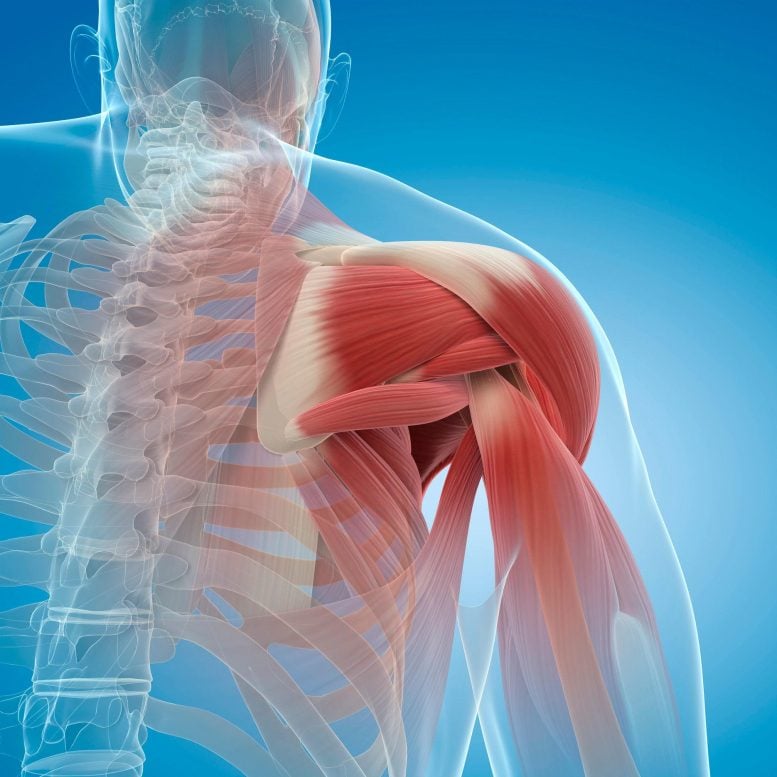
An adhesive that can stimulate muscles to stretch and contract has been developed – and it has the potential to prevent and enable recovery from muscle atrophy.
Muscles can become weak and waste away due to a lack of exercise, such as when a limb is immobilized in a cast, or gradually as people age. This condition, known as muscle atrophy, can also occur as a result of neurological disorders like ALS and MS, or as a response to certain diseases including cancer and diabetes.
Mechanotherapy, a type of therapy that uses manual or mechanical techniques, is believed to have the potential to aid in tissue repair. Massage, which uses compressive stimulation to relax muscles, is the most well-known form of mechanotherapy, however, it is not clear whether stretching and contracting muscles through external means can also be effective as a treatment. There have been two major obstacles to studying this possibility: a lack of mechanical systems that can evenly apply stretching and contraction forces to muscles along their entire length, and the inefficient delivery of these mechanical stimuli to the surface and deeper layers of muscle tissue.
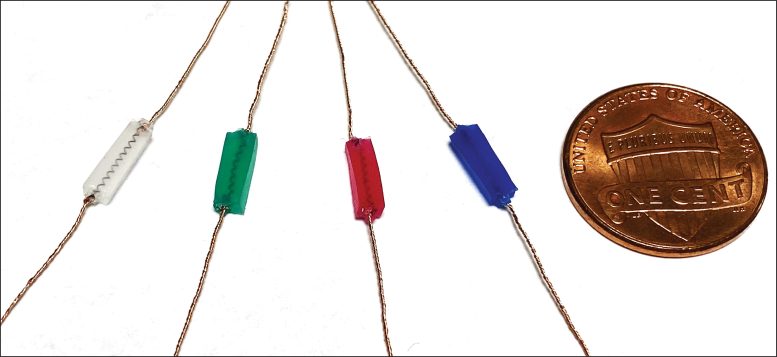
Now, bioengineers at the Wyss Institute for Biologically Inspired Engineering at Harvard University and the Harvard John A. Paulson School of Engineering and Applied Sciences (SEAS) have developed a mechanically active adhesive named MAGENTA, which functions as a soft robotic device and solves this two-fold problem. In an animal model, MAGENTA successfully prevented and supported the recovery from muscle atrophy. The team’s findings are published in Nature Materials.
“With MAGENTA, we developed a new integrated multi-component system for the mechanostimulation of muscle that can be directly placed on muscle tissue to trigger key molecular pathways for growth,” said senior author and Wyss Founding Core Faculty member David Mooney, Ph.D. “While the study provides first proof-of-concept that externally provided stretching and contraction movements can prevent atrophy in an animal model, we think that the device’s core design can be broadly adapted to various disease settings where atrophy is a major issue.” Mooney leads the Wyss Institute’s Immuno-Materials Platform and is also the Robert P. Pinkas Family Professor of Bioengineering at SEAS.
An Adhesive That Can Make Muscles Move
One of MAGENTA’s major components is an engineered spring made from nitinol, a type of metal known as “shape memory alloy” (SMA) that enables MAGENTA’s rapid actuation when heated to a certain temperature. The researchers actuated the spring by electrically wiring it to a microprocessor unit that allows the frequency and duration of the stretching and contraction cycles to be programmed. The other components of MAGENTA are an elastomer matrix that forms the body of the device and insulates the heated SMA, and a “tough adhesive” that enables the device to be firmly adhered to muscle tissue.
In this way, the device is aligned with the natural axis of muscle movement, transmitting the mechanical force generated by SMA deep into the muscle. Mooney’s group is advancing MAGENTA, which stands for “mechanically active gel-elastomer-nitinol tissue adhesive,” as one of several Tough Gel Adhesives with functionalities tailored to various regenerative applications across multiple tissues.
After designing and assembling the MAGENTA device, the team tested its muscle-deforming potential, first in isolated muscles ex vivo and then by implanting it on one of the major calf muscles of mice. The device did not induce any serious signs of tissue inflammation and damage and exhibited a mechanical strain of about 15% on muscles, which matches their natural deformation during exercise.
Next, to evaluate its therapeutic efficacy, the researchers used an in vivo model of muscle atrophy by immobilizing a mouse’s hind limb in a tiny cast-like enclosure for up to two weeks after implanting the MAGENTA device on it. “While untreated muscles and muscles treated with the device but not stimulated significantly wasted away during this period, the actively stimulated muscles showed reduced muscle wasting,” said first-author and Wyss Technology Development Fellow Sungmin Nam, Ph.D. “Our approach could also promote the recovery of muscle mass that already had been lost over a three-week period of immobilization, and induce the activation of the major biochemical mechanotransduction pathways known to elicit protein synthesis and muscle growth.”
Facets of Mechanotherapy
In a previous study, Mooney’s group in collaboration with Wyss Associate Faculty member Conor Walsh’s group found that regulated cyclical compression (as opposed to stretching and contraction) of acutely injured muscles, using a different soft robotic device, reduced inflammation and enabled the repair of muscle fibers in acutely injured muscle. In their new study, Mooney’s team asked whether those compressive forces could also protect from muscle atrophy. However, when they directly compared muscle compression via the previous device to muscle stretching and contraction via the MAGENTA device, only the latter had clear therapeutic effects in the mouse atrophy model.
“There is a good chance that distinct soft robotic approaches with their unique effects on muscle tissue could open up disease or injury-specific mechano-therapeutic avenues,” said Mooney.
To further expand the possibilities of MAGENTA, the team explored whether the SMA spring could also be actuated by laser light, which had not been shown before and would make the approach essentially wireless, broadening its therapeutic usefulness. Indeed, they demonstrated that an implanted MAGENTA device without any electric wires could function as a light-responsive actuator and deform muscle tissue when irradiated with laser light through the overlying skin layer. While laser actuation did not achieve the same frequencies as electrical actuation, and especially fat tissue seemed to absorb some laser light, the researchers think that the demonstrated light sensitivity and performance of the device could be further improved.
“The general capabilities of MAGENTA and the fact that its assembly can be easily scaled from millimeters to several centimeters could make it interesting as a central piece of future mechanotherapy not only to treat atrophy, but perhaps also to accelerate regeneration in the skin, heart, and other places that might benefit from this form of mechanotransduction,” said Nam.
“The growing realization that mechanotherapy can address critical unmet needs in regenerative medicine in ways that drug-based therapies simply cannot, has stimulated a new area of research that connects robotic innovations with human physiology down to the level of the molecular pathways that are transducing different mechanical stimuli,” said Wyss Founding Director Donald Ingber, M.D., Ph.D. “This study by Dave Mooney and his group is a very elegant and forward-looking example of how this type of mechanotherapy could be used clinically in the future.” Ingber is also the Judah Folkman Professor of Vascular Biology at Harvard Medical School and Boston Children’s Hospital, and the Hansjörg Wyss Professor of Bioinspired Engineering at SEAS.
Reference: “Active tissue adhesive activates mechanosensors and prevents muscle atrophy” by Sungmin Nam, Bo Ri Seo, Alexander J. Najibi, Stephanie L. McNamara and David J. Mooney, 10 November 2022, Nature Materials.
DOI: 10.1038/s41563-022-01396-x
The study was funded by the National Institute of Dental and Craniofacial Research, the Eunice Kennedy Shriver National Institute of Child Health and Human Development, and the National Science Foundation’s Materials Research Science and Engineering Center at Harvard University.
Never miss a breakthrough: Join the SciTechDaily newsletter.
Follow us on Google and Google News.
5 Comments
I’m just curious, but can this technology be tuned to destroy fat cells? Even better, cancer cells? But I can see this being used as an experimental get thin quick by targeting the fat cells, but also limiting the amount of cells that are destroyed in a set amount of time. If used as above, there would never be obesity
I wonder if NASA could use this for astronauts in extended stays in orbit.
Do you want a clinical trials project about this robotics studies
I am a 63 yr old female. I have been diagnosed with motor neuron disorder. I have bilateral arm weakness and muscle atrophy. How can I be involved in this research
in a nursing home…understaffed..no one would assist in this case, including out of town, very busy–too busy family. out of ideas..even cash would not attract help