
Close Menu
    Facebook X (Twitter) Instagram
    SciTechDaily
    • Biology
    • Chemistry
    • Earth
    • Health
    • Physics
    • Science
    • Space
    • Technology
    Facebook X (Twitter) Pinterest YouTube RSS
    SciTechDaily
    Home»Science»Treating Depression by Fine-Tuning Motivation in the Brain
    Science

    Treating Depression by Fine-Tuning Motivation in the Brain

    By Cold Spring Harbor LaboratoryDecember 30, 20224 Comments4 Mins Read
    Facebook Twitter Pinterest Telegram LinkedIn WhatsApp Email Reddit
    Share
    Facebook Twitter LinkedIn Pinterest Telegram Email Reddit
    Brain Connections Network Concept Illustration
    A group of neuroscientists has found brain cells that control the motivation of mice to perform tasks for rewards. When these cells are activated, mice work harder and avoid becoming addicted to rewards. The discovery could lead to new treatments for mental illnesses such as depression that affect motivation.

    Researchers found that specific neurons in mice control motivation, offering potential treatments for depression without the risk of addiction.

    Neuroscientists have discovered a set of brain cells that influence the motivation of mice to perform tasks for rewards. Increasing the cells’ activity makes a mouse work harder or more vigorously. The neurons come with a feature that prevents the mouse from overdoing it and becoming addicted to the reward. The findings reveal new possible therapeutic strategies for treating mental illnesses like depression that impair motivation.

    A characteristic of depression is a lack of motivation. Cold Spring Harbor Laboratory (CSHL) Professor Bo Li, in collaboration with CSHL Adjunct Professor Z. Josh Huang, discovered a group of neurons in the mouse brain that influences the animal’s motivation to perform tasks for rewards. Dialing up the activity of these neurons makes a mouse work faster or more vigorously—up to a point. These neurons have a feature that prevents the mouse from becoming addicted to the reward. The findings may point to new therapeutic strategies for treating mental illnesses like depression that affect motivation in humans. 

    The Role of Fezf2 Neurons in Motivation

    The anterior insular cortex is a region of the brain that plays a critical role in motivation. A set of neurons that activate a gene called Fezf2(Fezf2 neurons) in this area are active when mice are doing both physical and cognitive tasks. Li and his lab hypothesized that these neurons do not affect the mouse’s ability to do the task; rather, the brain cells influence the mouse’s motivational drive. 
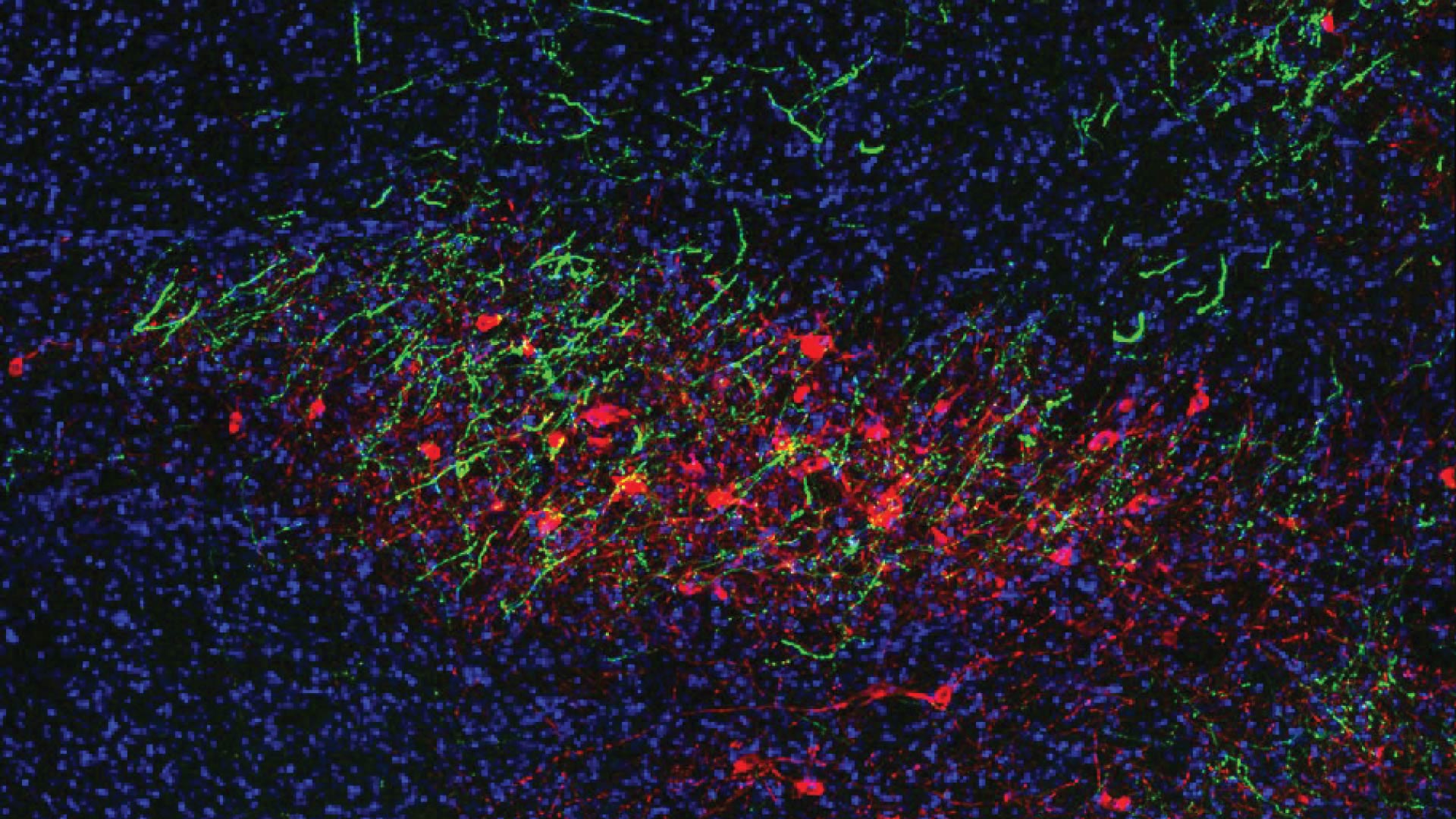
    Mouse Neuron Cluster
    Cold Spring Harbor Laboratory Professor Bo Li discovered a cluster of neurons in the mouse brain that influence motivation. These cells activate a gene called Fezf2 and are connected to and activate other neurons, which are stained green in this image of a mouse brain. Credit: Li lab/CSHL, 2021

    Mice were trained to lick a water bottle spout to receive a small sugar reward. When researchers dialed up the activity of these Fezf2 neurons, mice would lick more vigorously. If the neuron activity was dialed down, the mice would lick more slowly. The researchers saw a similar result in another experiment in which the mice ran on a wheel to receive a reward. The mice ran faster if the Fezf2 neurons were stimulated. The same effect occurred with other tasks.

    Addiction-Prevention Mechanism in Motivation

    Li and his team were surprised to discover a feature that prevents the mice from becoming addicted to the tasks and their rewards. When mice drank their fill of sugar water and were satiated, they would not lick or run faster to get more sugar, even if the researchers dialed up the activity of the Fezf2 neurons.

    Bo Li
    Bo Li, Professor, Ph.D., The University of British Columbia, 2003

    Finding a way to fine-tune the human equivalent of these neurons might help people struggling with motivation due to mental illnesses like depression. Li says, “We want to selectively increase the motivation of the person so that they can do the things that they need to do, but we don’t want to create addictive drugs.”

    Li and Huang published their findings in the journal Cell.

    Reference: “A genetically defined insula-brainstem circuit selectively controls motivational vigor” by Hanfei Deng, Xiong Xiao, Tao Yang, Kimberly Ritola, Adam Hantman and Yulong Li, 9 December 2021, Cell.
    DOI: 10.1016/j.cell.2021.11.019

    Never miss a breakthrough: Join the SciTechDaily newsletter.
    Follow us on Google and Google News.

    Addiction Brain Cold Spring Harbor Laboratory Neuroscience Psychiatry
    Share. Facebook Twitter Pinterest LinkedIn Email Reddit

    Related Articles

    Rewiring Reality: Stanford Unveils the Brain’s Fault Lines in Psychosis

    Counteracting Addiction: How Alcohol and Drugs Genetically Rewire Your Brain

    Singing Mice Unlock the Mysteries of Brain Time Perception

    Brain’s Hidden Highway: Neural Pathway Linking Motivation, Addiction and Disease

    Alarming Study: Smoking Causes Brain Shrinkage – “It Sounds Bad, and It Is Bad”

    The Amygdala Unveiled: How Our Brains Process Threats, Rewards, and Dopamine

    Cocaine Addiction Makes the Brain Age Faster – Could Be Caused by Inflammation or Cell Death

    How the Brain Changes During Depression Treatment

    How Touching Is Perceived in the Brain – Investigated With Two-Person MRI Scans on Couples

    4 Comments

    1. Rashmi Singh on January 1, 2023 7:00 am

      Is it possible for the mice to be addicted to the actual stimulation of neurons? So, they might not be addicted to the reward itself but may be addicted to the actual process of being motivated…

      Reply
    2. Steve on January 3, 2023 2:21 am

      Oh, this sounds awesome from a capitalist perspective! Give your employees this drug and they’ll be addicted to working long hours! Perfect drug for late-stage neoliberal western society!

      Reply
    3. Nancy Urgell on January 4, 2023 4:02 am

      Thank you trying to destroy the world. Leave people brain chemicals alone. The reason is everyone are getting their chemicals changed by drugs that make them not want to be motivated we have to find ways to help people with depression and anxiety differently then through drugs

      Reply
    4. Steve Rhan on January 6, 2023 7:57 am

      In as much as there’s the naive presumption that so many people oughtn’t ordinarily be depressed except by their own personal unmotivaed failures, strictly due such certain shortcomings that can be remedied somehow with the right sort of treatment, behavior modifications, yada, yada.
      So you all will crash and burn for such guant, naive hypocrissy.

      Reply
    Leave A Reply Cancel Reply

    • Facebook
    • Twitter
    • Pinterest
    • YouTube

    Don't Miss a Discovery

    Subscribe for the Latest in Science & Tech!

    Trending News

    Just 10 Minutes a Day: Scientists Say This Ancient Chinese Practice Shows Powerful Blood Pressure Benefits

    Scientists Say This Popular Food Could Help Your Body Get Rid of Microplastics

    For the First Time, ChatGPT Has Solved an Unproven Math Problem in Geometry

    This Popular Supplement May Actually Slow Biological Aging, Scientists Reveal

    Can a Common Vitamin Fight the Most Aggressive Brain Cancer?

    Scientists Discover How to Stop Vision Loss Before It Starts

    The Mediterranean Isn’t Safe: Scientists Warn of Inevitable Tsunami

    Scientists Say Washing Dishes With a Sponge Has a Concerning Side Effect

    Follow SciTechDaily
    • Facebook
    • Twitter
    • YouTube
    • Pinterest
    • Newsletter
    • RSS
    SciTech News
    • Biology News
    • Chemistry News
    • Earth News
    • Health News
    • Physics News
    • Science News
    • Space News
    • Technology News
    Recent Posts
    • This One Vitamin May Help Protect Your Brain From Dementia Years Later
    • A 30-Year-Old Flu Shot Still Works Today With One Big Problem
    • Widely Available Drug Found To Ease One of Long COVID’s Most Stubborn Symptoms
    • New Study Finds Internalized Stress May Accelerate Cognitive Decline
    • Stopping Weight-Loss Drugs Like Ozempic Can Quickly Erase Heart Benefits
    Copyright © 1998 - 2026 SciTechDaily. All Rights Reserved.
    • Science News
    • About
    • Contact
    • Editorial Board
    • Privacy Policy
    • Terms of Use

    Type above and press Enter to search. Press Esc to cancel.