
Close Menu
    Facebook X (Twitter) Instagram
    SciTechDaily
    • Biology
    • Chemistry
    • Earth
    • Health
    • Physics
    • Science
    • Space
    • Technology
    Facebook X (Twitter) Pinterest YouTube RSS
    SciTechDaily
    Home»Biology»The Brain Balances Pleasure and Pain – Here’s How
    Biology

    The Brain Balances Pleasure and Pain – Here’s How

    By Cold Spring Harbor LaboratoryJanuary 1, 2020No Comments4 Mins Read
    Facebook Twitter Pinterest Telegram LinkedIn WhatsApp Email Reddit
    Share
    Facebook Twitter LinkedIn Pinterest Telegram Email Reddit
    Brain Steers Our Actions
    Opposing signals for positive and negative motivation are sent through a shared brain circuit by different types of neurons, and the balance of activity between these two groups of neurons may determine a person’s actions toward seeking pleasure or avoiding negativity.

    As our brains take in information about the world and use it to steer our actions, two key principles guide our choices: seek pleasure and avoid pain. Researchers at Cold Spring Harbor Laboratory (CSHL) have zeroed in on an information-processing hub in the brains of mice to discover how neurons there divide the labor to handle these opposing behavioral motivations.

    Their work, reported on December 31, 2019 in the journal Neuron, reveals that different classes of neurons control positive and negative motivation, sending opposing signals along a shared motivation-processing brain circuit. Ultimately, the balance of activity between these two groups of cells may determine whether a person acts to seek out pleasurable experiences or avoid negative ones, says CSHL Professor Bo Li, who led the study.

    Brain Schematic Recording
    Researchers have zeroed in on the ventral pallidum (see VP in brain diagram), an information-processing hub in the brains of mice to discover how neurons there influence the animals’ motivation to either seek pleasurable experiences or avoid negative ones. Credit: Li lab/CSHL, 2019

    Li wants to understand the brain’s motivation-processing circuits because the behaviors they control are often disrupted in people with mental illness. People suffering from depression may stop doing things that once gave them pleasure, for example, whereas people with anxiety disorders may go to greater lengths to avoid potential threats.

    The ability to recognize and respond to potential rewards or punishments depends in part on a part of the brain called the ventral pallidum. Researchers have observed activity in this brain region when animals seek rewards, such as a sip of water, or avoid punishments, such as an annoying puff of air. What Li wanted to understand was how the different types of neurons that reside in this part of the brain ensure an animal responds appropriately to signals associated with both types of motivation.
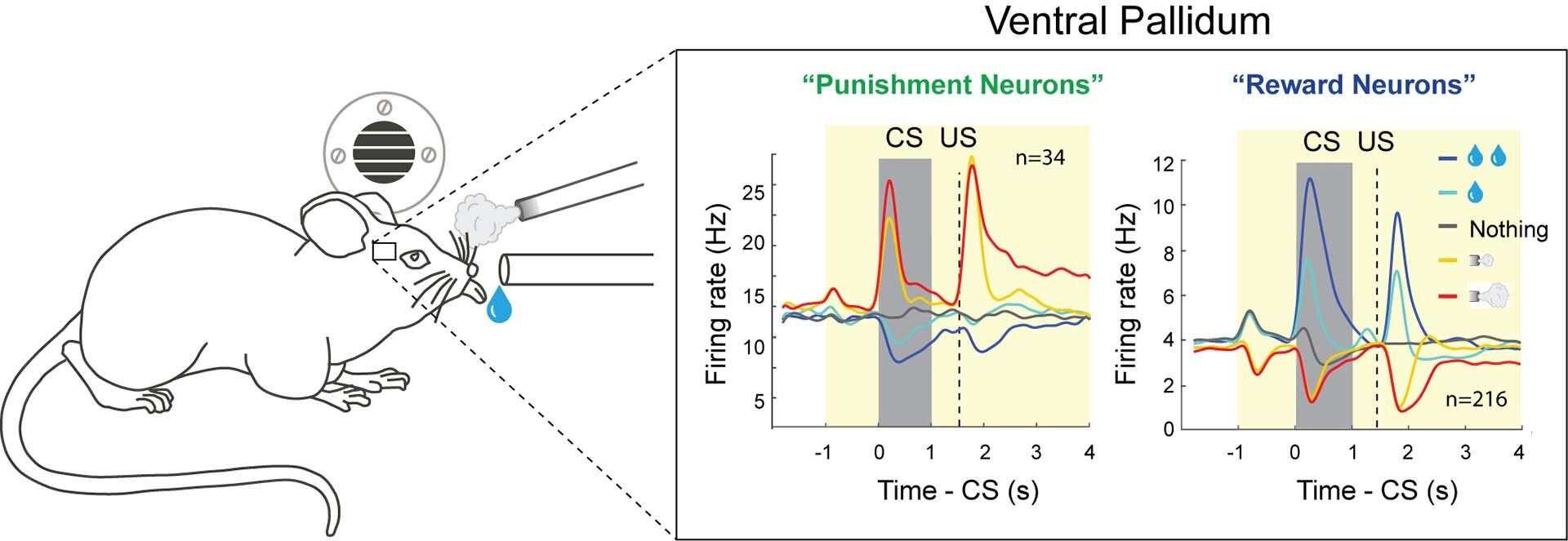
    Ventral Pallidum Diagram
    CSHL Professor Bo Li and colleagues monitored the activity of individual brain cells and confirmed those cells’ identities with a flash of light. After training mice to associate certain sounds with either a sip of water or a puff of air, they monitored neural activity in the ventral pallidum. Neurons that used the neurotransmitter GABA to dampen activity in the circuit influencing motivation were important in motivating the mice to seek a water reward. The neurons that used the neurotransmitter glutamate to excite the brain circuit were essential for avoiding the air-puff punishment. Credit: Li lab/CSHL, 2019

    To investigate, his team took advantage of research tools that allowed them to monitor the activity of individual brain cells and to confirm those cells’ identities with a flash of light. After training mice to associate certain sounds with either a sip of water or a puff of air, Li and his colleagues used the technique to monitor neural activity in the ventral pallidum. They found that neurons that used the neurotransmitter known as GABA to dampen activity in the circuit influencing motivation were important in motivating the mice to seek a water reward. The neurons that used the neurotransmitter known as glutamate to excite the brain circuit, on the other hand, were essential for avoiding the air-puff punishment.

    In more complex situations, where animals were presented with the potential for both punishment and reward, both sets of neurons responded. Mice made different choices in response to the combined stimuli: Thirsty animals, for example, were more willing to risk an air puff to obtain a sip of water than animals that had just drunk their fill. But if the team artificially shifted the balance of activity in the ventral pallidum by manipulating one class of neurons or the other, they could alter the animals’ behavior.

    That balance between signals that either inhibit or excite neurons in the ventral pallidum appears critical in controlling which motivation an animal acts on, Li says. Now, he is eager to find out whether it is disrupted in people with psychiatric disorders. “Behavioral changes in people with depression or stress-induced anxiety may be caused by changes in this circuit,” he says. With the new findings, his team has important leads about how to investigate the causes and symptoms of these disorders more deeply.

    Reference: “Opposing contributions of GABAergic and glutamatergic ventral pallidal neurons to motivational behaviours” by Marcus Stephenson-Jones, Christian Bravo-Rivera, Sandra Ahrens, Alessandro Furlan, Carolina Fernandes-Henriques and Bo Li, 31 December 2019, Neuron.
    DOI: 10.1101/594887

    Never miss a breakthrough: Join the SciTechDaily newsletter.
    Follow us on Google and Google News.

    Brain Cold Spring Harbor Laboratory Neuroscience
    Share. Facebook Twitter Pinterest LinkedIn Email Reddit

    Related Articles

    Pushing the Limits of Neuroscience: BARseq Is Mapping the Brain at a Million-Neuron Scale

    Overeating? Researchers Discover That These Cells May Be To Blame

    Scientists Discover How Sex Hormones Define Brain Differences Between Men and Women

    Neural Activity Differences Between an Expert’s Brain and a Novice’s

    Human Brains Take Longer to Wire Up Than Simian Ones

    Researchers Use fMRI to Study How Humor Activates Kids’ Brain Regions

    Neuroscientists Decode Correlation Between Sound and Brain Activity

    Mother’s Nurturing Results in Larger Hippocampus in Children

    Neuroscientists Study Cortical Areas Specialized in Processing Visual Inputs in Mice

    Leave A Reply Cancel Reply

    • Facebook
    • Twitter
    • Pinterest
    • YouTube

    Don't Miss a Discovery

    Subscribe for the Latest in Science & Tech!

    Trending News

    Scientists Discover Game-Changing New Way To Treat High Cholesterol

    This Small Change to Your Exercise Routine Could Be the Secret to Living Longer

    Scientists Discover 430,000-Year-Old Wooden Tools, Rewriting Human History

    AI Could Detect Early Signs of Alzheimer’s in Under a Minute – Far Before Traditional Tests

    What if Dark Matter Has Two Forms? Bold New Hypothesis Could Explain a Cosmic Mystery

    This Metal Melts in Your Hand – and Scientists Just Discovered Something Strange

    Beef vs. Chicken: Surprising Results From New Prediabetes Study

    Alzheimer’s Breakthrough: Scientists Discover Key Protein May Prevent Toxic Protein Clumps in the Brain

    Follow SciTechDaily
    • Facebook
    • Twitter
    • YouTube
    • Pinterest
    • Newsletter
    • RSS
    SciTech News
    • Biology News
    • Chemistry News
    • Earth News
    • Health News
    • Physics News
    • Science News
    • Space News
    • Technology News
    Recent Posts
    • Researchers Discover Unknown Beetle Species Just Steps From Their Lab
    • Jellyfish Caught Feasting on Exploding Sea Worms for the First Time
    • Ancient “Spaghetti” in Dogs’ Hearts Reveals Heartworm’s Shocking Origins
    • Milk Nanoparticles Could Revolutionize Treatment for Deadly Bile Duct Cancer
    • Largest-Ever Study Finds Medicinal Cannabis Ineffective for Anxiety, Depression, PTSD
    Copyright © 1998 - 2026 SciTechDaily. All Rights Reserved.
    • Science News
    • About
    • Contact
    • Editorial Board
    • Privacy Policy
    • Terms of Use

    Type above and press Enter to search. Press Esc to cancel.