
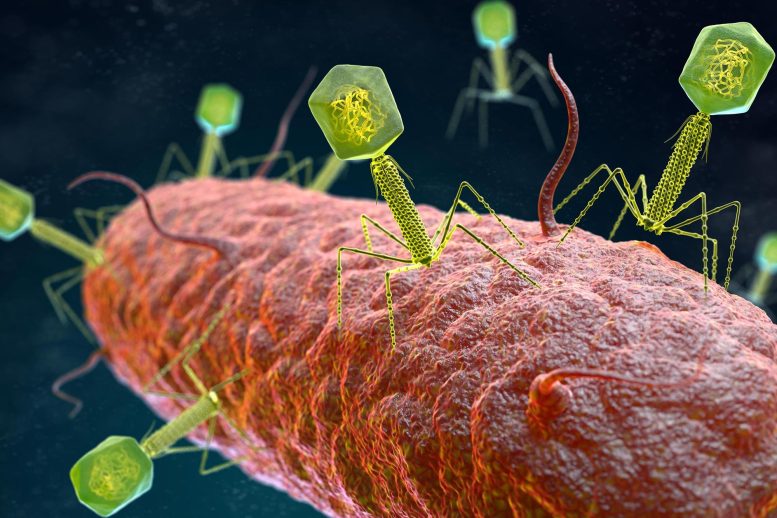
Like humans, bacteria have various immune systems to defend against pathogens such as viruses. These immune systems usually degrade the DNA of the pathogens to make it harmless. In the research group of Assistant Professor Daan Swarts from the Laboratory of Biochemistry at Wageningen University & Research, an entirely new immune system that utilizes another mechanism for invader neutralization has been discovered. The findings are published in the scientific journal Cell.
Deep inside our body a continuous arms race is taking place. On the one hand, viruses keep searching for new ways to penetrate our cells, and on the other hand, our body keeps coming up with better defense mechanisms to eliminate these viruses. This is how sickness and health are usually kept in balance. The same arms race is waged between bacteria and their pathogenic ‘invaders’: viruses and plasmids.
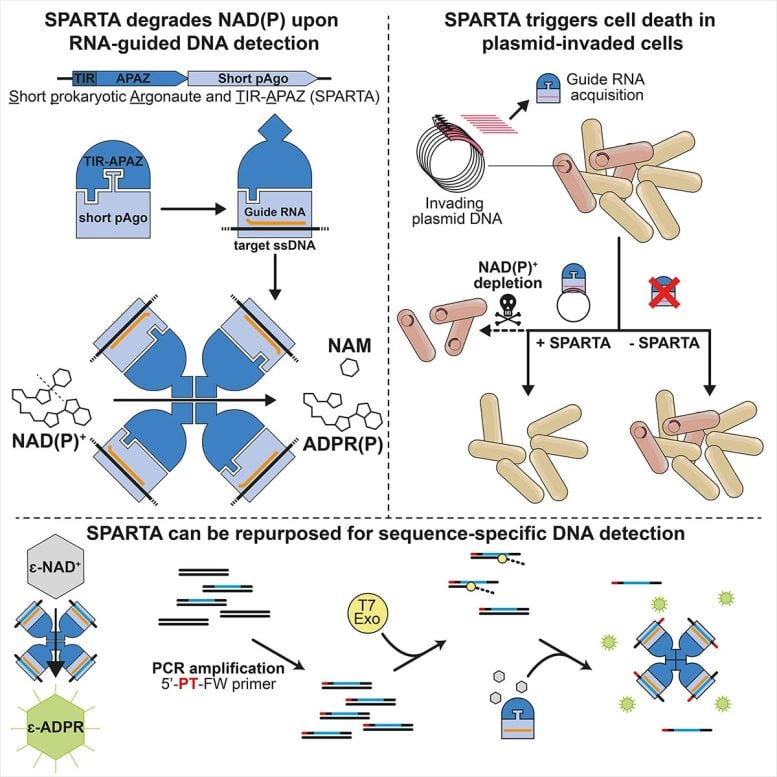
In an article published in the scientific journal Cell, PhD candidate Bel Koopal from Daan Swarts’ research group describes a new defense mechanism in this arms race. The scientists demonstrate that a novel type of bacterial ‘Argonaute proteins’, after detecting the invading DNA, deliberately break down all molecules with the eloquent name nicotinamide adenine dinucleotide (NAD+).
Completely shuts down cell
Argonaute proteins occur in multicellular organisms like plants and humans, but also in unicellular organisms like bacteria. These Argonautes are programmed with a small strand of ‘guide RNA’ or ‘guide DNA’ to find invasive RNA or DNA with the same sequence. In most cases, the intruder is then destroyed by cutting it up into smaller, harmless pieces. Although the Argonaute protein in Swarts’ research also uses guide RNA, it defends through a fundamentally different approach: after detecting invasive DNA, it completely shuts down the cell by breaking down NAD+.
Infected Cell Perishes
The NAD+ molecule has a crucial function in the metabolism of cells and keeps the proverbial engine running allowing for the continued existence of a cell. “Without NAD+, the cell will eventually die,” Swarts explains. “This might sound contradictory, but it is exactly what is meant to happen. By letting the infected cell die, the invader cannot propagate or spread to neighboring bacteria. The bacterium cell is ‘sacrificed’ in order to save other, healthy cells.”
Advanced Bacteria
This immune system was found in different species of bacteria. Swarts was not surprised these unicellular organisms possess such complex defense mechanisms. “People often underestimate how capable bacteria are,” he says. “No matter how small bacteria are, their immune systems have been evolving for millions of years and become increasingly advanced. They have to, because the viruses are often very sophisticated too.”
“In the future, we might be able to detect diseases in the human body using this kind of genetic tools”
Daan Swarts
Swarts, Koopal, and their colleagues conducted the research primarily from a scientific desire to understand the mechanisms of Argonaute proteins. However, Swarts believes that these new insights will also have practical applications in the long term. For example, the research group demonstrated that the immune system can be isolated and subsequently reprogrammed with a strand of guide RNA of choice. As the NAD+ degradation can easily be detected, the Argonaute protein can be used to recognize specific DNA sequences on command. “In the future, we might be able to detect diseases in the human body using this kind of genetic tools,” Swarts looks ahead. “But we’re not there yet. For the time being, we are motivated by a fundamental curiosity.”
Reference: “Short prokaryotic Argonaute systems trigger cell death upon detection of invading DNA” by Balwina Koopal, Ana Potocnik, Sumanth K. Mutte, Cristian Aparicio-Maldonado, Simon Lindhoud, Jacques J.M. Vervoort, Stan J.J. Brouns and Daan C. Swarts, 4 April 2022, Cell.
DOI: 10.1016/j.cell.2022.03.012
Never miss a breakthrough: Join the SciTechDaily newsletter.
Follow us on Google and Google News.