
New method offers an easy route for making bilobalide and related compounds so scientists can explore their potential uses as drugs and pesticides.
Chemists at Scripps Research have invented an efficient method for making a synthetic version of the plant compound bilobalide, which is naturally produced by ginkgo trees. It’s a significant feat because bilobalide—and closely related compounds—hold potential commercial value as medicines and “green” insecticides.
Ginkgo trees produce the compound to repel insect pests, but it is effectively non-toxic to humans. The method, published in Nature on October 16, 2019, allows chemists to make and study bilobalide and related compounds relatively easily and much more affordably than previously possible.
“This process demonstrates how inventing the right new chemical reactions allows quick access to complex natural compounds,” says Ryan Shenvi, Ph.D., professor in the Department of Chemistry at Scripps Research. “Now we can access bilobalide and the chemical space around it, much of which might have even better properties.”
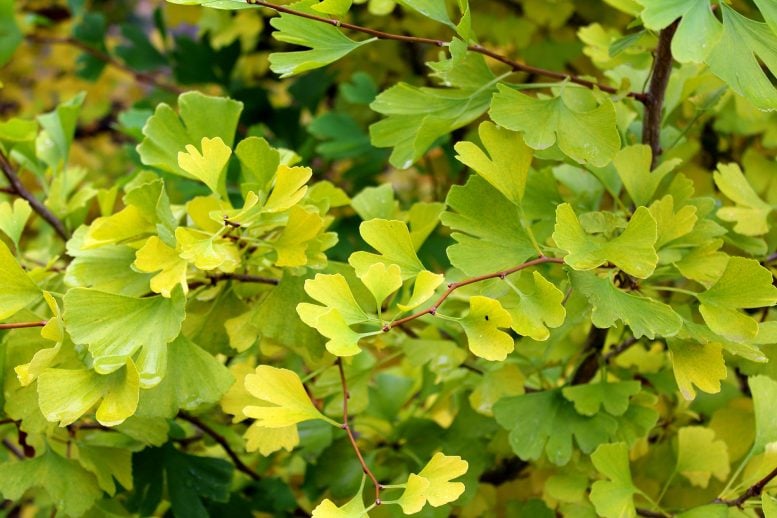
The ginkgo tree (Ginkgo biloba) is considered a living fossil. Closely related species lived on Earth 270 million years ago, before dinosaurs, and managed to survive subsequent global cataclysms that extinguished the dinosaurs as well as most other kinds of plants and animals.
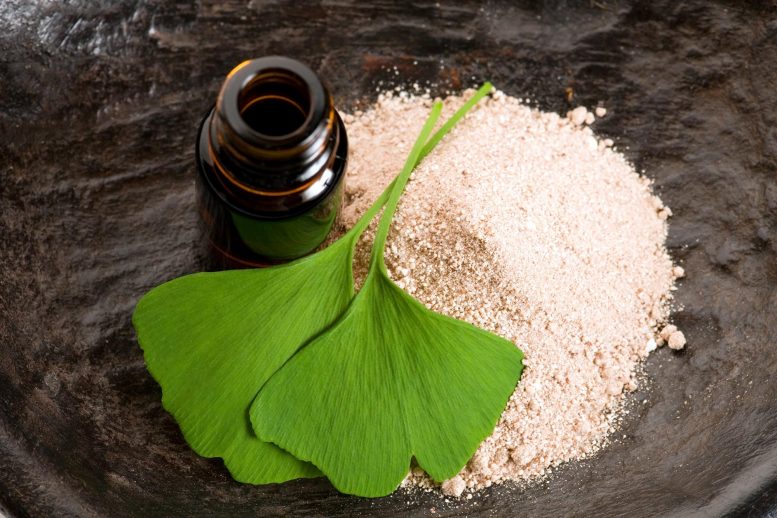
Unsurprisingly, given that legacy, individual ginkgo trees today are unusually hardy and long-lived; some specimens are said to be thousands of years old. Traditional Chinese medicine includes the use of ginkgo extracts for a variety of ailments, and even the leaves are said to have been used in ancient times as bookmarks to protect against paper-eating insects like silverfish.
A likely factor in G. biloba’s longevity is the set of insecticidal compounds found in its leaves and nuts. These include ginkgolide compounds, which can cause dangerous bleeding in humans who ingest them at high enough doses, but also the less well-known bilobalide, which has powerful effects on insects but appears to be essentially non-toxic to people. Bilobalide also breaks down quickly in the environment, adding to its attributes for a “green” insecticide.
However, bilobalide’s carbon-skeleton structure with eight oxygen atoms makes its synthesis intrinsically challenging. Previously previous procedures were long due in part to the difficulty of positioning all of these oxygen atoms in the correct places.
“We tried a different approach,” Shenvi says. “Rather than chiseling away at the structure by putting oxygen atoms in one-by-one, we started with large, oxygen-containing fragments, and then pieced them together, like assembling Ikea furniture.”
The new synthesis method, developed principally by graduate students Meghan Baker and Robert Demoret, as well as postdoc Masaki Ohtawa, culminated with a procedure in which the bowl-like molecular architecture was opened and a final oxygen atom was placed at a precise location inside it.
“Figuring out how to do the last part was a monumental effort,” Shenvi says.
Overall, the synthesis takes much less time and effort than earlier techniques, and as a result of its development, chemists now have a practical method for synthesizing organic compounds that can be used to make both bilobalide and its derivative compounds, allowing them to study the compounds’ potential as insecticides or even pharmaceuticals. Researchers have reported in previous studies that bilobalide reverses cognitive deficits in an animal model of Down syndrome, and that it protects dopamine neurons in a model of Parkinson’s disease.
“We were first interested in bilobalide because of its potential relevance for human neuroscience,” Shenvi says. “However, since word has spread about the new synthesis, we’ve had the strongest expression of interest from the agrochemical industry, because of bilobalide’s good characteristics as an insecticide and its safety profile.”
Shenvi and his colleagues plan to use their new method to make bilobalide analogs and explore their properties.
Reference: “Concise asymmetric synthesis of (−)-bilobalide” by Meghan A. Baker, Robert M. Demoret, Masaki Ohtawa and Ryan A. Shenvi, 16 October 2019, Nature.
DOI: 10.1038/s41586-019-1690-5
Authors of the study, “Concise asymmetric synthesis of (−)-bilobalide,” were Meghan Baker, Robert Demoret, and Ryan Shenvi, of Scripps Research, and Masaki Ohtawa of Kitasato University.
Support for the research was provided by the National Institutes of Health (R35 GM122606), the Uehara Memorial Foundation, Eli Lilly, Novartis, Bristol-Myers Squibb, Amgen, Boehringer-Ingelheim, the Sloan Foundation, and the Baxter Foundation.
Never miss a breakthrough: Join the SciTechDaily newsletter.
Follow us on Google and Google News.
1 Comment
This really is both equally a very good information when i rather definitely preferred verifying. This may not be at all times i always get likely to see a challenge. Medicines