
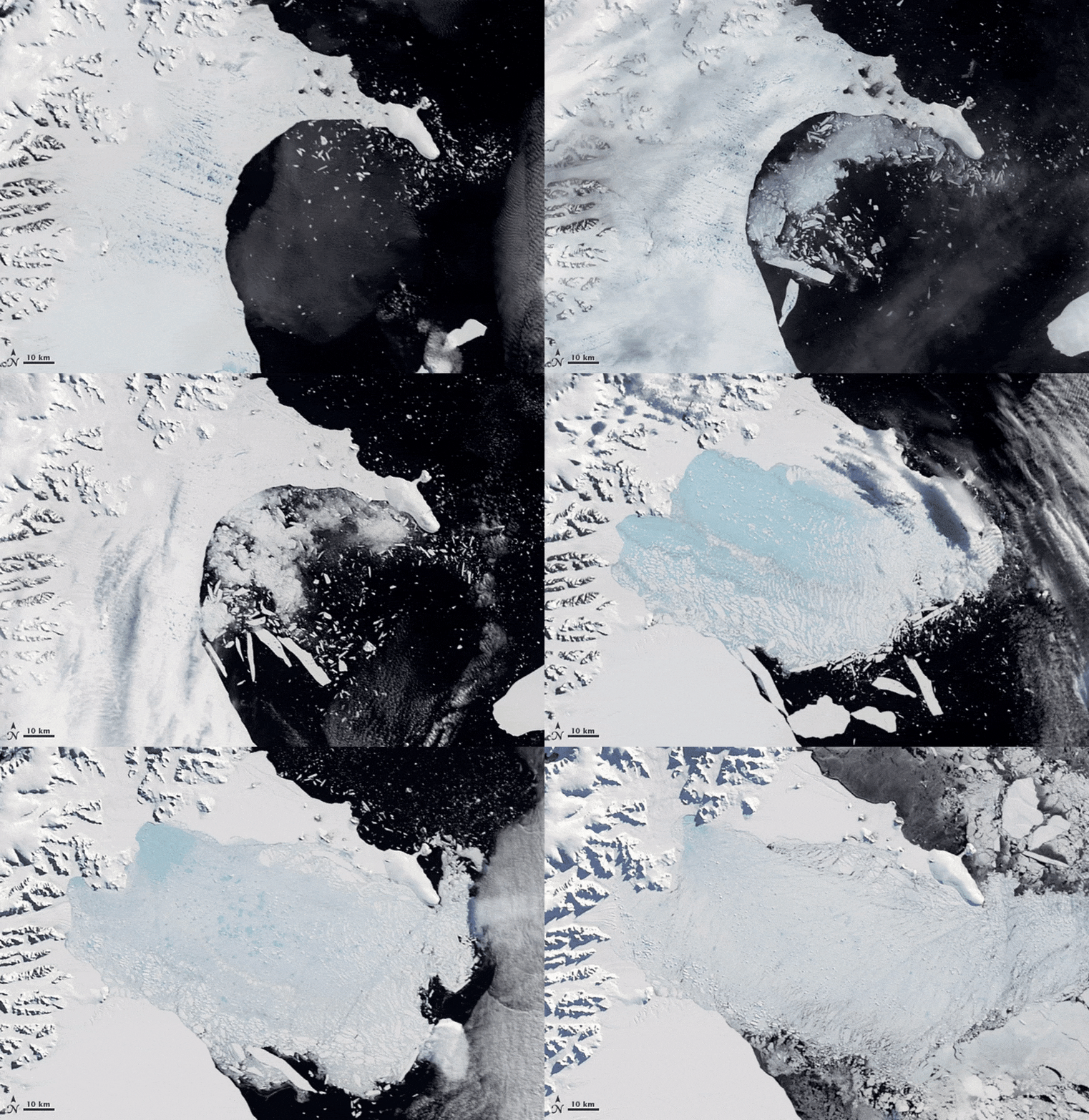
Fractures from melting and run-off will indirectly lead to sea level rise.
More than a third of the Antarctic’s ice shelf area could be at risk of collapsing into the sea if global temperatures reach 4°C (7.2°F) above pre-industrial levels, new research has shown.
The University of Reading led the most detailed ever study forecasting how vulnerable the vast floating platforms of ice surrounding Antarctica will become to dramatic collapse events caused by melting and runoff, as climate change forces temperatures to rise.
It found that 34% of the area of all Antarctic ice shelves — around half a million square kilometers — including 67% of ice shelf area on the Antarctic Peninsula, would be at risk of destabilization under 4°C of warming. Limiting temperature rise to 2°C (3.6°F) rather than 4°C would halve the area at risk and potentially avoid significant sea level rise.
Larsen C Among Most Threatened Ice Shelves
The researchers also identified Larsen C – the largest remaining ice shelf on the peninsula, which split to form the enormous A68 iceberg in 2017 – as one of four ice shelves that would be particularly threatened in a warmer climate.
Dr. Ella Gilbert, a research scientist in the University of Reading’s Department of Meteorology, said: “Ice shelves are important buffers preventing glaciers on land from flowing freely into the ocean and contributing to sea level rise. When they collapse, it’s like a giant cork being removed from a bottle, allowing unimaginable amounts of water from glaciers to pour into the sea.
“We know that when melted ice accumulates on the surface of ice shelves, it can make them fracture and collapse spectacularly. Previous research has given us the bigger picture in terms of predicting Antarctic ice shelf decline, but our new study uses the latest modeling techniques to fill in the finer detail and provide more precise projections.
“The findings highlight the importance of limiting global temperature increases as set out in the Paris Agreement if we are to avoid the worst consequences of climate change, including sea level rise.”
The new study, published in the Geophysical Research Letters journal, used state-of-the-art, high-resolution regional climate modeling to predict in more detail than before the impact of increased melting and water runoff on ice shelf stability.
Ice shelf vulnerability from this fracturing process was forecast under 1.5°C (2.7°F), 2°C, and 4°C global warming scenarios, which are all possible this century.
Ice shelves are permanent floating platforms of ice attached to areas of the coastline and are formed where glaciers flowing off the land meet the sea.
Surface Melting Can Trigger Collapse
Every summer, ice at the surface of the ice shelf melts and trickles down into small air gaps in the snow layer below, where it refreezes. However, in years when there is a lot of melting but little snowfall, the water pools on the surface or flows into crevasses, deepening and widening them until the ice shelf eventually fractures and collapses into the sea. If there is water collecting on the surface of the ice shelf, that suggests it could be vulnerable to collapse in this way.
This is what happened to the Larsen B ice shelf in 2002, which fractured following several years of warm summer temperatures. Its collapse caused the glaciers behind the ice shelf to speed up, losing billions of tonnes of ice to the sea.
The researchers identified the Larsen C, Shackleton, Pine Island, and Wilkins ice shelves as most at-risk under 4°C of warming, due to their geography and the significant runoff predicted in those areas.
Dr. Gilbert said: “If temperatures continue to rise at current rates, we may lose more Antarctic ice shelves in the coming decades.
“Limiting warming will not just be good for Antarctica – preserving ice shelves means less global sea level rise, and that’s good for us all.”
Reference: “Surface melt and runoff on Antarctic ice shelves at 1.5°C, 2°C and 4°C of future warming” by E. Gilbert and C. Kittel, 8 April 2021, Geophysical Research Letters.
DOI: 10.1029/2020GL091733
Never miss a breakthrough: Join the SciTechDaily newsletter.
Follow us on Google and Google News.
2 Comments
If…
Stop talking about possibilities and talk about probabilities, have some decency.
“… Antarctic’s ice shelf area COULD be at risk of collapsing …”
I’m reminded of Mark Twain’s quip that he had “been on the verge of being an angel his whole life.”
The claim is predicated on two unexamined assumptions: 1) that the predictions of future temperature-rise scenarios have significant probability, and, more importantly, 2) that pack ice serves a significant role acting as a buttress against the emerging glaciers.
I have never seen a defense in support of the claim of the buttressing. [If anyone can point me to a rigorous defense, I’d appreciate it] If the shelf ice were holding back the glaciers on land, it would be under compression, and tension cracks that allow calving could not exist! Yet, the article makes reference to abundant crevasses! The movement of glaciers is retarded predominantly by the ice-bedrock friction, and the shear strength of the glacial ice; the forces acting on the glacier are a function of its thickness and the slope of the bed. While glacial ice moves slowly, it does move. Therefore, it has a momentum. When shelf ice freezes onto the leading edge of the glacier, it acquires the momentum of the glacier. Thus, there is little to impede the glacier floating on water. Newton’s 2nd Law: “an object in motion will stay in motion unless acted on by a net external force.”
This research is little more than hand waving based on speculation. It it poor science.