
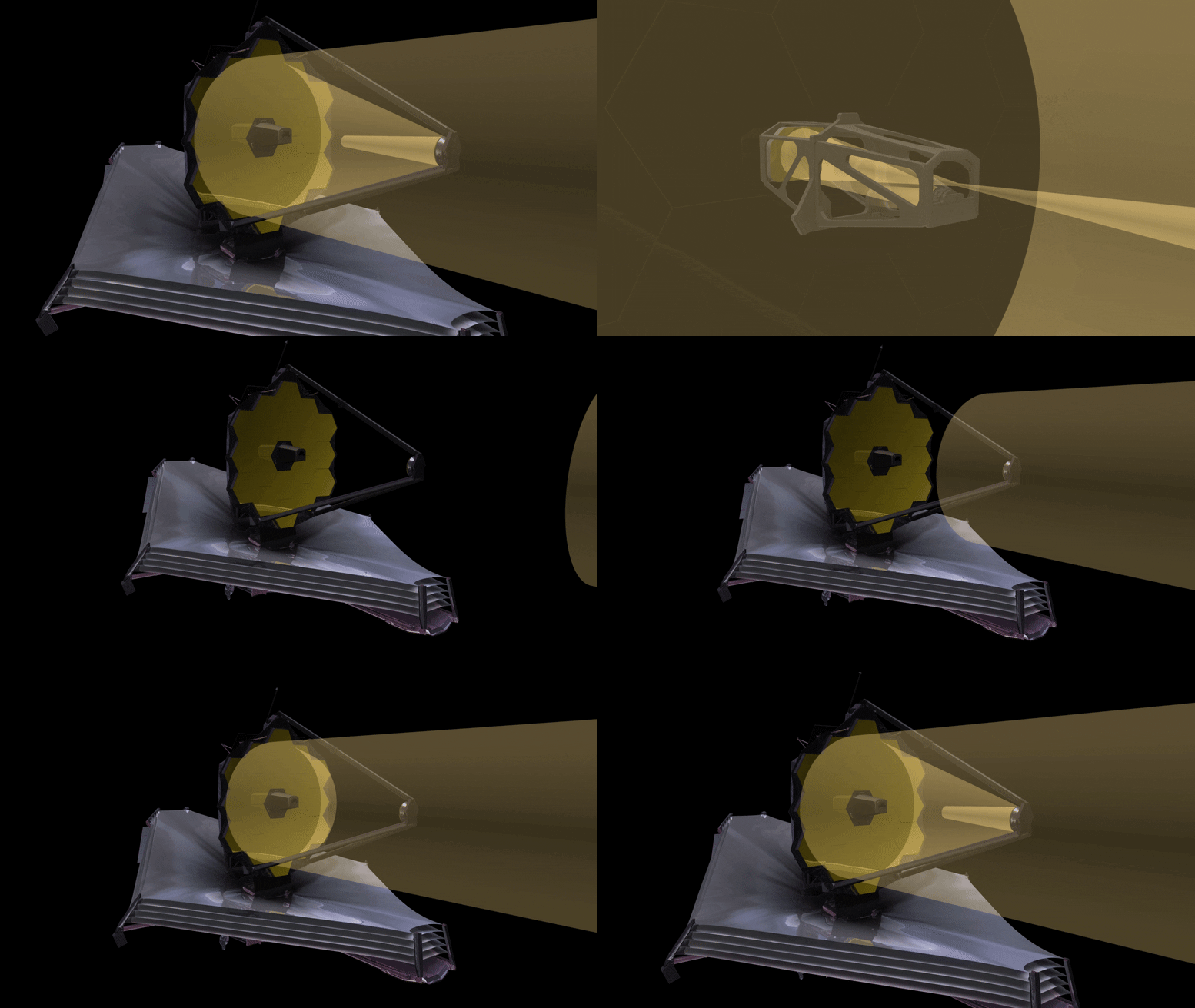
While telescope alignment continues, Webb’s Mid-Infrared Instrument (MIRI) is still in cooldown mode. MIRI, which will be the coldest of Webb’s four instruments, is the only instrument that will be actively cooled by a cryogenic refrigerator, or cryocooler. This cryocooler uses helium gas to carry heat from MIRI’s optics and detectors out to the warm side of the sunshield. To manage the cooldown process, MIRI also has heaters onboard, to protect its sensitive components from the risk of ice forming. The Webb team has begun progressively adjusting both the cryocooler and these heaters, to ensure a slow, controlled, stable cooldown for the instrument. Soon, the team will turn off MIRI’s heaters entirely, to bring the instrument down to its operating temperature of less than 7 kelvins (-447 degrees Fahrenheit, or -266 degrees Celsius).
In the meantime, after achieving alignment with the Near-Infrared Camera (NIRCam), Webb engineers have begun aligning the telescope to the remaining near-infrared instruments. For more about this six-week process, we hear today from Michael McElwain and Charles Bowers, members of the Webb team at NASA’s Goddard Space Flight Center:
“Webb’s alignment at the NIRCam field showed some spectacular diffraction-limited images, producing a tantalizing glimpse of the capabilities this observatory will carry for its science program. This was a major milestone because it required nearly all of the observatory systems to be functioning as designed. It all worked as well as we dared to hope, and it was certainly a moment to celebrate.
“The next step is to ensure the telescope is well-aligned to the instruments other than NIRCam, including the guider (the Fine Guidance Sensor, or FGS) and the other three science instruments: the Near-Infrared Slitless Spectrograph (NIRISS), Near-Infrared Spectrometer (NIRSpec), and MIRI. All the near-infrared instruments have already been passively cooled, are approaching their operational temperatures, and are participating in this next alignment stage. MIRI requires active cooling by a cryocooler, which is now underway, and it will be ready for alignment in a few weeks.
“This is the sixth stage of our telescope alignment plan, the Telescope Alignment Over Instrument Fields of View. Each of the instruments occupies a part of the telescope focal plane, just slightly offset with respect to each other. NIRCam was intentionally placed at the center of the telescope field where the telescope’s optical performance is best due to its demanding imaging performance requirements. Additionally, NIRCam was equipped with some specialized optical tools used to align the telescope. However, the initial alignment using only NIRCam could lead to an incorrect placement that compensates errors from primary-to-secondary mirror misalignments with the primary mirror itself. Small misalignments of this type will be evident in images in instruments farther from the center of the telescope field of view.
“The first step was to simply look at star fields as seen by NIRCam, NIRISS, FGS, and NIRSpec to see whether they were in focus. The stars looked nearly in-focus, which was a sign that the primary to secondary mirror alignment was already very good. A more accurate optical error measurement has been carried out at five to 10 field positions within each operational science instrument, using data taken with the secondary mirror positioned out of focus. This dataset provided a conclusive determination of the telescope alignment state.
“The Webb optics team analyzed the multi-instrument dataset and determined that only minor focus adjustments are needed on the secondary mirror and science instruments. Since the telescope is still cooling along with the MIRI instrument, we will not apply the corrections at this time and will defer them until the next round.
“When MIRI is available, an additional round of measurements will be conducted by each science instrument to determine the final state of the telescope alignment. We will iterate this process as needed to ensure the telescope performance is optimized for all of the instruments. After the telescope alignment to all instruments is complete, we will transition to the final two months of commissioning, where we will carry out optical stability tests and measure the science instrument performance before embarking on the Cycle 1 science program.”
Written by:
- Michael McElwain, Webb observatory project scientist, NASA Goddard
- Charles Bowers, Webb deputy observatory project scientist, NASA Goddard
Never miss a breakthrough: Join the SciTechDaily newsletter.
Follow us on Google and Google News.