
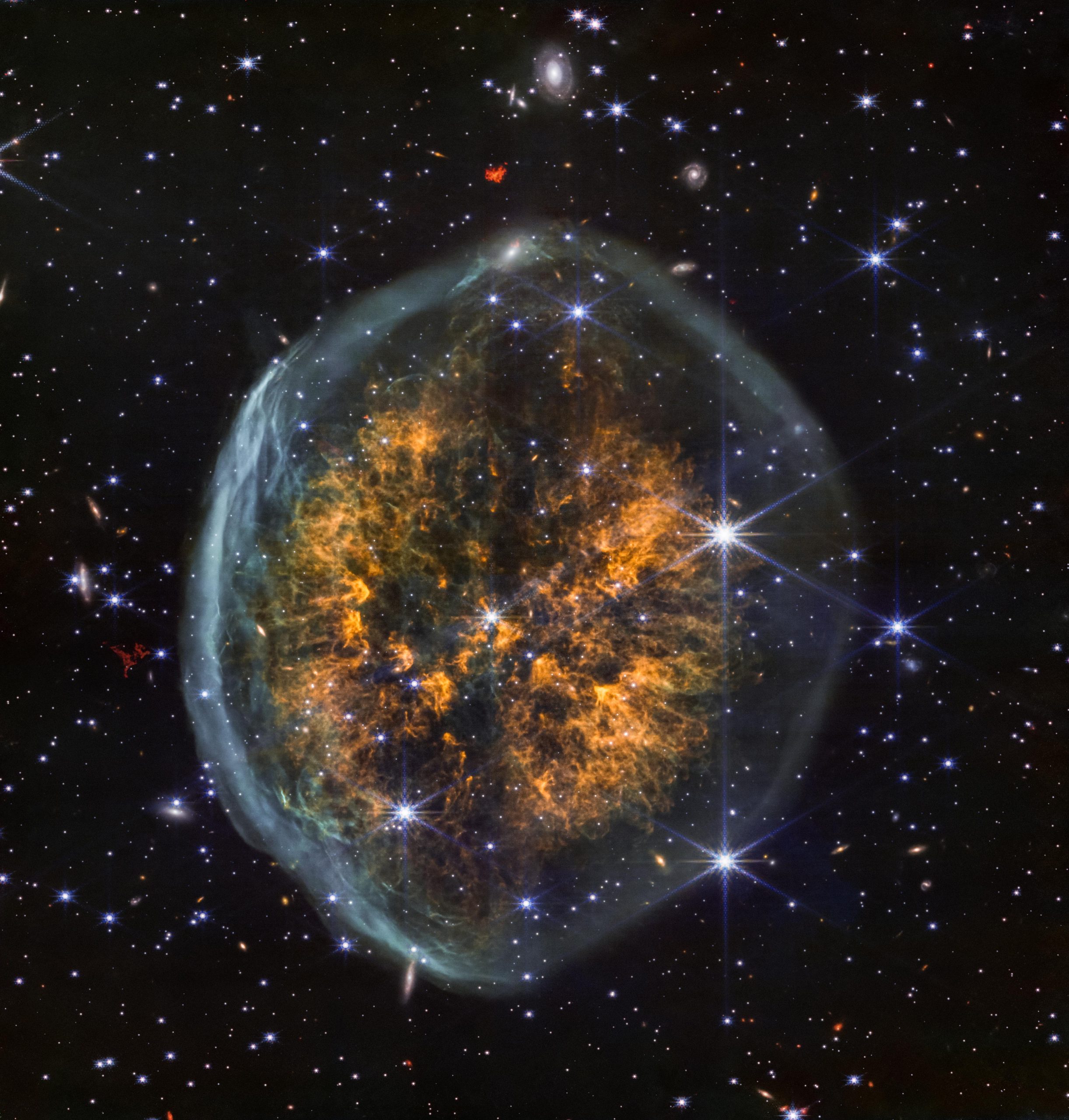
Webb has captured the haunting “Exposed Cranium” nebula—an otherworldly cloud shaped by a dying star that looks remarkably like a brain inside a skull.
New images from NASA’s James Webb Space Telescope are shedding fresh light on a strange and little explored nebula surrounding a dying star. The detailed observations reveal complex structures within the cloud of gas and dust, offering a clearer view of how the object formed and how it continues to evolve.
Known as Nebula PMR 1, this cosmic cloud has an eerie appearance that resembles a brain inside a transparent skull. Because of this unusual shape, it has earned the nickname the “Exposed Cranium” nebula. Webb observed the object using both near-infrared and mid-infrared wavelengths, allowing scientists to see features that were previously hidden.
The nebula was originally detected in infrared light more than ten years ago by NASA’s now-retired Spitzer Space Telescope, which paved the way for Webb’s more detailed observations. With its far more powerful instruments, Webb reveals finer structures that make the nebula’s brain-like pattern even more striking.
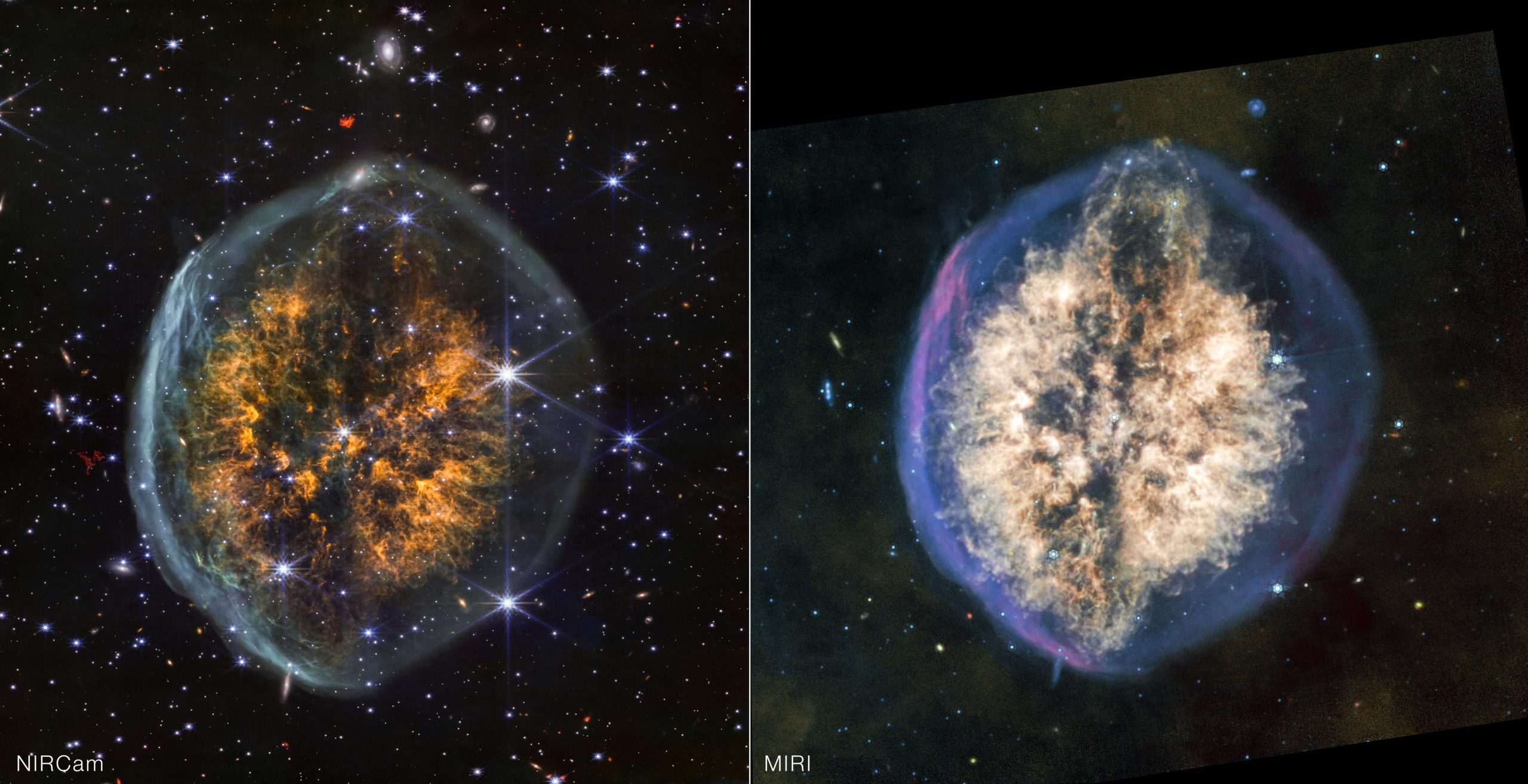
Webb Reveals Layers and Jets in a Dying Star’s Nebula
The new images show that the nebula contains several distinct regions that reflect different stages of its formation. An outer shell of gas, made mostly of hydrogen, was expelled earlier in the star’s life. Closer to the center lies a more complex cloud made up of several different gases and shaped by ongoing activity.
Both Webb’s NIRCam (Near-Infrared Camera) and MIRI (Mid-Infrared Instrument) highlight a dark lane that runs vertically through the center of the nebula. This feature divides the cloud into two halves that resemble the left and right sides of a brain. The telescope’s sharp resolution suggests that the dark band may be linked to a powerful outflow from the central star. In many dying stars, energetic jets blast outward in opposite directions.
Signs of this activity are especially visible near the top of the nebula in Webb’s MIRI image, where the gas in the inner region appears to be pushed outward, hinting at ongoing ejections from the star.
A Rare Snapshot of a Star Near the End of Its Life
Although many details about Nebula PMR 1 remain uncertain, astronomers know it is being shaped by a star approaching the final phase of its fuel-burning “life.” During these late stages, stars shed their outer layers into space. While this transformation takes place over enormous distances and timescales, it is considered relatively rapid in cosmic terms.
Webb’s observations capture a moment in this process as the star continues to lose material. The star’s ultimate fate depends on its mass, which scientists have not yet determined. If the star is sufficiently massive, it may eventually explode as a supernova. If it is more similar to our Sun, it will continue losing layers until only a compact core remains. That leftover core will become a dense white dwarf that slowly cools over billions of years.
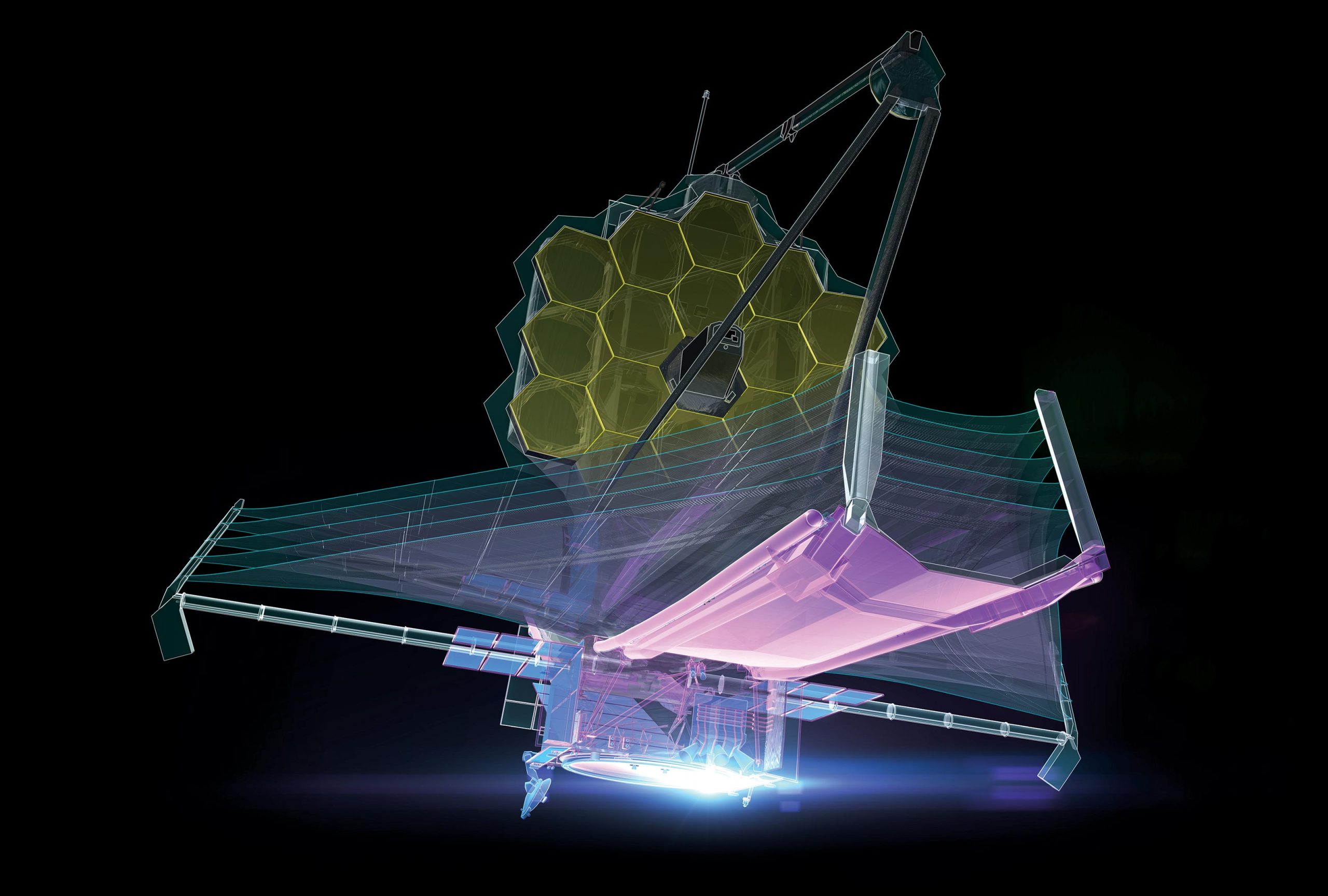
The James Webb Space Telescope’s Mission
The James Webb Space Telescope is the most powerful space observatory ever built for studying the universe. Its instruments are designed to investigate objects throughout our solar system, search for planets around other stars, and explore the origins and structure of the cosmos.
Webb is an international collaboration led by NASA together with ESA (European Space Agency) and CSA (Canadian Space Agency). The telescope continues to reveal new details about the universe, helping scientists better understand how stars, planets, and galaxies form and evolve.
Never miss a breakthrough: Join the SciTechDaily newsletter.
Follow us on Google and Google News.
3 Comments
How many stars have been observed expiring, and has there been any pattern to how distant they were?
Doesn’t look like any brain I have ever seen…
Memo 2603151537_Source1.Reinterpretation【】()
Source1.
https://scitechdaily.com/nasas-webb-telescope-reveals-an-eerie-nebula-that-looks-like-a-giant-brain/
1.
_NASA’s James Webb Space Telescope has discovered (a strange nebula that looks like a giant brain).
_NASA’s James Webb Space Telescope has captured a surprising new image of the mysterious “Exposed Skull” nebula, a ghostly cloud of gas and dust surrounding a dying star. (This nebula, known as PMR 1, eerily resembles a brain inside a transparent skull, with a dark central passageway dividing it into two hemispheres.)
ㅡc2.【The nebula resembles a human brain or an eyeball. This could be something like the uncertainty principle or quantum entanglement, which appear to exist as perception. A domain (*) that exists only when perceived becomes akin to the concept of discovery.
—If Edison had not discovered the light bulb or the Wright brothers had not created the prototype of the airplane, would we really be able to see lights today in the basements of buildings or inside skyscrapers at night?
If there had been no early flying vehicles, would the F-22 or KF-21 have been able to demonstrate their performance? 1548.
—There are countless cases where civilization has evolved under the preconditions of invention and discovery. 21st-century human civilization, which discovered elements, applied them, and created chemical substances, is also a kind of conceptual definition (*).
】
1-1.
Webb captured the “Exposed Skull” nebula, a peculiar cloud formed by a dying star that looks as if a brain is inside a skull.
_New images taken by NASA’s James Webb Space Telescope are providing new insights into a strange and little-known nebula surrounding a dying star. Detailed observations have revealed the complex internal structure of the gas and dust cloud, allowing for a clearer understanding of how this celestial body formed and how it continues to evolve.
1-2.
This cosmic cloud, known as the _11_PMR 1 Nebula, has a peculiar appearance resembling a brain inside a transparent skull. Due to this unusual shape, it earned the nickname “Exposed Skull” Nebula. The Webb Space Telescope observed this object using both near-infrared and mid-infrared wavelengths, enabling scientists to observe features that were previously unseen.
—a1.【() This nebula is a closed dbr.ain(*) with msbase.emwave.parpi(*). 1332.】
1-3.
This nebula was first observed in infrared about a decade ago by NASA’s Spitzer Space Telescope (now decommissioned), which paved the way for more detailed observations using the Webb Space Telescope. Equipped with much more powerful instruments, Webb reveals the nebula’s fine structures, making its brain-like¹ features even more impressive.
2.
The difference between what the Webb Space Telescope’s infrared instruments reveal and what they conceal within the PMR 1 “Exposed Skull” nebula is clearly evident in this side-by-side comparison image.
In the region observed by NIRCam, more stars and background galaxies shine brightly, whereas in the region observed by MIRI, cosmic dust shines more prominently. Webb Telescope Reveals Layers and Jet Ejection Structures in Dying Star Nebula
The new image shows that the nebula is composed of distinct regions reflecting various stages of its formation process. The outer shell, composed primarily of hydrogen, was ejected early in the star’s life.
_ (The closer to the center, the more complex the cloud composed of various types of gas exists, which is formed by continuous activity.)
—b1.【()ms_nebula(*)’s surprising feature is that when the nebula becomes sufficiently massive, it reaches a state of high-density particles near the center. This is a completely new aspect, entirely different from a state where only stars are gathered. Uh-huh.1400.
—The energy for the birth of new stars is concentrated white in the center, while the actual birthplace twinkles red at the top of the sides. Uh-huh.1405. 】
2-1.
_The Webb Space Telescope’s Near-Infrared Camera (NIRCam) and Mid-Infrared Observation Instrument (MIRI) both captured (a dark band running vertically across the center of the nebula).
—【() ms_base.ms_nebula(*) has a middle band. The vertical dark band indicates the opposite direction of the inverse progression of the inversion. 1338.】
_This band divides the nebula into two parts, much like the left and right hemispheres of the brain. The telescope’s excellent resolution suggests that this dark band is likely related to powerful ejecta spewing from the central star. From many dying stars, energy-rich jets are ejected in opposite directions.
2-2.
_Signs of this activity are particularly evident in the MIRI images from the Webb Space Telescope (near the top of the nebula), suggesting that gas in the inner regions appears to be pushed outward, indicating continuous gas emission from the stars.
—【() As seen in the Horsehead Nebula… the gas layer heads toward the top, heating the mass at the center of the msnebula with nuclear density, and creating new.nkstars in the inside parpi multilayer as if being compressed and flung out. Hmm. 1344. 1408.
】
While many details regarding the PMR 1 nebula are still uncertain, astronomers know that this nebula is forming as a star enters the final stage of its life. (In these late stages, stars release their outer shells into space.) Although this change occurs over vast distances and periods of time, it is considered to proceed relatively quickly from a cosmic perspective.