
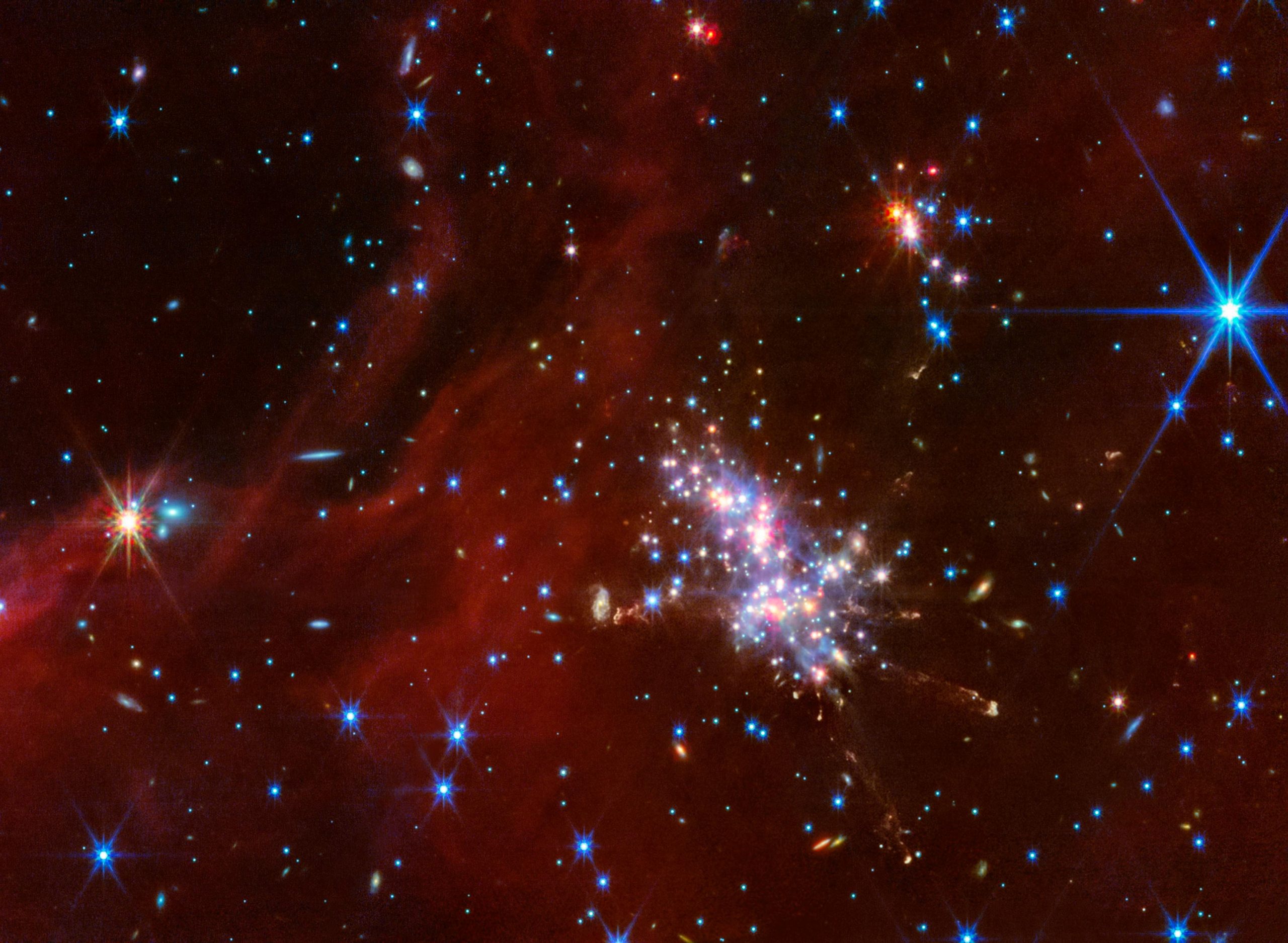
Among the Milky Way’s outskirts is a firecracker show of star formation.
How do environmental factors affect the star formation process?
To help answer this question, NASA’s James Webb Space Telescope examined the fringes of our Milky Way galaxy. Webb’s near- and mid-infrared imaging capabilities enabled scientists to examine a star-forming area reminiscent of our galaxy during its early formation.
Webb Space Telescope Peers into the Extreme Outer Galaxy
Astronomers have directed NASA’s James Webb Space Telescope to examine the outskirts of our Milky Way galaxy. Scientists call this region the Extreme Outer Galaxy due to its location more than 58,000 light-years away from the Galactic Center. (For comparison, Earth is approximately 26,000 light-years from the center.)
A team of scientists used Webb’s NIRCam (Near-Infrared Camera) and MIRI (Mid-Infrared Instrument) to image select regions within two molecular clouds known as Digel Clouds 1 and 2. With its high degree of sensitivity and sharp resolution, the Webb data resolved these areas, which are hosts to star clusters undergoing bursts of star formation, in unprecedented detail. Details of this data include components of the clusters such as very young (Class 0) protostars, outflows and jets, and distinctive nebular structures.
These Webb observations, which came from telescope time allocated to Mike Ressler of NASA’s Jet Propulsion Laboratory in Southern California, are enabling scientists to study star formation in the outer Milky Way in the same depth of detail as observations of star formation in our own solar neighborhood.
Insights Into the Digel Clouds
“In the past, we knew about these star forming regions but were not able to delve into their properties,” said Natsuko Izumi of Gifu University and the National Astronomical Observatory of Japan, lead author of the study. “The Webb data builds upon what we have incrementally gathered over the years from prior observations with different telescopes and observatories. We can get very powerful and impressive images of these clouds with Webb. In the case of Digel Cloud 2, I did not expect to see such active star formation and spectacular jets.”
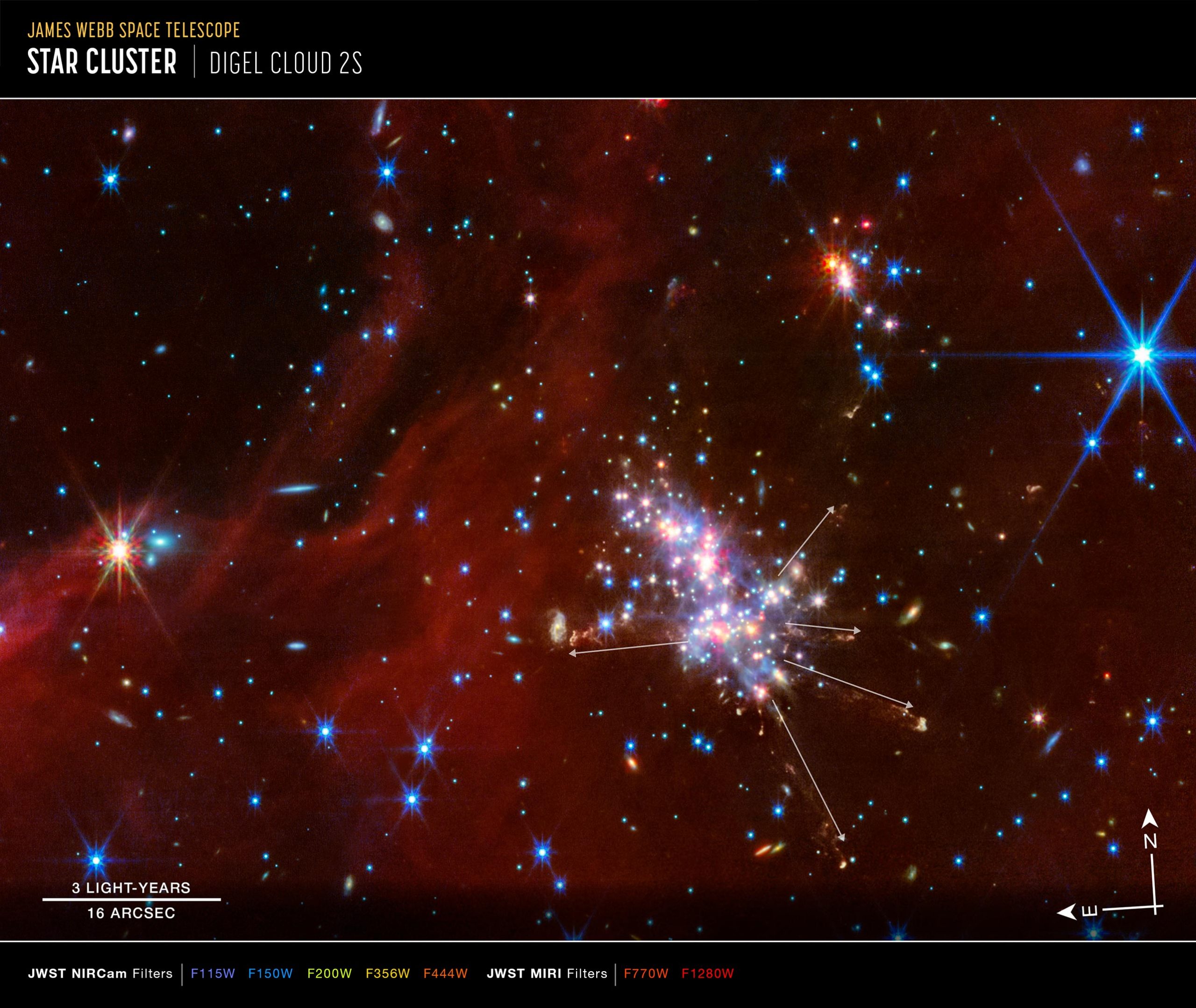
The north and east compass arrows show the orientation of the image on the sky. Note that the relationship between north and east on the sky (as seen from below) is flipped relative to direction arrows on a map of the ground (as seen from above).
The scale bar is labeled in light-years and arcseconds. One light-year is equal to about 5.88 trillion miles or 9.46 trillion kilometers. One arcsecond is equal to 1/3600 of one degree of arc. (The full Moon has an angular diameter of about 0.5 degrees.) The actual size of an object that covers one arcsecond on the sky depends on its distance from the telescope.
This image shows invisible near- and mid-infrared wavelengths of light that have been translated into visible-light colors. The color key shows which NIRCam and MIRI filters were used when collecting the light. The color of each filter name is the visible light color used to represent the infrared light that passes through that filter.
In the main cluster are five white arrows, which highlight the paths of five protostar jets.
Credit: NASA, ESA, CSA, STScI, Michael Ressler (NASA-JPL)
Composition and Dynamics of Young Stars
Although the Digel Clouds are within our galaxy, they are relatively poor in elements heavier than hydrogen and helium. This composition makes them similar to dwarf galaxies and our own Milky Way in its early history. Therefore, the team took the opportunity to use Webb to capture the activity occurring in four clusters of young stars within Digel Clouds 1 and 2: 1A, 1B, 2N, and 2S.
For Cloud 2S, Webb captured the main cluster containing young, newly formed stars. This dense area is quite active as several stars are emitting extended jets of material along their poles. Additionally, while scientists previously suspected a sub-cluster might be present within the cloud, Webb’s imaging capabilities confirmed its existence for the first time.
“We know from studying other nearby star-forming regions that as stars form during their early life phase, they start emitting jets of material at their poles,” said Ressler, second author of the study and principal investigator of the observing program. “What was fascinating and astounding to me from the Webb data is that there are multiple jets shooting out in all different directions from this cluster of stars. It’s a little bit like a firecracker, where you see things shooting this way and that.”
The Continuous Study of Star Formation
The Webb imagery skims the surface of the Extreme Outer Galaxy and the Digel Clouds, and is just a starting point for the team. They intend to revisit this outpost in the Milky Way to find answers to a variety of current mysteries, including the relative abundance of stars of various masses within Extreme Outer Galaxy star clusters. This measurement can help astronomers understand how a particular environment can influence different types of stars during their formation.
“I’m interested in continuing to study how star formation is occurring in these regions. By combining data from different observatories and telescopes, we can examine each stage in the evolution process,” said Izumi. “We also plan to investigate circumstellar disks within the Extreme Outer Galaxy. We still don’t know why their lifetimes are shorter than in star-forming regions much closer to us. And of course, I’d like to understand the kinematics of the jets we detected in Cloud 2S.”
Though the story of star formation is complex and some chapters are still shrouded in mystery, Webb is gathering clues and helping astronomers unravel this intricate tale.
These findings have been published in the Astronomical Journal.
The observations were taken as part of Guaranteed Time Observation program 1237.
Reference: “Overview Results of JWST Observations of Star-forming Clusters in the Extreme Outer Galaxy” by Natsuko Izumi, Michael E. Ressler, Ryan M. Lau, Patrick M. Koch, Masao Saito, Naoto Kobayashi and Chikako Yasui, 10 July 2024, The Astronomical Journal.
DOI: 10.3847/1538-3881/ad4e2e
The James Webb Space Telescope is the world’s premier space science observatory. Webb is solving mysteries in our solar system, looking beyond to distant worlds around other stars, and probing the mysterious structures and origins of our universe and our place in it. Webb is an international program led by NASA with its partners, ESA (European Space Agency) and CSA (Canadian Space Agency).
Never miss a breakthrough: Join the SciTechDaily newsletter.
Follow us on Google and Google News.
1 Comment
Memo 2409150349
James Webb’s direction of astronomical observation is basically the profession of experts based on basic knowledge of interpreting observatory data. That’s the reality, but the question of ‘Do you understand the universe properly’ seems to be separate.
Although I can finally make a comprehensive evaluation of James Webb’s data, I do not currently have the technical knowledge of observation that implements the data. It is not an academic, operator, or observation equipment engineer optimized for observation equipment.
Source 1. Edit
Astronomers have directed NASA’s James Webb Space Telescope to survey the outskirts of the Milky Way. Scientists call the area the Extreme Outer Galaxy because it is more than 58,000 light-years away from the center of the galaxy. (The Earth is about 26,000 light-years away from the center for comparison.)
Using Webb’s NIRCam (Near-Infrared Camera) and MIRI (Medium-Infrared Instrument), the team of scientists imaged the selected regions within two molecular clouds known as Digel Clouds 1 and 2. With a high level of sensitivity and sharp resolution, Webb data decomposed these regions, hosts of clusters that are undergoing star-forming outbursts, into unprecedented detail. The details of this data include components of clusters such as very young (Class 0) protostars, outflows and jets, and unique nebular structures.
Scale bars are denoted by light years and second angles. One light year is equivalent to about 5.88 trillion miles or 9.46 trillion kilometers. Each second is equivalent to 1/3600 of a degree. (The angle of the full moon is about 0.5 degrees.) The actual size of the object occupying a second angle in the sky depends on the distance from the telescope.
This image shows invisible near and mid-infrared wavelengths converted to visible light colors. The color key shows which NIRCam and MIRI filters were used when collecting light. The color of each filter name is the color of visible light used to indicate infrared rays passing through that filter.
For Cloud 2S, Webb captured a major cluster containing a young, newly formed star. This dense region is highly active as several stars emit extended jets of matter along the poles. In addition, scientists previously suspected that sub-clusters could exist within the cloud, but Webb’s imaging capabilities confirmed their existence for the first time.
We know from studying other nearby star-forming regions that when stars form in their early life stages, they begin to emit matter jets from the poles. What’s interesting and surprising to me from the web data is that this group of stars shoots out several jets in all different directions. It’s like a firecracker, so you can see objects shooting up and down.
continuous study of star formation
The web footage is just the team’s starting point, scanning the surface of the Far Outer Galaxy and the DIGEL cloud. They plan to revisit this outpost in the Milky Way to find answers to various current mysteries, including the relative abundances of stars of various masses within the Far Outer Galaxy cluster. This measurement may help astronomers understand how certain environments may affect different types of stars during star formation.
1.
Webb’s video appears to have scanned the surface of the galaxy’s polar clouds. It feels like looking around on the side of example 1. The cluster area is packed with huge masses. To find out the mystery, the entire Milky Way must be decomposed into qpeoms nanopixel data. Then the side might reveal how young stars were born there. In other words, the star’s birth 1 is not just focused on the side. Because of the convenience of Webb observation, it means that the universe should not be ‘sewn together like a big bang analysis’. Haha.
ㅡㅡㅡㅡㅡㅡㅡㅡㅡㅡㅡㅡㅡ
Source 1.
https://scitechdaily.com/webb-space-telescope-uncovers-star-birth-secrets-at-galaxys-edge/
Webb Space Telescope Reveals Secret of Star Birth at Galaxy’s End