
Close Menu
    Facebook X (Twitter) Instagram
    SciTechDaily
    • Biology
    • Chemistry
    • Earth
    • Health
    • Physics
    • Science
    • Space
    • Technology
    Facebook X (Twitter) Pinterest YouTube RSS
    SciTechDaily
    Home»Space»Astronomy & Astrophysics 101: Dwarf Galaxy
    Space

    Astronomy & Astrophysics 101: Dwarf Galaxy

    By ESA/HubbleApril 23, 20221 Comment3 Mins Read
    Facebook Twitter Pinterest Telegram LinkedIn WhatsApp Email Reddit
    Share
    Facebook Twitter LinkedIn Pinterest Telegram Email Reddit
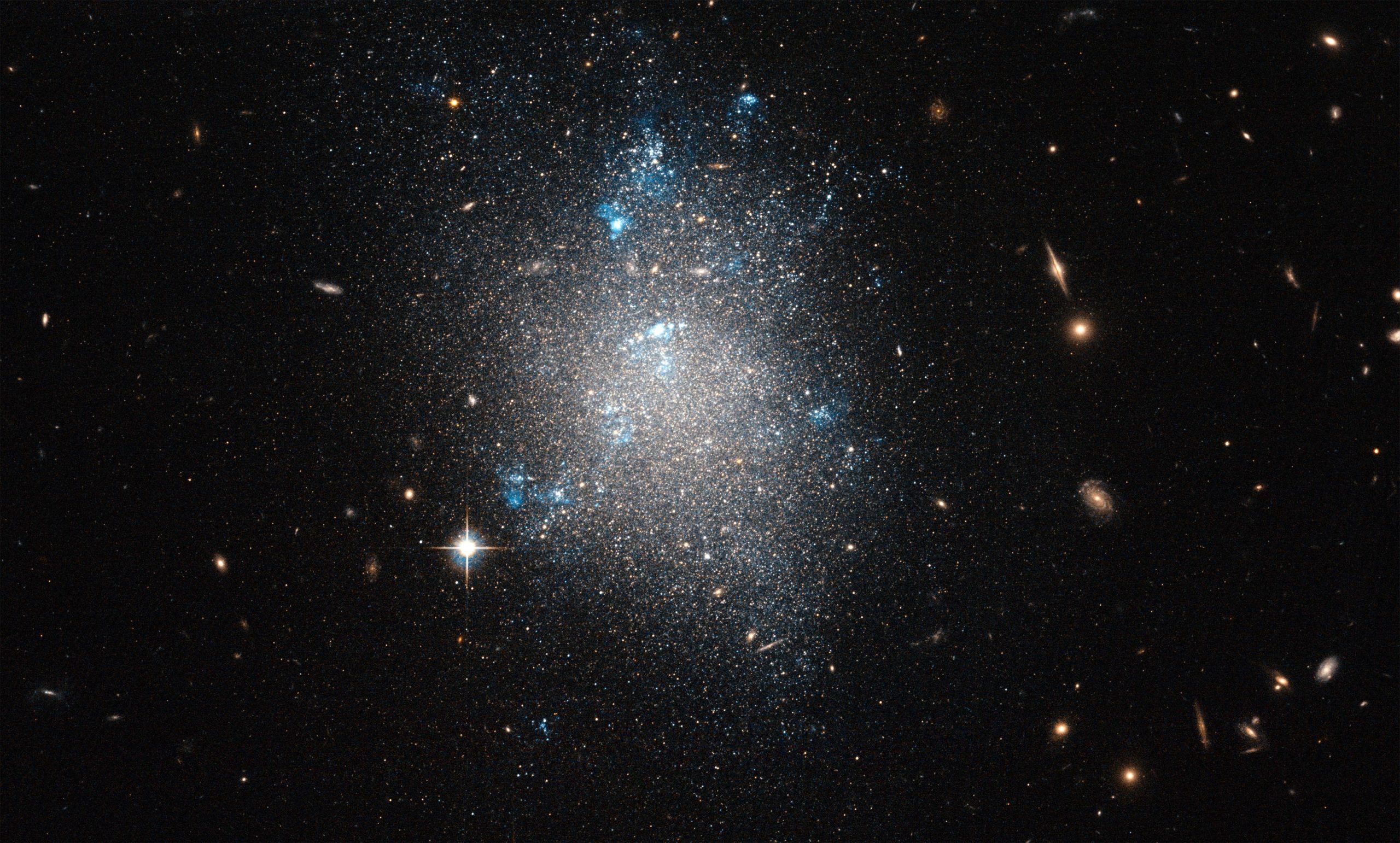
    Dwarf Galaxy NGC 5477
    Hubble Space Telescope image of NGC 5477, an archetypal dwarf galaxy in the Messier 101 group. Without obvious structure, but with visible signs of ongoing starbirth, NGC 5477 looks much like an archetypal dwarf irregular galaxy. The bright nebulae that extend across much of the galaxy are clouds of glowing hydrogen gas in which new stars are forming. These glow pinkish red in real life, although the selection of green and infrared filters through which this image was taken makes them appear almost white. Credit: ESA/Hubble & NASA

    What Is a Dwarf Galaxy?

    Dwarf galaxies are small galaxies made up of a few billion stars.

    Compared to their larger cousins, which can contain hundreds of billions of stars, dwarf galaxies are typically home to a just few billion stars. A number of such dwarf galaxies orbit larger galaxies, such as the Milky Way or the Andromeda Galaxy. They are thought to have been created by gravitational forces in the early stages of the creation of these larger galaxies, or as a result of collisions between galaxies, forming from streams of material and dark matter ejected from the parent galaxies. The Milky Way galaxy features at least 14 satellite dwarf galaxies orbiting it. They are thought to be contemporary versions of some of the remote galaxies observed in deep field galaxy surveys, and can thus help us to understand the early stages of galaxy and star formation in the young Universe.


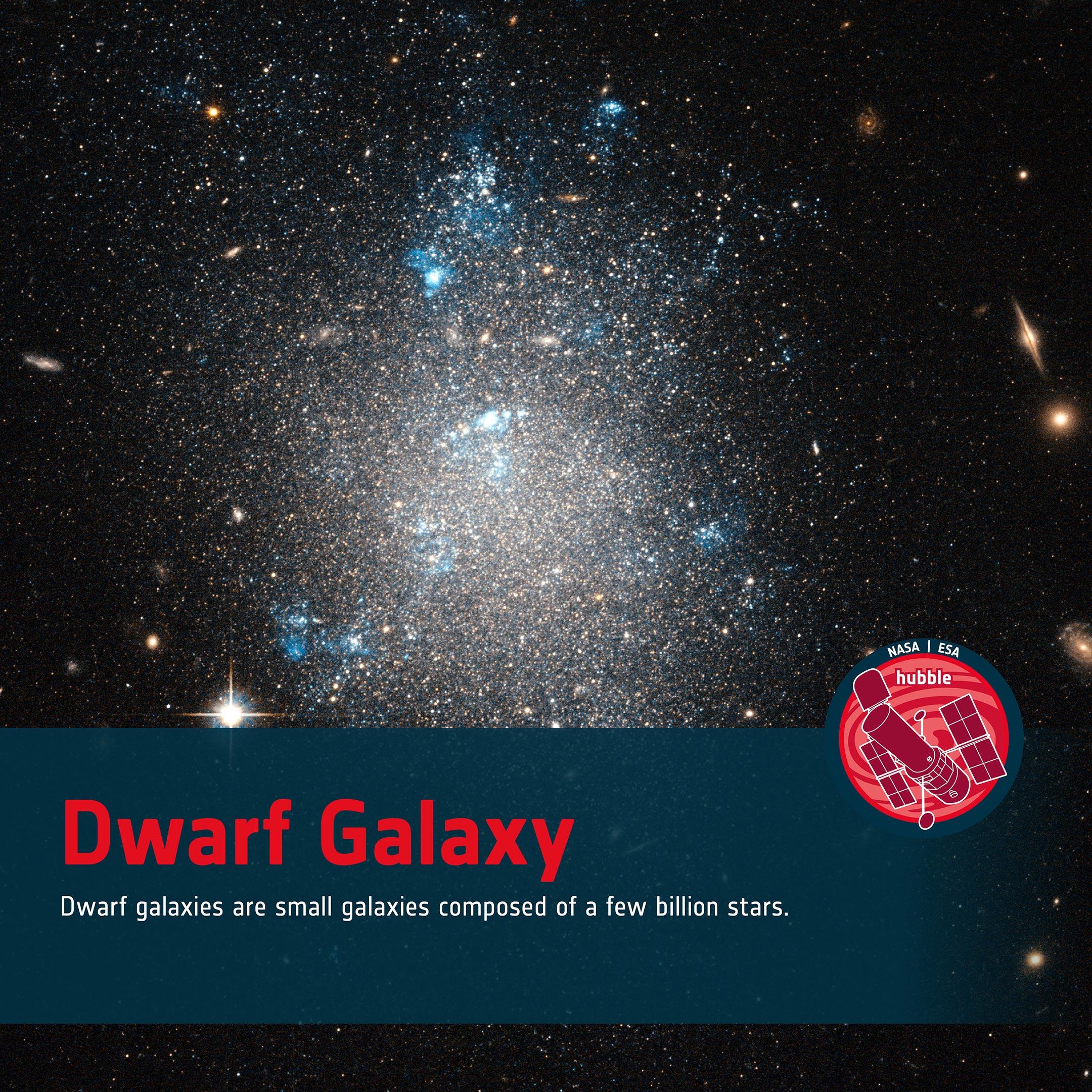
    Dwarf galaxies are small galaxies composed of a few billion stars. Credit: NASA & ESA

    The importance of dwarf galaxies in terms of cosmology is in stark contrast to their unspectacular shapes, as they are thought to be important in our understanding of the overall evolution of galaxies. Dwarf irregulars tend to have low metallicity and relatively large amounts of gas, and are thought to be similar to the earliest galaxies that populated the Universe.

    An international team of astronomers used data from both the Hubble Space Telescope and ESA’s Gaia satellite to directly measure the 3D motions of individual stars in the nearby Sculptor Dwarf Galaxy, which resides 300,000 light-years away. The achieved accuracy was better than for any previous measurement of a galaxy beyond the Milky Way. The motions provided a field test of the currently-accepted cosmological model and also measured the trajectory of the galaxy through space.
    Word Bank Dwarf Galaxy
    Dwarf Galaxy. Credit: ESA/Hubble & NASA

    Hubble has also made detailed observations of the dwarf galaxy NGC 2366, which is home to a bright, star-forming nebula and is close enough for astronomers to discern its individual stars. While we see the stars because they shine brightly, galaxies are overwhelmingly made up of the empty space between them. Hubble’s high-resolution images can capture this perfectly. The telescope’s field of view for it’s observations of the galaxy were equivalent to a little over a fifth of the diameter of the full Moon. Although this is comparatively large by the standard of Hubble’s images, NGC 2366 is much too faint to observe with the naked eye.

    This Hubblecast episode looks at starburst dwarf galaxies at a time when most of the stars in the Universe were formed, and how Hubble observations show that dwarf galaxies played a bigger role than expected in the early history of the Universe.

    Never miss a breakthrough: Join the SciTechDaily newsletter.
    Follow us on Google and Google News.

    Astronomy Astrophysics European Space Agency Hubble Space Telescope
    Share. Facebook Twitter Pinterest LinkedIn Email Reddit

    Related Articles

    Hubble Captures a Dangerous Dance Over 100 Million Light-Years From Earth

    Hubble Captures the Final Acts of a Monster Star

    Hubble Find Surprises Astronomers: White Dwarfs Can Still Undergo Stable Thermonuclear Activity

    First Evidence of Water Vapor at Jupiter’s Moon Ganymede – May Hold More Water Than All of Earth’s Oceans

    Our Giant Universe: Hubble Spots Massive Galaxy Cluster With a Wealth of Exciting Possibilities

    Tantrums of a Baby Star: Herbig-Haro Objects

    Unexpected Discovery: Hubble Space Telescope Uncovers Concentration of Small Black Holes

    “Unprecedented” – Unusual Planetary Nebula Fades Mere Decades After It Arrived

    Hubble Captures Unprecedented Fading of Stingray Nebula – “This Is Very, Very Dramatic, and Very Weird”

    1 Comment

    1. Howard Jeffrey Bender, Ph.D. on April 23, 2022 1:12 pm

      This article gives a brief overview of dwarf galaxies, but it doesn’t mention the importance of the position of dwarfs in relation to Dark Matter.

      Many dwarf galaxies lie in a very thin plane extending from the poles of their parent (such as the Milky Way or Andromeda galaxies) in direct contradiction to the accepted idea that a halo of Dark Matter surrounds the parent and that dwarfs should be formed all over. But also reports that many dwarf galaxies without obvious Dark Matter have stars that orbit their cores much faster than expected suggest that a significant modification of the Cold Dark Matter paradigm or new mass profiles may be needed. NAOC research suggests that unusual kinds of Dark Matter (warm, fuzzy) creates those dwarfs. There are also reports that very unexpected supermassive Black Holes have been found in some of these tiny dwarfs. What’s going on?

      Specifics on this can be found by searching YouTube for “Dwarf Galaxies – A String Theory Way”

      Reply
    Leave A Reply Cancel Reply

    • Facebook
    • Twitter
    • Pinterest
    • YouTube

    Don't Miss a Discovery

    Subscribe for the Latest in Science & Tech!

    Trending News

    289-Million-Year-Old Reptile Mummy Reveals Origin of Human Breathing System

    New Brain Discovery Challenges Long-Held Theory of Teenage Brain Development

    Scientists Discover Plants “Scream” – We Just Couldn’t Hear Them Until Now

    Scientists Discover a Surprising Reason Intermittent Fasting Extends Life

    This Simple Fruit Wash Could Make Produce Safer and Last Days Longer

    Scientists Say Adding This Unusual Seafood to Your Diet Could Reverse Signs of Aging

    Scientists Say a Hidden Structure May Exist Inside Earth’s Core

    Doctors Surprised by the Power of a Simple Drug Against Colon Cancer

    Follow SciTechDaily
    • Facebook
    • Twitter
    • YouTube
    • Pinterest
    • Newsletter
    • RSS
    SciTech News
    • Biology News
    • Chemistry News
    • Earth News
    • Health News
    • Physics News
    • Science News
    • Space News
    • Technology News
    Recent Posts
    • Scientists Just Discovered Light Can Actually Slow Plant Growth
    • Scientists Finally Solved One of Water’s Biggest Mysteries
    • 7,000-Year-Old DNA Rewrites the Story of the “Neolithic Revolution”
    • Missing Medieval Relic of Legendary English King Found After Being Missing for 40 Years
    • New Study Challenges Long-Held Assumptions About Cancer and Aging
    Copyright © 1998 - 2026 SciTechDaily. All Rights Reserved.
    • Science News
    • About
    • Contact
    • Editorial Board
    • Privacy Policy
    • Terms of Use

    Type above and press Enter to search. Press Esc to cancel.