

Two new research studies explore how a stellar nursery in the heart of the Milky Way is affected by the region’s strong magnetic fields.
Despite decades of research, the process of how stars form is still filled with unanswered questions. Because stars create nearly all the chemical elements in the universe, including the carbon and oxygen essential for life, understanding their formation is crucial to uncovering the origins of both the universe and life itself.
At the heart of our Milky Way lies Sagittarius C, a dense region packed with star-forming material. Yet, it produces far fewer stars than scientists expect. Now, two new studies using NASA’s James Webb Space Telescope have taken a closer look at star formation in this extreme environment, located just 200 light-years from the supermassive black hole at the galaxy’s center.
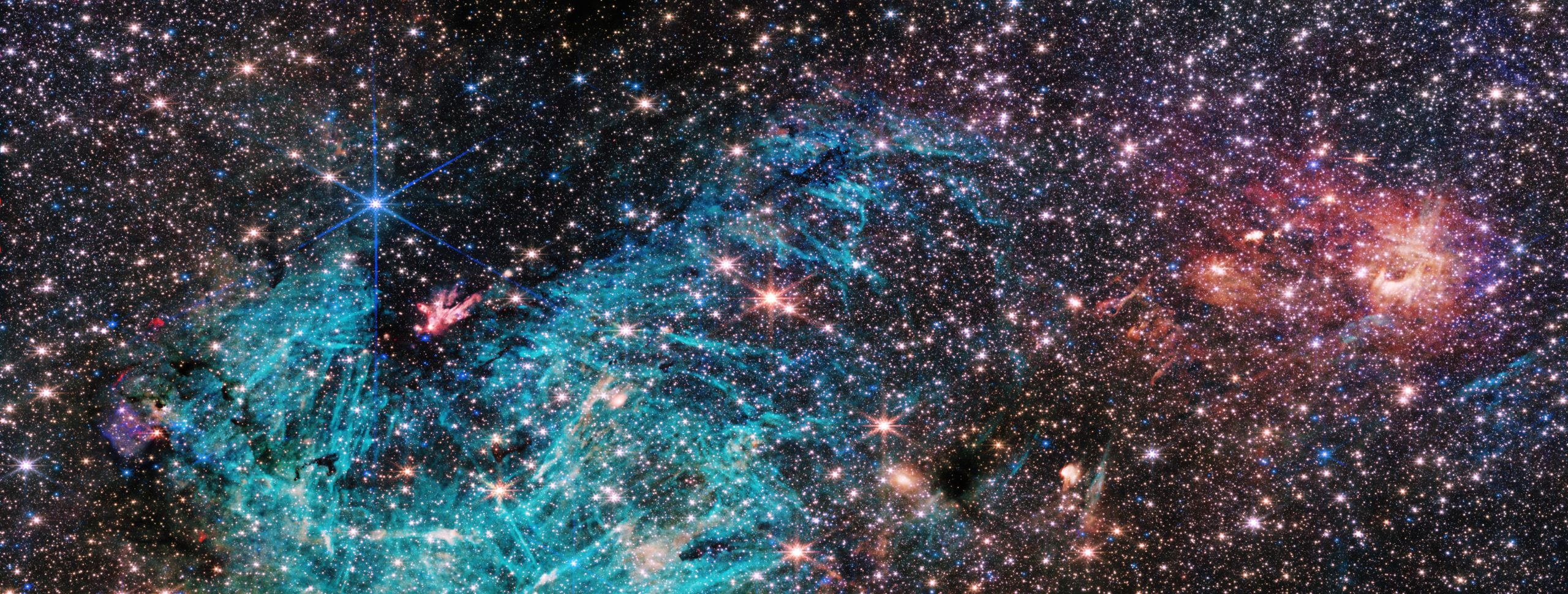
A vast region of ionized hydrogen, shown in cyan, wraps around an infrared-dark cloud, which is so dense that it blocks the light from distant stars behind it. Intriguing needle-like structures in the ionized hydrogen emission lack any uniform orientation. Researchers note the surprising extent of the ionized region, covering about 25 light-years. Credit: NASA, ESA, CSA, STScI, Samuel Crowe (UVA)
Webb Space Telescope Explores Effect of Strong Magnetic Fields on Star Formation
New research based on a 2023 image taken by NASA’s James Webb Space Telescope has uncovered powerful outflows from still-forming protostars in Sagittarius C, a dense, active region near the center of the Milky Way. The findings also offer fresh insight into how strong magnetic fields may influence interstellar gas and shape the life cycle of stars.
“A big question in the Central Molecular Zone of our galaxy has been, if there is so much dense gas and cosmic dust here, and we know that stars form in such clouds, why are so few stars born here?” said astrophysicist John Bally of the University of Colorado Boulder, one of the principal investigators. “Now, for the first time, we are seeing directly that strong magnetic fields may play an important role in suppressing star formation, even at small scales.”
Because Sagittarius C is crowded with dust, studying it in detail has long been a challenge. But Webb’s advanced near-infrared instruments allow astronomers to see through the haze and observe young stars in this extreme environment with unprecedented clarity.
Testing Star Formation Theories in Extreme Conditions
“The extreme environment of the galactic center is a fascinating place to put star formation theories to the test, and the infrared capabilities of NASA’s James Webb Space Telescope provide the opportunity to build on past important observations from ground-based telescopes like ALMA and MeerKAT,” said Samuel Crowe, another principal investigator on the research, a senior undergraduate at the University of Virginia and a 2025 Rhodes Scholar.
Bally and Crowe each led a study published in The Astrophysical Journal.
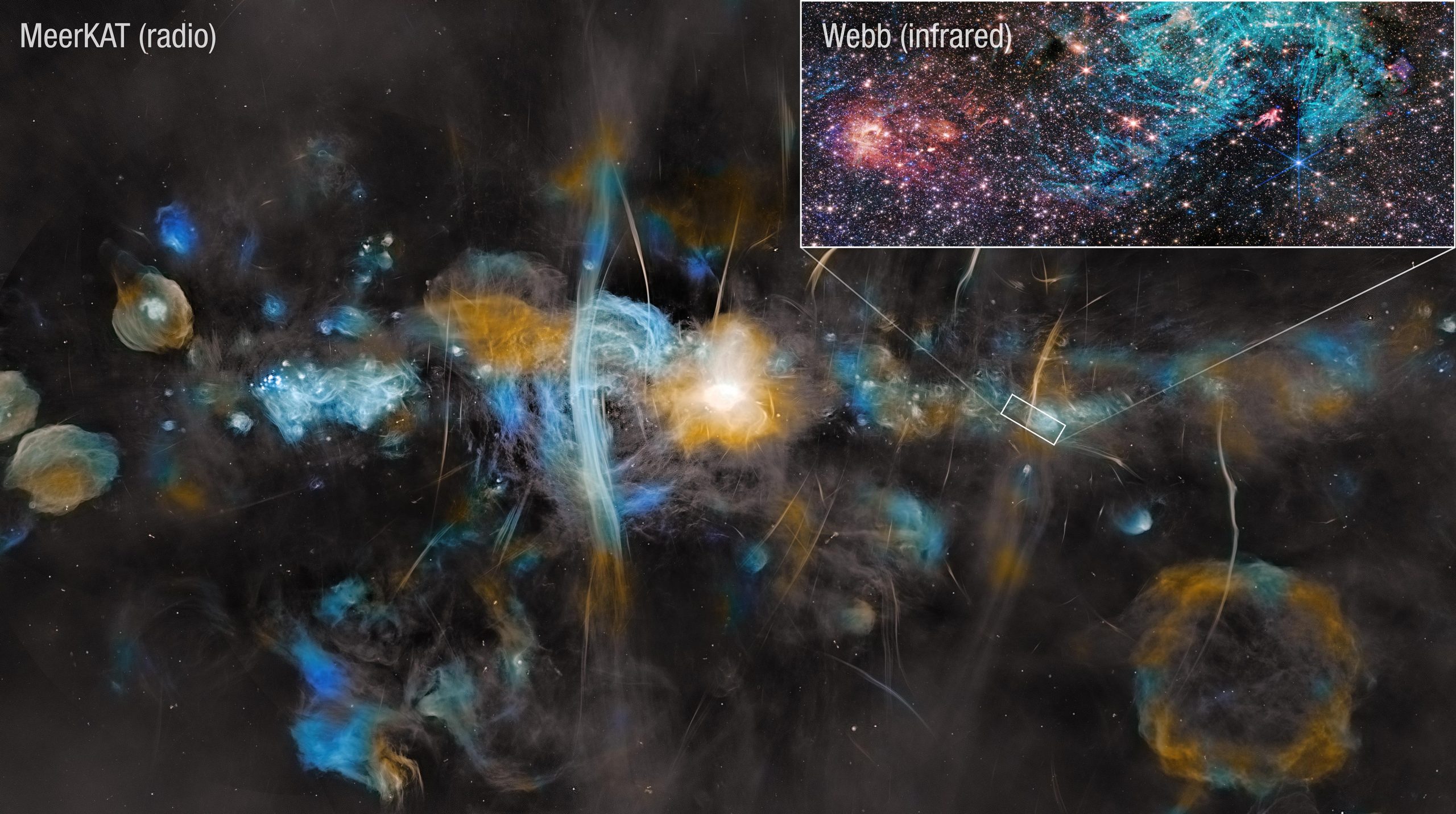
At the center of the MeerKAT image the region surrounding the Milky Way’s supermassive black hole blazes bright. Huge vertical filamentary structures echo those captured on a smaller scale by Webb in Sagittarius C’s blue-green hydrogen cloud. Like a super-long exposure photograph, MeerKAT shows the bubble-like remnants of supernovas that exploded over millennia, capturing the dynamic nature of the Milky Way’s chaotic core.
Astronomers think the strong magnetic fields in the heart of the galaxy are shaping the filaments seen by MeerKAT and Webb, and may also play a role in suppressing star formation in the region. Though there is a rich cloud of raw star-making material in Sagittarius C, star formation rates are not as high as astronomers expect. Instead, magnetic fields may be strong enough resist the gravity that would typically cause dense clouds of gas and dust to collapse and forge stars.
Credit: NASA, ESA, CSA, STScI, SARAO, Samuel Crowe (UVA), John Bally (CU), Ruben Fedriani (IAA-CSIC), Ian Heywood (Oxford)
Using Infrared to Reveal Forming Stars
In Sagittarius C’s brightest cluster, the researchers confirmed the tentative finding from the Atacama Large Millimeter Array (ALMA) that two massive stars are forming there. Along with infrared data from NASA’s retired Spitzer Space Telescope and SOFIA (Stratospheric Observatory for Infrared Astronomy) mission, as well as the Herschel Space Observatory, they used Webb to determine that each of the massive protostars is already more than 20 times the mass of the Sun. Webb also revealed the bright outflows powered by each protostar.
Even more challenging is finding low-mass protostars, still shrouded in cocoons of cosmic dust. Researchers compared Webb’s data with ALMA’s past observations to identify five likely low-mass protostar candidates.
New Discoveries in Shocked Hydrogen and Jets
The team also identified 88 features that appear to be shocked hydrogen gas, where material being blasted out in jets from young stars impacts the surrounding gas cloud. Analysis of these features led to the discovery of a new star-forming cloud, distinct from the main Sagittarius C cloud, hosting at least two protostars powering their own jets.
“Outflows from forming stars in Sagittarius C have been hinted at in past observations, but this is the first time we’ve been able to confirm them in infrared light. It’s very exciting to see, because there is still a lot we don’t know about star formation, especially in the Central Molecular Zone, and it’s so important to how the universe works,” said Crowe.
Magnetic Fields and Star Formation
Webb’s 2023 image of Sagittarius C showed dozens of distinctive filaments in a region of hot hydrogen plasma surrounding the main star-forming cloud. New analysis by Bally and his team has led them to hypothesize that the filaments are shaped by magnetic fields, which have also been observed in the past by the ground-based observatories ALMA and MeerKAT (formerly the Karoo Array Telescope).
“The motion of gas swirling in the extreme tidal forces of the Milky Way’s supermassive black hole, Sagittarius A*, can stretch and amplify the surrounding magnetic fields. Those fields, in turn, are shaping the plasma in Sagittarius C,” said Bally.
Filaments, Plasma, and Suppressed Starbirth
The researchers think that the magnetic forces in the galactic center may be strong enough to keep the plasma from spreading, instead confining it into the concentrated filaments seen in the Webb image. These strong magnetic fields may also resist the gravity that would typically cause dense clouds of gas and dust to collapse and forge stars, explaining Sagittarius C’s lower-than-expected star formation rate.
“This is an exciting area for future research, as the influence of strong magnetic fields, in the center of our galaxy or other galaxies, on stellar ecology has not been fully considered,” said Crowe.
References:
“The JWST-NIRCam View of Sagittarius C. I. Massive Star Formation and Protostellar Outflows” by Samuel Crowe, Rubén Fedriani, Jonathan C. Tan, Alva Kinman, Yichen Zhang, Morten Andersen, Lucía Bravo Ferres, Francisco Nogueras-Lara, Rainer Schödel, John Bally, Adam Ginsburg, Yu Cheng, Yao-Lun Yang, Sarah Kendrew, Chi-Yan Law, Joseph Armstrong and Zhi-Yun Li, 2 April 2025, The Astrophysical Journal.
DOI: 10.3847/1538-4357/ad8889
“The JWST-NIRCam View of Sagittarius C. II. Evidence for Magnetically Dominated H ii Regions in the Central Molecular Zone” by John Bally, Samuel Crowe, Rubén Fedriani, Adam Ginsburg, Rainer Schödel, Morten Andersen, Jonathan C. Tan, Zhi-Yun Li, Francisco Nogueras-Lara, Yu Cheng, Chi-Yan Law, Q. Daniel Wang, Yichen Zhang and Suinan Zhang, 2 April 2025, The Astrophysical Journal.
DOI: 10.3847/1538-4357/ad9d0b
The James Webb Space Telescope is the world’s premier space science observatory. Webb is solving mysteries in our solar system, looking beyond to distant worlds around other stars, and probing the mysterious structures and origins of our universe and our place in it. Webb is an international program led by NASA with its partners, ESA (European Space Agency) and CSA (Canadian Space Agency).
Never miss a breakthrough: Join the SciTechDaily newsletter.
Follow us on Google and Google News.